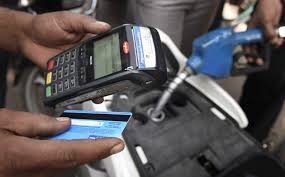
1% transaction fee: Petrol bunks to stop accepting cards from tonight

January 8, 2017

Jan 8: The petrol bunks across the country will stop accepting debit cards and credit cards for filling fuel from midnight on Sunday as banks will now debit a Merchant Discount Rate of 1 per cent from petroleum dealers, said President of All India Petroleum Dealers Association Ajay Bansal.

cardTalking to reporters after a two-day State-level convention of petroleum dealers here on Sunday, Mr. Bansal said each petroleum dealer was operating with a profit margin of 2 per cent.

On Saturday, banks referred to the Reserve Bank of India notification dated December 16 and said an MDR ranging between between 0.25 and 1 per cent will be deducted for each debit card transaction. An MDR of 1 per cent will be deducted for each credit card transaction.

“We are operating on a very thin margin. We cannot afford this deduction. Hence we have no other go than stop accepting debit and credit cards,” Mr. Bansal said. When pointed that the dealers are going against government directions, Mr. Bansal said they have no other option. Mr. Bansal said the decision to stop accepting debit and credit cards had been conveyed to Petroleum Ministry and Finance Ministry officials, he said.

Paytm and BHIM

Mr. Bansal said petroleum dealers will however accept payments through Paytm and Bhim apps. “But we have to stop accepting Paytm if they impose charge for each transaction,” he said. There are as many as 28,000 petrol bunks where Paytm was being accepted.

Mr. Bansal said the petroleum dealers are in favour of Central Government's move towards cashless transactions. “But we cannot afford to pay from our margin. We want our profit margin (of 2 per cent) intact,” he said.

Comments

Wonder Kotian
 - 
Monday, 9 Jan 2017

Wa master mind success, Fantastic \ cash less is not better than card less\" our great Anna!!!!!
\"While two fighting opponent fall down even he says my noose upside\" like all our great annaas say !!!!!!!
\" Now not wait and see, now wait and watch\""

Althaf
 - 
Sunday, 8 Jan 2017

Fenku ki tho Aisi ki taisi

Add new comment

  • Coastaldigest.com reserves the right to delete or block any comments.
  • Coastaldigset.com is not responsible for its readers’ comments.
  • Comments that are abusive, incendiary or irrelevant are strictly prohibited.
  • Please use a genuine email ID and provide your name to avoid reject.
News Network
April 12,2020

Bengaluru, Apr 12: Cheif Minister BS Yediyurappa on Sunday paid homage to Legendary Kannada actor Dr. Rajkumar on his 14th death anniversary.

Yediyurappa shared a poster of Dr Rajkumar on his Twitter with a caption, “We pay homage to Karnataka Ratna Dr. Rajlumar on his death anniversary. Let us keep the unique service rendered by Dr. Rajkumar through Theater and movies. ”

Let us keep the unique service rendered by Dr. Rajkumar through theater and movies. ”

Dr Rajkumar is one of the greatest actors in the history of Kannada film industry and is known as a legendary actor in Sandalwood. He has acted in more than 200 movies and has a huge fan base even after his demise.

Comments

Add new comment

  • Coastaldigest.com reserves the right to delete or block any comments.
  • Coastaldigset.com is not responsible for its readers’ comments.
  • Comments that are abusive, incendiary or irrelevant are strictly prohibited.
  • Please use a genuine email ID and provide your name to avoid reject.
News Network
January 31,2020

Bidar, Jan 31: In a disturbing development, the police have arrested two women – a schoolteacher and mother of two students – in connection with staging a play against the Citizenship Amendment Act and National Register of Citizens at a prestigious school in Karnataka’s Bidar.

The arrested have been identified as Farida Begum, headmistress of Shaheen Urdu Medium Primary School, and Navida, the mother of a student who played a role in the play.

The development comes days after police filed a sedition case against the management of Shaheen School following a complaint lodged by the ABVP claiming that play contained objectionable dialogues against Prime Minister Narendra Modi. The drama was performed during an annual function of the school on January 21.

Bidar SP Sreedhara T confirmed the arrest of Farida Begum and Navida, and said the accused were remanded to judicial custody on Thursday.

Sreedhara said that based on the complaint by one Neelesh Rakshal, the police filed an FIR under sedition charges, initially against the headmistress and management of the school on Saturday. He said that the police have questioned about 50 people, including the members of the management committee of Shaheen Urdu Medium Primary School, staff of the school, audience, parents and students. Based on the statements and evidence, the headmistress and the parent have been arrested.

The SP said that as per the statements and evidence collected, they came to know that the headmistress played a major role in organising the controversial play. The students practised the drama for a week and the headmistress knew about its script containing controversial dialogues against the Prime Minister and senior BJP leaders.

Considering this, she has been booked for creating communal disharmony and abetting sections. The SP said that when a dialogue of slapping the Prime Minister was said on the stage, Navida gave her chappals to the child, to be used while saying the dialogue. She has been arrested for abetting.

Expressing shock over sedition case and arrests, Dr Abdul Qadeer, the chairman of Shaheen Group of Institutions, said that the school management would fight out legally.

About Shaheen Group

Founded by Dr Abdul Qadeer, Shaheen Group has spread its wings through nine states of India and runs 43 institutions and related units. It has also been running a unique course for Huffaz named as ‘Hifz Ul Quran Plus’ in which Huffaz are prepared to appear and excel in competitive exams (NEET-JEE(IIT)).

According to Dr Qadeer, Shaheen’s mission is to engage, educate and empower wards, equipping them with strengths to enter the world of opportunities through free education across various domains in state- owned academic centers of excellence.

The group also runs coaching centers for medical and engineering entrance examinations. So far 1,200 students from the Shaheen Group of institutions got seats in government medical colleges, he said.

‘Hifz Ul Quran Plus’ course was for huffaz between 12 and 17 years. A four-year integrated course is conducted for Huffaz-E-Karam for getting students modern education. By pursuing this course and by appearing in competitive exams (NEET-IIT JEE), Huffaz will be able to get admission into MBBS, BE, & MBA, he said.

Comments

Add new comment

  • Coastaldigest.com reserves the right to delete or block any comments.
  • Coastaldigset.com is not responsible for its readers’ comments.
  • Comments that are abusive, incendiary or irrelevant are strictly prohibited.
  • Please use a genuine email ID and provide your name to avoid reject.
Media Release
February 14,2020

Veteran journalist P. Sainath has said that the nation is in a crisis. And this crisis is not limited to just the rural area. It has become a national crisis at various areas such as agriculture, education, economy, job creation etc.

He was delivering the endowment lecture on the topic ‘Indian democracy at the post-liberalization and post-truth era’ at Media Manthan 2020 organized by the PG department of journalism and mass communication at St Aloysius College (Autonomous). 

Mr Sainath said that the many policies adopted in the 90s led to India becoming unusually unequal. Referring to the speech Ambedkar had made at the Constituent Assembly while handing over the draft of the Constitution, Mr Sainath said, “Ambedkar had warned about the weakness of Indian democracy that liberty without equality allows the supremacy of a few over the multitude. Liberty, equality and fraternity must be kept together as we cannot have one without the other.” 

Mr Sainath stated that the agrarian crisis was no longer about the loss of productivity, employment or about farmer suicide; it was a societal, civilizational crisis. Commenting on the lopsided policies such as cow-slaughter ban, he explained how cow slaughter ban had adversely affected many industries due to their interdependency. While Muslims who slaughtered cows were rendered helpless, the cattle traders who were mostly OBCs lost their earnings as the cattle prices crashed. An important industry like Kolhapur sandals industry in Maharashtra went bankrupt as a result of the cow slaughter ban in Maharashtra. He said the policymakers had no idea how the rural industries were interconnected. Demonetisation too devastated the rural economy as 98 percent of rural transactions happen through cash. 

Mr Sainath also spoke about the crisis of inequality which affects the Dalits and the Adivasis far more than anyone else as 90 percent of the rural households take home less than Rs 10,000/- per month. “Women are yet another group whose labour is never counted in the gross domestic product. Women and girls globally do unpaid work which amounts to about 12.5 billion working hours per year. Monetarily speaking, this is worth 10.8 trillion dollars,” Mr Sainath added. 

Speaking about the crisis of jobs Mr Sainath said that major companies were laying off employees just to create more profits for the investors and the adoption of artificial intelligence in the industry would further destroy millions of jobs.

Rector of St Aloysius College Institutions Fr Dionysius Vaz SJ, Principal Dr (Fr) Praveen Martis SJ, HOD of Journalism and Mass Communication department Dr (Fr) Melwyn Pinto SJ were present.

‘Veerappan and Vijay Mallya’s business models are interesting!’

Addressing the gathering during his endowment lecture on Friday, Mr Sainath made an interesting comment on the so called ‘revenue model’. “Whenever I visit IIMs and IITs for lectures on my PARI project, the students there ask me what my revenue model for my project is. I tell them that I do not have a revenue model. In fact, journalism does not begin with a revenue model. Gandhiji, Ambedkar, Bhagat Singh were all great journalists. But they did not have a revenue model,” Mr Sainath said.

On a lighter note, he said that the best revenue model that he liked was that of forest brigand Veerappan and liquor baron Vijay Mallya. “Veerappan ruled the forest for forty years and from the top ministers to the villagers he could dictate terms and liver royally. Similarly, Mallya’s revenue model was to steal the banks and run away abroad and live like a king,” Mr Sainath added.

Journalism is not and can never be a business. It is a calling, he opined. While newspaper can be a business, television can be a business, journalism per se cannot be reduced to a business. “Unfortunately today, journalists are recruited on a contract basis and they have no bargaining power; and there are no unions to fight for their cause. Hence, they are at the mercy of the corporate media houses for their survival and are made to write stories that cannot be called journalism,” Mr Sainath said.

Answering a question as to the pressures he faced as a journalist, he said that external pressures from the government or others could be very well handled. It is the internal pressures from once own media house that journalists find it difficult to manage.


 

Comments

Add new comment

  • Coastaldigest.com reserves the right to delete or block any comments.
  • Coastaldigset.com is not responsible for its readers’ comments.
  • Comments that are abusive, incendiary or irrelevant are strictly prohibited.
  • Please use a genuine email ID and provide your name to avoid reject.