10 more venues cleaned under Swacch Mangaluru drive

[email protected] (CD Network)
October 31, 2016

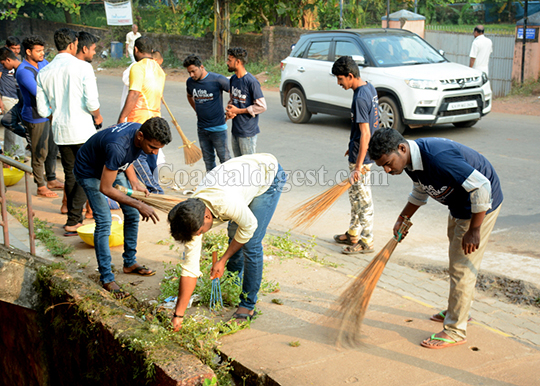
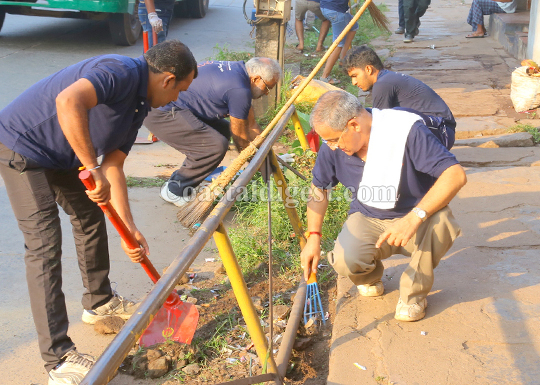
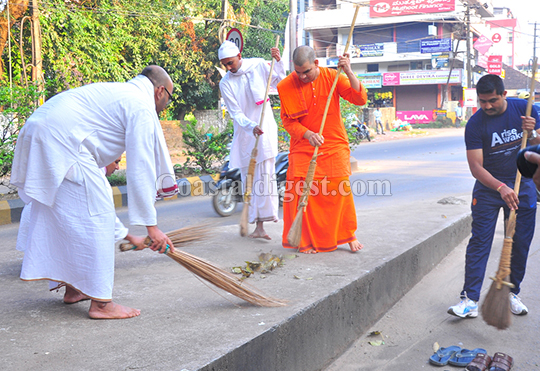
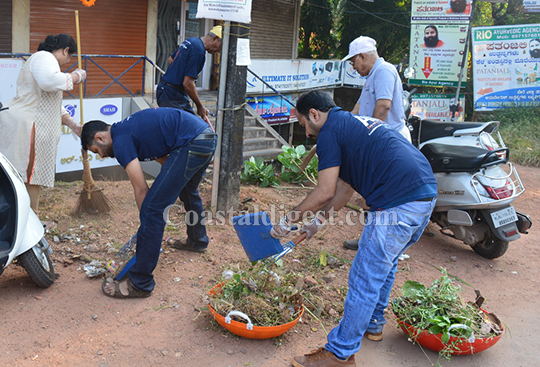
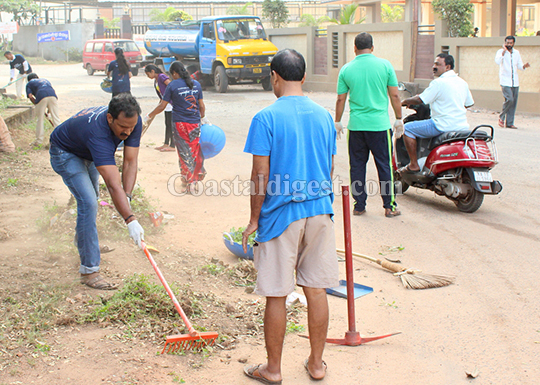
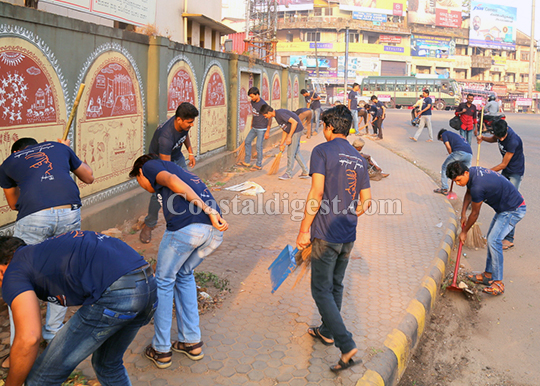
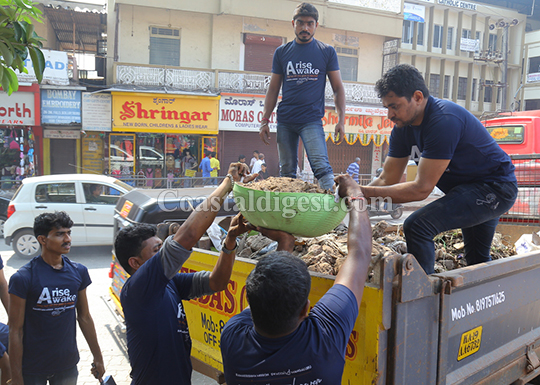
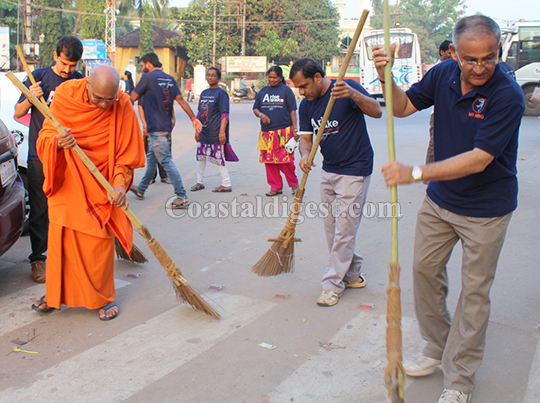
Mangaluru, Oct 31: The fourth week of 10 cleanliness drives of the 400 Abhiyans being organized by Ramakrishna Mission, Mangaluru took off on Sunday, the 30th October at 10 different venues in Mangalore.
Rkmm 1

33 A B Shetty Circle – Employees of Sri Ram Transport Finance Co. Ltd. Took up the cleanliness drive surrounding AB Shetty Circle. Swami Jitakamanandaji, President, Ramakrishna Math, Mangalore and Capt. Ganesh Karnik, MLC jointly flagged off the drive. Sri Sathyanarayana K V, DGM & Sri Sharatchandra, DGM of Sriram Transport Finance guided the team members in cleaning the surroundings of RTO office.
34 Marnamikatta – Members of Lions Club under the leadership of Sri Sadashiva Rai & Sri Prashanth Rao cleaned the Marnamikatta area for about 2 hours. The team was coordinated by Sri Suresh Shetty. Swami Jitakamanandaji & Sri Harshakumar Kedige jointly flagged off the drive.
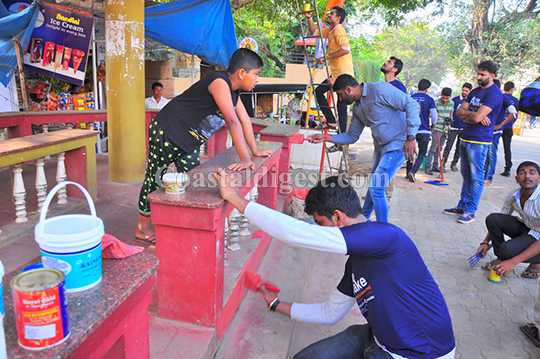
35 Milagres Circle – The members of Hindu warriors WhatsApp Group took up the 35th cleanliness drive near Milagres circle. Swami Dharmavratanandaji flagged off the drive. The volunteers cleaned the road dividers removing the mud and stones accumulated under the guidance of Sri Prashanth Ubarangala. The area around Light House Hill road was also cleared off the construction debris and the medians were painted. Sri Shivu Puttur & Sri Yogish Karyathadka coordinated the team.
36 Pandeshwara – The surroundings of Rosario church & school were cleaned. Mr. Latif, Corporator, MCC & Br Nishchay jointly flagged off the cleanliness drive. Sri Kumble Gopalakrishna Coordinated the team.
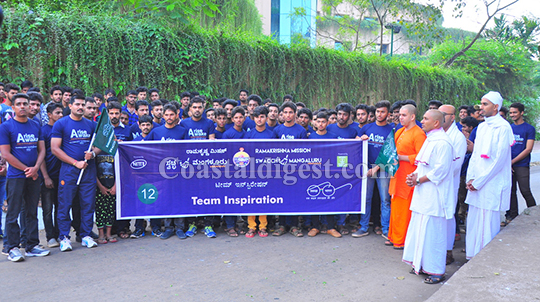
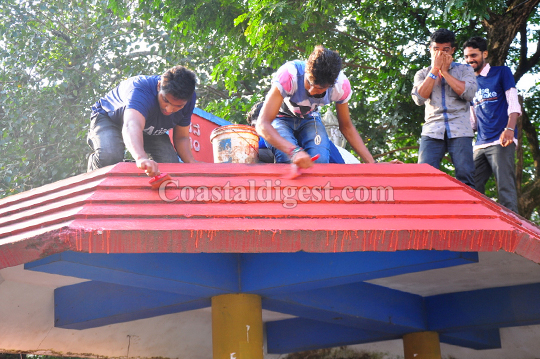
37 Kottara – Team Inspiration carried out the cleanliness drive around Infosys in Kottara. Swami Ekagamyanandaji of Ramakrishna Math, Mangalore & Sri Madan, SI, Bunder jointly flagged off the drive. Brahmacharis of the Ramakrishna math too joined hands with several volunteers in cleaning the area. Both sides of the road were cleaned and bus shelter was painted. Prof Sheshappa Amin, GFGC, car Street guided the volunteers.
38 Jeppu – The team of Swacch Jeppu carried out the cleanliness drive in the Jeppu area. Swami Jitakamanandaji & Sri Praveen Kumar jointly flagged off the drive. Cleanliness was carried out for two hours.
39 Bunts Hostel – Silver Fox Youth team cleaned the surroundings of Bunts Hostel area for about 2 hours. Swami Dharmavratanandaji of Ramakrishna Math & Capt. Ganesh Karnik jointly flagged off the drive. Sri Dhanush & Sri Nihal guided the team in the cleanliness drive.
40 Attavara – The devotees of Sri Chakrapani temple joined in the Swacch Mangaluru Abhiyan by cleaning the temple premises, KMC & surrounding areas. Br Shivakumar of Ramakrishna Math flagged off the drive. JCB & tipper was used to clear the dirt and mud accumulated in the area. Sri Akshith guided the team.
41 Monkey Stand – Crazy Guys team of Monkey Stand carried out the cleanliness drive in Monkey stand and Amar Alva road. Swami Chidambaranandaji of Ramakrishna Math flagged off the drive. Sri Dilraj Alva guided the team in the drive.
42 Morgan's gate - The members of Bhagini Samaj & Nivedita Balaga carried out the 38th cleanliness drive in Morgans gate & Bhagini Samaj area. It was a sight to see the old and young join the cleanliness drive alike.
Rkmm 2

Rkmm 3

Rkmm 4

Rkmm 5

Rkmm 6

Rkmm 7

Rkmm 8

Rkmm 9

Rkmm 10

Rkmm 11

Comments

anti corruption
 - 
Wednesday, 2 Nov 2016

Before cleaning the streets, the central govt should clean their minds & hearts for Bharat to be swachh.

naren kotian
 - 
Tuesday, 1 Nov 2016

hahaha all thief sorry althaf ... i cannot see single burqa clad women or low grade athar special affect otte topi doing swach bharath program.... yesterday did u see swatch bharath initiative in madya pradesh , 8 parasites were cleared by spraying bullets ... adu onthara swacha bharath kanappa ... hahaha ... we are doing swatch bharath in kashmir also ... hats off to ramakrishna mission ...

Shaima umar farooq
 - 
Tuesday, 1 Nov 2016

Well done keep it up. Gud work by team. Masha allah.

Ahmed
 - 
Tuesday, 1 Nov 2016

Does MCC have paid staff for cleaning the areas? if so, where are they? only taking salary from tax money and sleeping at home.
Then, general public has to clean the filth?

Althaf
 - 
Monday, 31 Oct 2016

Until We clear our dirty politicians and terrorists organisations like RSS,BD,Rama sene, Shivasene etc india will not be a clean country. All indians should join together to clean this Organisations.

Peace
 - 
Monday, 31 Oct 2016

No need to make politics by taking some photographs & advertising. I appreciate this work but not as one particular task to promote someone.
Being humans its our duty to keep clean & hygeine environment around all time. but above images shows clearly about particular xxx advertisement. It will not promote awareness, coz here this work is done only for taking for photographs & particular situation.
Hope it will continue regularly in village area where really need awareness....

Add new comment

  • Coastaldigest.com reserves the right to delete or block any comments.
  • Coastaldigset.com is not responsible for its readers’ comments.
  • Comments that are abusive, incendiary or irrelevant are strictly prohibited.
  • Please use a genuine email ID and provide your name to avoid reject.
DHNS
January 2,2020

Jan 2: A year after 12,000 acres of forests in Bandipur went up in smoke, the Karnataka Forest Department is gearing up for the summer even as the Forest Survey of India (FSI) has cautioned that 22.78 lakh acres (9,222 sq km) or about 20% of the green cover spread across three districts in the central part of the state is fire-prone.

The FSI studied forest fire incidents across the country between 2004-05 and 2017 before coming up with state-specific inputs.

According to the 13-year observation, Karnataka has 7,352 “fire points” or areas measuring 5 km X 5 km with frequent fire incidents.

Though the number is lower compared to states like Maharashtra, Madhya Pradesh and Odisha with over 20,000 points, the sheer spread of the fire-prone area itself is a challenge for the Karnataka Forest Department.

According to data, about three lakh acres (1,199.9 sq km) of forest area is very highly fire prone with 26 to 52 fire incidents in 13 years. This is followed by 7.6 lakh acres (3,067 sq km) of “highly fire prone” areas with an average of one to two incidents every year.

Almost all of the “red alert” areas are concentrated in Uttara Kannada, Chikkmagaluru, Shivamogga and Chamarajanagar districts. As temperature rises at the end of January, so does the risk of forest fires, requiring officials to be on vigil till the end of summer.

After an investigation into the Bandipur blaze revealed that faulty fire lines and poor supervision were the reason for the spread of the fire, the department has come up with a multi-pronged approach to prevent similar incidents this year.

“After the Bandipur incident, we have created a fire cell and a standard operating procedure (SOP) which everyone has to follow. Firstly, a fire management plan is prepared and approved by a competent authority.

The SOP has well defined firelines which have to be executed by December-end and burning must be completed by January 15,”  Principal Chief Conservator of Forests (Head of Forest Force) Punati Sridhar told DH.

He said that to ensure its strict implementation, GPS readings of firelines are to be submitted for random verification.

“All the required equipment from fire jackets to shoes, gloves, backpack sprayers and tractors mounted with 2,000-5,000 litre tanks with high pressure pumps will be deployed at vantage points,” he said.

In addition, the department’s fire cell works in collaboration with the Karnataka State Remote Sensing Applications Centre (KSRSAC) to give fire alerts within half and hour of an area catching fire and detected by satellites.

“Earlier, the gap used to be four hours by when the fire would have spread beyond control. Now, with reduced time gap, it would be easier to control fire early,” he added.

Comments

Add new comment

  • Coastaldigest.com reserves the right to delete or block any comments.
  • Coastaldigset.com is not responsible for its readers’ comments.
  • Comments that are abusive, incendiary or irrelevant are strictly prohibited.
  • Please use a genuine email ID and provide your name to avoid reject.
News Network
January 6,2020

Bengaluru, Jan 6: JD(S) leader H D Kumaraswamy on Monday said he would not get involved in any 'wicked act' of bringing down the B S Yediyurappa-led government in Karnataka, amid claims that 15 to 20 BJP MLAs were ready to come out.

Clarifying that he would not disturb the government, the former Chief Minister said for him, the development of the state was important. "With great difficulty, you (Yediyurappa) have become Chief Minister for the fourth time, (I am) happy, I have nowhere said that I will disturb your government. Even now some people come and ask why I'm sitting silent when 15-20 people are ready to come out of BJP and why don't I make an attempt (to poach them), Kumaraswamy said. Speaking to reporters in Hassan, he sought to know why he should get entangled in that 'sludge' and he was not in a hurry.

"I will not get involved in a wicked act of removing a responsible government like Yediyurappa did. For me the development of the state is important," he said.

Though Kumaraswamy had raised questions about the longevity of the BJP government ahead of the December 5 bypolls, he had even then given clear indications that he would not attempt to pull down the administration as it would affect the development of the state.

The ruling BJP had swept the by-elections by winning 12 of the total 15 seats, helping the Yediyurappa government retain the majority in the Assembly.

With BJP winning 12 of the 15 assembly constituencies, it's numbers went up from 105 (including an independent) to 117, which is well ahead of the halfway mark of 111 in a 223-member Assembly (two seats-- Maski and R R Nagar-- are vacant due to pending litigation in the High Court).

The BJP came to power after the Kumaraswamy-led Congress-JD(S) coalition government collapsed as 17 MLAs had rebelled against the alliance leadership and resigned as legislators, to later favour the saffron party.

Comments

Add new comment

  • Coastaldigest.com reserves the right to delete or block any comments.
  • Coastaldigset.com is not responsible for its readers’ comments.
  • Comments that are abusive, incendiary or irrelevant are strictly prohibited.
  • Please use a genuine email ID and provide your name to avoid reject.
Agencies
July 5,2020

The deadly coronavirus that entered India while there was still nip in the air has beaten rising mercury, humid conditions, unique Indian genome and has entered monsoon season with more potency as fresh cases are only breaking all records in the country.

India recorded a single-day spike of record 24,850 new coronavirus cases on Sunday, taking its total tally to 6.73 lakh corona-positive cases.

Top Indian microbiologists were hopeful in March that after the 21-day lockdown, as summer approaches, the rise in temperature would play an important role in preventing the drastic spread of COVID-19 virus in India.

Several virologists hinted that by June this year, the impact of COVID-19 would be less than what it appeared in March-April.

The claims have fallen flat as the virus is mutating fast, becoming more potent than ever.

According to experts, the novel coronavirus is a new virus whose seasonality and response to hot humid weather was never fully understood.

"The theory was based on the fact that high temperatures can kill the virus as in sterilisation techniques used in healthcare. But these are controlled environment conditions. There are many other factors besides temperature, humidity which influence the transmission rate among humans," Dr Anu Gupta, Head, Microbiologist and Infection Control, Fortis Escorts Heart Institute, told IANS.

There is no built-up immunity to COVID-19 in humans.

"Also, asymptomatic people might be passing it to many others unknowingly. New viruses tend not to follow the seasonal trend in their first year," Gupta emphasized.

Globally, as several countries are now experiencing hot weather, the World Health Organization (WHO) reported a record hike in the number of coronavirus cases, with the total rising by 2,12,326 in 24 hours in the highest single-day increase since COVID-19 broke out.

So far over 11 million people worldwide have tested positive for the disease which has led to over 5,25,000 deaths, according to data from Johns Hopkins University. The US remained the worst-hit country with over 28 lakh cases, followed by Brazil with 15.8 lakh.

According to Sandeep Nayar, Senior Consultant and HOD, Respiratory Medicine, Allergy & Sleep Disorders, BLK Super Speciality Hospital in New Delhi, whether temperature plays a role in COVID-19 infection is highly debated.

One school of thought said in the tropical regions of South Asia, the virus might not thrive longer.

"On the other hand, another school of thought has found that novel Coronavirus can survive in a hot and humid environment and tropical climate does not make a difference to the virus. According to them, this is what distinguishes the novel coronavirus from other common viruses, which usually wane in hot weather," stressed Nayar.

Not much has been studied in the past and no definite treatment or vaccine is available to date.

"Every day, new properties and manifestation of the disease come up. As of now, the only way to prevent this monster is by taking appropriate precautions. Hand hygiene, social distancing, cough etiquette and face masks definitely reduce spread of COVID-19 infection," Nayar told IANS.

Not just top Indian health experts, even Indian-American scientists had this theory in mind that sunshine and summer may ebb the spread of the coronavirus.

Ravi Godse, Director of Discharge Planning, UPMC Shadyside Pennsylvania in the US told IANS in April: "In the summer, the humidity can go up as well, meaning more water drops in the air. If the air is saturated with water and somebody sneezes virus droplets into such air, it is likely that the droplets will fall to the ground quicker, making them less infectious. So the short answer is yes, summer/sunshine could be bettera.

According to Dr Puneet Khanna, Head of Respiratory Medicine and Pulmonology, Manipal Hospital, Delhi, COVID-19 death rates are not too different in tropical countries but since the disease affected them late it was yet to show its peak in these areas.

"The virus can survive well in hot and humid countries and this is proven now," he stressed.

Comments

Add new comment

  • Coastaldigest.com reserves the right to delete or block any comments.
  • Coastaldigset.com is not responsible for its readers’ comments.
  • Comments that are abusive, incendiary or irrelevant are strictly prohibited.
  • Please use a genuine email ID and provide your name to avoid reject.