


11 get life term in Gulberg society massacre case

June 17, 2016

Ahmedabad, Jun 17: Calling the Gulberg massacre as the "darkest day" in the history of civil society, a special SIT court here today sentenced 11 convicts to life imprisonment in the case of burning alive of 69 people, including former Congress MP Eshan Jafri in the 2002 post-Godhra violence.
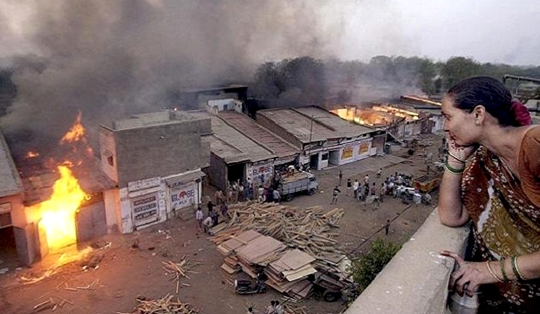
Gulberg1

Rejecting the demand for death sentence for all the convicts, the court said life imprisonment for the 11 will be till death if the state does not exercise power to remit the sentence.

The court awarded ten year jail term to one of the 13 convicted for lesser offences while 12 others have been given seven-year sentence each. The prosecution had argued that all the 24 convicts should be given death penalty.

While describing the massacre as the darkest day in the history of civil society, Special court Judge P B Desai refused death penalty saying, "If you look at all aspects, no previous antecedent has been placed on record".

Post the incident, 90 per cent of the accused were released on bail, yet no complaints against them have been given even by victims, and there is no record to show that they committed any offence during the time of bail, the judge further said, while giving reasons why he thought that this was not a fit case to give capital punishment to the convicts.

The court said it has decided to award imprisonment for life without any time frame to 11 accused, who have been convicted for murder, while requesting the state not to use its power to remit the sentence after 14 years of imprisonment.

"CrPC provisions give power to the state to remit sentence after 14 years jail, section 433-A imposes some restriction on that power. In case the state does not exercise power to remit the sentence, life imprisonment will mean that it is till death," the court said.

"I cannot add beyond what has been prescribed under section 302, it is not necessary for a state to exercise power to remit sentence, state may not exercise power of remittance," the judge said, adding the court's direction cannot be binding as he cannot take away the executive powers of the state.

As regards the 13 others accused convicted for lesser offences not including murder (302), the court awarded 10 years imprisonment to one Mangilal Jain, while 12 others were awarded seven-year sentence each.

The Gulberg Society massacre, which took place here on February 28, 2002 when Narendra Modi was the Gujarat Chief Minister, shook the nation when a mob of 400 people set about attacking the society in the heart of Ahmedabad and killed the residents including Jafri.

It was one of the nine cases of the 2002 Gujarat riots probed by the Supreme Court-appointed SIT.

"All the sentences will run concurrently as the Supreme Court has laid it down clearly that if the crime had single purpose, sentences given for different sections of IPC should run concurrently," the court said.

The prosecution and the victims had demanded that sentences awarded to all the accused should not run concurrently as all the 24 convicts will have to spend their entire life behind bars.

Earlier on June 2, the court had convicted 11 persons for murder and other offences, while 13 others, including VHP leader Atul Vaidya, were charged with lesser offences. It had acquitted 36 others in the case.

Those given life sentence in the case are - Kailash Dhobi, Yogendra Shekhawat, Jayesh Jingar, Krishna Kalal, Jayesh Parmar, Raju Tiwari, Bharat Rajput, Dinesh Sharma, Narayan Tank, Lakhansinh Chudasama and Bharat Taili.

One Mangilal Jain, who was convicted for lesser offence, has been sentenced to 10 years jail term.

Besides, VHP leader Atul Vaid, Mukesh Jingar, Prakash Padhiyar, Surendrasinh Chauhan, Dilip Parmar, Babu Marwadi, Manish Jain, Dharmesh Shukla, Kapil Mishra, Suresh Dhobi, Ambesh Jingar and Sandeep Punjabi have been sentenced to seven years imprisonment each.

During the argument on quantum of sentence, special public prosecutor and counsel for Supreme Court-appointed Special Investigation Team (SIT), R C Kodekar had asked the court for nothing less than death sentence or jail term till death for all 24 convicts.

Lawyer for the victims, S M Vora, also sought maximum punishment for the accused and argued that sentencing for each offence should not run concurrently so that they spend their entire life in jail.

However, lawyer of the accused, Abhay Bhardwaj, has refuted the demand of capital punishment or maximum punishment in his arguments saying that the incident was spontaneous and there were enough provocations for it.

The Gulberg society massacre was one of the nine cases of 2002 Gujarat riots probed by the SC-appointed SIT.

The incident had taken place a day after S-6 coach of Sabarmati Express was burnt near Godhra train station in which 58 'kar sevaks' returning from Ayodhya were killed.

During the course of trial, as many as 338 witnesses were cross-examined, with four different judges having presided over the case.

Comments

Ahmed Ali K
 - 
Friday, 17 Jun 2016

Death sentence?
for what?
Is he a non Hindu?

Jaleel S
 - 
Friday, 17 Jun 2016

Rarest of rare judgement...

Add new comment

  • Coastaldigest.com reserves the right to delete or block any comments.
  • Coastaldigset.com is not responsible for its readers’ comments.
  • Comments that are abusive, incendiary or irrelevant are strictly prohibited.
  • Please use a genuine email ID and provide your name to avoid reject.
Agencies
June 22,2020

Mumbai, Jun 22: After downgrading India's outlook to negative from stable, Fitch Ratings on Monday revised the outlook on nine Indian banks to negative.

The outlook on the Long-Term Issuer Default Ratings (IDR) was revised to negative from stable due to the banks' high dependence on the Centre to re-capitalise them.

Accordingly, the IDR outlook of the Export-Import Bank of India, the State Bank of India, the Bank of Baroda, the Bank of Baroda (New Zealand), the Bank of India, the Canara Bank, the Punjab National Bank, ICICI Bank and Axis Bank Ltd have been downgraded to negative.

"At the same time, Fitch has affirmed IDBI Bank Limited's (IDBI) IDR while maintaining the outlook at negative," Fitch said in a statement.

The rating actions follow Fitch's revision of the outlook on the 'BBB-' rating on India to negative from stable on June 18, due to the impact of the escalating coronavirus pandemic on India's economy.

"The IDRs for all the above Indian banks are support-driven and anchored to their respective SRFs," the statement said.

"They are based on Fitch's assessment of high to moderate probability of extraordinary state support for these banks, which takes into account our assessment of the sovereign's ability and propensity to provide extraordinary support."

According to the statement, the negative outlook on India's sovereign rating reflects an increasing strain on the state's ability to provide extraordinary support, due to the sovereign's limited fiscal space and the significant deterioration in fiscal metrics due to challenges from the COVID-19 pandemic.

"The rating action does not affect the banks' Viability Rating (VR). EXIM does not have a VR as its role as a policy bank makes an assessment of its standalone credit profile less meaningful."

Comments

Add new comment

  • Coastaldigest.com reserves the right to delete or block any comments.
  • Coastaldigset.com is not responsible for its readers’ comments.
  • Comments that are abusive, incendiary or irrelevant are strictly prohibited.
  • Please use a genuine email ID and provide your name to avoid reject.
News Network
January 15,2020

New Delhi, Jan 15: The Delhi government Wednesday told the high court that execution of the death row convicts in the Nirbhaya gangrape and murder case will not take place on January 22 as a mercy plea has been filed by one of them.

The four convicts -- Vinay Sharma (26), Mukesh Kumar (32), Akshay Kumar Singh (31) and Pawan Gupta (25) -- are to be hanged on January 22 at 7 am in Tihar jail. A Delhi court had issued their death warrants on January 7.

Justices Manmohan and Sangita Dhingra Sehgal were told by the Delhi government and the Centre that the petition filed by convict Mukesh, challenging his death warrant, was premature.

The Delhi government and the prison authorities informed the court that under the rules, it will have to wait for the mercy plea to be decided before executing the death warrant.

They also said that none of the four convicts can be executed on January 22 unless the present mercy plea is decided.

The Supreme Court had on Tuesday dismissed the curative pleas of Mukesh and Vinay.

The mercy plea hearing began Wednesday morning and will continue in the afternoon.

Comments

Add new comment

  • Coastaldigest.com reserves the right to delete or block any comments.
  • Coastaldigset.com is not responsible for its readers’ comments.
  • Comments that are abusive, incendiary or irrelevant are strictly prohibited.
  • Please use a genuine email ID and provide your name to avoid reject.
News Network
February 9,2020

Panaji, Feb 9: Archbishop of Goa and Daman, Rev Filipe Neri Ferrao, has urged the central government to "immediately and unconditionally revoke the Citizenship Amendment Act" and stop quashing the "right to dissent".

He also appealed to the government not to implement the proposed countrywide National Register of Citizens (NRC) and the National Population Register (NPR).

Diocesan Centre for Social Communications Media, a wing of the Goa Church, in a statement on Saturday said, "The Archbishop and the Catholic community of Goa would like to appeal to the government to listen to the voice of millions in India, to stop quashing the right to dissent and, above all, to immediately and unconditionally revoke the CAA and desist from implementing the NRC and the NPR."

The CAA, NRC and NPR are "divisive and discriminatory" and will certainly have a "negative and damaging effect" on a multi-cultural democracy like ours, the church said.

There is serious concern that NRC and NPR will result in "direct victimisation of the underprivileged classes, particularly Dalits, adivasis, migrant labourers, nomadic communities and the countless undocumented people who, after having been recognised as worthy citizens and voters for more than 70 years, will suddenly run the risk of becoming stateless and candidates for detention camps," it said.

There has been widespread discontent and open protests throughout the country and even abroad against the CAA, NRC and NPR, which are "forecasting a systematic erosion of values, principles and rights" that have been guaranteed to all citizens in the Constitution, the release said.

Eminent citizens, including top intellectuals and legal luminaries, have taken a studied and unequivocal stand against the CAA, NRC and NPR, it noted.

Goa also witnessed several protests, which transcended the confines of religious and caste affiliation and brought people from all walks of life together on one united platform, said the statement.

It said Christians in India have always been a peace-loving community and deeply committed to the ideals of justice, liberty, equality and fraternity, enshrined in the Constitution.

"We have always taken great pride that our beloved country is a secular, sovereign, socialist, pluralistic and democratic republic," the church said.

The very fact that CAA uses religion goes against the secular fabric of the country, it said. "It goes against the spirit and heritage of our land which, since times immemorial, has been a welcoming home to

all, founded on the belief that the whole world is one big family," the church said.

"We pray for our beloved country, that good sense, justice and peace prevail in the hearts and minds of all," it added.

Comments

Add new comment

  • Coastaldigest.com reserves the right to delete or block any comments.
  • Coastaldigset.com is not responsible for its readers’ comments.
  • Comments that are abusive, incendiary or irrelevant are strictly prohibited.
  • Please use a genuine email ID and provide your name to avoid reject.