


11 get life term in Gulberg society massacre case

June 17, 2016

Ahmedabad, Jun 17: Calling the Gulberg massacre as the "darkest day" in the history of civil society, a special SIT court here today sentenced 11 convicts to life imprisonment in the case of burning alive of 69 people, including former Congress MP Eshan Jafri in the 2002 post-Godhra violence.
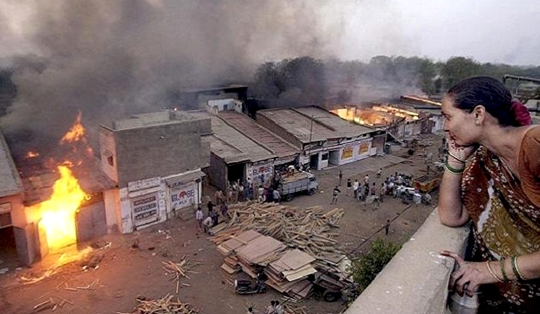
Gulberg1

Rejecting the demand for death sentence for all the convicts, the court said life imprisonment for the 11 will be till death if the state does not exercise power to remit the sentence.

The court awarded ten year jail term to one of the 13 convicted for lesser offences while 12 others have been given seven-year sentence each. The prosecution had argued that all the 24 convicts should be given death penalty.

While describing the massacre as the darkest day in the history of civil society, Special court Judge P B Desai refused death penalty saying, "If you look at all aspects, no previous antecedent has been placed on record".

Post the incident, 90 per cent of the accused were released on bail, yet no complaints against them have been given even by victims, and there is no record to show that they committed any offence during the time of bail, the judge further said, while giving reasons why he thought that this was not a fit case to give capital punishment to the convicts.

The court said it has decided to award imprisonment for life without any time frame to 11 accused, who have been convicted for murder, while requesting the state not to use its power to remit the sentence after 14 years of imprisonment.

"CrPC provisions give power to the state to remit sentence after 14 years jail, section 433-A imposes some restriction on that power. In case the state does not exercise power to remit the sentence, life imprisonment will mean that it is till death," the court said.

"I cannot add beyond what has been prescribed under section 302, it is not necessary for a state to exercise power to remit sentence, state may not exercise power of remittance," the judge said, adding the court's direction cannot be binding as he cannot take away the executive powers of the state.

As regards the 13 others accused convicted for lesser offences not including murder (302), the court awarded 10 years imprisonment to one Mangilal Jain, while 12 others were awarded seven-year sentence each.

The Gulberg Society massacre, which took place here on February 28, 2002 when Narendra Modi was the Gujarat Chief Minister, shook the nation when a mob of 400 people set about attacking the society in the heart of Ahmedabad and killed the residents including Jafri.

It was one of the nine cases of the 2002 Gujarat riots probed by the Supreme Court-appointed SIT.

"All the sentences will run concurrently as the Supreme Court has laid it down clearly that if the crime had single purpose, sentences given for different sections of IPC should run concurrently," the court said.

The prosecution and the victims had demanded that sentences awarded to all the accused should not run concurrently as all the 24 convicts will have to spend their entire life behind bars.

Earlier on June 2, the court had convicted 11 persons for murder and other offences, while 13 others, including VHP leader Atul Vaidya, were charged with lesser offences. It had acquitted 36 others in the case.

Those given life sentence in the case are - Kailash Dhobi, Yogendra Shekhawat, Jayesh Jingar, Krishna Kalal, Jayesh Parmar, Raju Tiwari, Bharat Rajput, Dinesh Sharma, Narayan Tank, Lakhansinh Chudasama and Bharat Taili.

One Mangilal Jain, who was convicted for lesser offence, has been sentenced to 10 years jail term.

Besides, VHP leader Atul Vaid, Mukesh Jingar, Prakash Padhiyar, Surendrasinh Chauhan, Dilip Parmar, Babu Marwadi, Manish Jain, Dharmesh Shukla, Kapil Mishra, Suresh Dhobi, Ambesh Jingar and Sandeep Punjabi have been sentenced to seven years imprisonment each.

During the argument on quantum of sentence, special public prosecutor and counsel for Supreme Court-appointed Special Investigation Team (SIT), R C Kodekar had asked the court for nothing less than death sentence or jail term till death for all 24 convicts.

Lawyer for the victims, S M Vora, also sought maximum punishment for the accused and argued that sentencing for each offence should not run concurrently so that they spend their entire life in jail.

However, lawyer of the accused, Abhay Bhardwaj, has refuted the demand of capital punishment or maximum punishment in his arguments saying that the incident was spontaneous and there were enough provocations for it.

The Gulberg society massacre was one of the nine cases of 2002 Gujarat riots probed by the SC-appointed SIT.

The incident had taken place a day after S-6 coach of Sabarmati Express was burnt near Godhra train station in which 58 'kar sevaks' returning from Ayodhya were killed.

During the course of trial, as many as 338 witnesses were cross-examined, with four different judges having presided over the case.

Comments

Ahmed Ali K
 - 
Friday, 17 Jun 2016

Death sentence?
for what?
Is he a non Hindu?

Jaleel S
 - 
Friday, 17 Jun 2016

Rarest of rare judgement...

Add new comment

  • Coastaldigest.com reserves the right to delete or block any comments.
  • Coastaldigset.com is not responsible for its readers’ comments.
  • Comments that are abusive, incendiary or irrelevant are strictly prohibited.
  • Please use a genuine email ID and provide your name to avoid reject.
News Network
May 11,2020

Kolkata, May 11: Murshidabad district, one of the biggest contributors to the army of migrant workers from West Bengal, received news of unnatural deaths of three of these people since Saturday. While two died in Kerala, one was found dead in a rented house in Odisha.

Residents of Baliaghati village in Murshidabad’s Suti police station area said Safikul Sheikh (31) was killed in a road accident in Kerala. Sheikh’s associates called up his family on Sunday morning and said he had gone to a local market, violating lockdown orders, when the accident took place. Sheikh wanted to return home before Eid but got stranded.

Mohammad Hafijul, one of Sheikh’s relatives, said, “A few days ago a special train from Kerala carried migrant workers to Murshidabad but Safikul did not have the money to buy a ticket. We do not know how his body will be brought back.”

In another incident, a 24-year-old resident of Domkal allegedly hanged himself in Kerala on Saturday. He used to work in a brick kiln. His mother said, “My son was depressed as he could not buy a ticket to board the special train that came to Murshidabad. We have appealed to the local administration to bring back his body.”

In the third incident, Bakul Sheikh (24) died under mysterious circumstances at Sonepur in Odisha where he went five months ago to work as a mason. Sheikh hails from Kohetpur village in Shamserganj. His relatives told the local police that his associates called up and said he was found dead inside the toilet of the house where he was living with other migrant workers.

Comments

Add new comment

  • Coastaldigest.com reserves the right to delete or block any comments.
  • Coastaldigset.com is not responsible for its readers’ comments.
  • Comments that are abusive, incendiary or irrelevant are strictly prohibited.
  • Please use a genuine email ID and provide your name to avoid reject.
News Network
April 23,2020

New Delhi, Apr 23: The entire Muslim community cannot be held responsible for one group's "crime", Minority Affairs Minister Mukhtar Abbas Naqvi said on Thursday while reacting to instances of Muslims being blamed for the spurt in COVID-19 cases after Tablighi Jamaat congregation here, and asserted that most of the minority community members have condemned the group's action.

In an interview to news agency, Naqvi also expressed confidence that Muslims will abide by lockdown guidelines during the holy month of Ramzan.

He said across the India, imams, Ulema and Muslim organizations have unanimously decided that during Ramzan (the Islamic holy month), Muslims will not congregate in mosques, religious places and perform all rituals like 'Iftaar' (breaking of fast) and 'taraweeh' (special prayers) at home keeping in mind social distancing norms.

Naqvi said he has spoken with state waqf board officials, social and religious leaders, imams on adherence to the lockdown and social distancing guidelines during the Ramzan month starting Friday or Saturday evening and they have begun creating awareness among the people.

Asked about some people blaming Muslims for the spread of the pandemic after a large number of cases were found linked to the Tablighi Jamaat event at Nizamudddin here, Naqvi said the whole community cannot be held responsible for the "crime" of one organisation or one person.

"Whatever that organisation did, criminal negligence or crime...most Muslims have strongly reacted to it, condemned it and called for action against it. Entire community cannot be held responsible for one person or one organisation's crime," he asserted, adding that this has always been India's culture.

Last week, the Union Health Ministry had said 29.8 per cent of the total COVID-19 cases — 4,291 out of 14,378 COVID-19 infections — in the country were linked to the Tablighi Jamaat congregation in March at the group's headquarters in Delhi following which some sections of the society severely criticised Muslims, and blamed them for the spread of the pandemic in the country.

Naqvi's comments also assume significance in view of the 57-member prominent international Mulim grouping, Organisation of Islamic Cooperation (OIC), asking India to take "urgent steps" to protect the rights of its minority Muslim community and stop the incidents of "Islamophobia" in the country.

Hitting out at the OIC, the minister had said the country is "heaven for Muslims" and those trying to vitiate the atmosphere of prosperity cannot be friends of Indian Muslims.

Naqvi said those targeting Muslims are few isolated people who are trying to spread "misinformation" and "we should be united and isolate such elements".

On the COVID-19 lockdown restrictions during Ramzan, Naqvi said no Muslim wants to stay away from mosques during the holy month, but everyone has resolved to win this battle against coronavirus.

During this month, everyone should pray to God that not only India but also the entire world is freed from this COVID-19 pandemic, he said.

Asked whether Muslims have followed lockdown and social distancing guidelines till now, Naqvi said, "absolutely, the entire country is standing united in this fight against coronavirus."

"When Prime Minister Narendra Modi had appealed to people with folded hands, he had appealed to 130 crore Indians, it was not based on caste or religion. And everybody responded to his appeal and acted on it," he said.

People have faith that whatever Prime Minister Modi does is for the health and safety of the people, Naqvi said.

Asked about the role of the Opposition in the fight against COVID-19 and Congress chief Sonia Gandhi and Rahul Gandhi's suggestions, Naqvi said,"some people have criticized, but that is their habit, we don't take any offence to it."

Comments

Add new comment

  • Coastaldigest.com reserves the right to delete or block any comments.
  • Coastaldigset.com is not responsible for its readers’ comments.
  • Comments that are abusive, incendiary or irrelevant are strictly prohibited.
  • Please use a genuine email ID and provide your name to avoid reject.
Agencies
May 30,2020

New Delhi, May 30: The COVID-19 pandemic has left the Indian private healthcare sector in acute financial distress, a new survey said on Friday adding that the healthcare facilities in the country have witnessed at least 80 per cent fall in average revenue.

Post the lockdown from March 24, Indian hospitals have seen a large impact, especially among small and medium-sized hospitals, which are now facing existential challenges.

The survey by healthcare industry body NATHEALTH was conducted in 251 healthcare facilities across nine states and 69 cities to assess the impact of COVID-19 on the domestic healthcare industry.

The findings showed that 90 per cent of the surveyed healthcare facilities are facing financial challenges with 21 per cent facilities facing an existential threat.

"There is a need for a stimulus package to revive the Indian healthcare industry which will be crucial to provide much-needed relief to the healthcare sector which is the frontline defence in this fight against COVID-19," said Dr Sudarshan Ballal, President NATHEALTH.

According to the survey, hospitals in tier 1 and tier 2 cities are experiencing a 78 per cent reduction in OPD footfalls, and a drop of 79 per cent in in-patient admissions.

The study found that 90 per cent of organisations require some form of financial assistance.

The findings indicated that even after the lockdown lift, the situation will remain difficult for the hospitals and nursing homes as patients will hesitate from visiting hospitals.

Comments

Add new comment

  • Coastaldigest.com reserves the right to delete or block any comments.
  • Coastaldigset.com is not responsible for its readers’ comments.
  • Comments that are abusive, incendiary or irrelevant are strictly prohibited.
  • Please use a genuine email ID and provide your name to avoid reject.