


11 get life term in Gulberg society massacre case

June 17, 2016

Ahmedabad, Jun 17: Calling the Gulberg massacre as the "darkest day" in the history of civil society, a special SIT court here today sentenced 11 convicts to life imprisonment in the case of burning alive of 69 people, including former Congress MP Eshan Jafri in the 2002 post-Godhra violence.
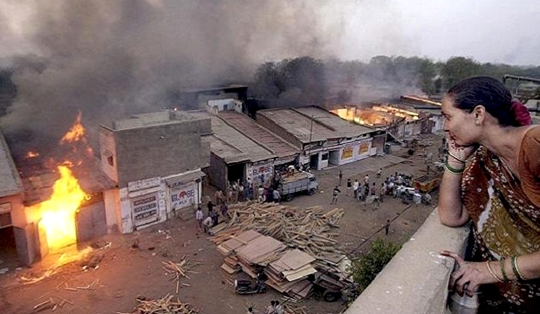
Gulberg1

Rejecting the demand for death sentence for all the convicts, the court said life imprisonment for the 11 will be till death if the state does not exercise power to remit the sentence.

The court awarded ten year jail term to one of the 13 convicted for lesser offences while 12 others have been given seven-year sentence each. The prosecution had argued that all the 24 convicts should be given death penalty.

While describing the massacre as the darkest day in the history of civil society, Special court Judge P B Desai refused death penalty saying, "If you look at all aspects, no previous antecedent has been placed on record".

Post the incident, 90 per cent of the accused were released on bail, yet no complaints against them have been given even by victims, and there is no record to show that they committed any offence during the time of bail, the judge further said, while giving reasons why he thought that this was not a fit case to give capital punishment to the convicts.

The court said it has decided to award imprisonment for life without any time frame to 11 accused, who have been convicted for murder, while requesting the state not to use its power to remit the sentence after 14 years of imprisonment.

"CrPC provisions give power to the state to remit sentence after 14 years jail, section 433-A imposes some restriction on that power. In case the state does not exercise power to remit the sentence, life imprisonment will mean that it is till death," the court said.

"I cannot add beyond what has been prescribed under section 302, it is not necessary for a state to exercise power to remit sentence, state may not exercise power of remittance," the judge said, adding the court's direction cannot be binding as he cannot take away the executive powers of the state.

As regards the 13 others accused convicted for lesser offences not including murder (302), the court awarded 10 years imprisonment to one Mangilal Jain, while 12 others were awarded seven-year sentence each.

The Gulberg Society massacre, which took place here on February 28, 2002 when Narendra Modi was the Gujarat Chief Minister, shook the nation when a mob of 400 people set about attacking the society in the heart of Ahmedabad and killed the residents including Jafri.

It was one of the nine cases of the 2002 Gujarat riots probed by the Supreme Court-appointed SIT.

"All the sentences will run concurrently as the Supreme Court has laid it down clearly that if the crime had single purpose, sentences given for different sections of IPC should run concurrently," the court said.

The prosecution and the victims had demanded that sentences awarded to all the accused should not run concurrently as all the 24 convicts will have to spend their entire life behind bars.

Earlier on June 2, the court had convicted 11 persons for murder and other offences, while 13 others, including VHP leader Atul Vaidya, were charged with lesser offences. It had acquitted 36 others in the case.

Those given life sentence in the case are - Kailash Dhobi, Yogendra Shekhawat, Jayesh Jingar, Krishna Kalal, Jayesh Parmar, Raju Tiwari, Bharat Rajput, Dinesh Sharma, Narayan Tank, Lakhansinh Chudasama and Bharat Taili.

One Mangilal Jain, who was convicted for lesser offence, has been sentenced to 10 years jail term.

Besides, VHP leader Atul Vaid, Mukesh Jingar, Prakash Padhiyar, Surendrasinh Chauhan, Dilip Parmar, Babu Marwadi, Manish Jain, Dharmesh Shukla, Kapil Mishra, Suresh Dhobi, Ambesh Jingar and Sandeep Punjabi have been sentenced to seven years imprisonment each.

During the argument on quantum of sentence, special public prosecutor and counsel for Supreme Court-appointed Special Investigation Team (SIT), R C Kodekar had asked the court for nothing less than death sentence or jail term till death for all 24 convicts.

Lawyer for the victims, S M Vora, also sought maximum punishment for the accused and argued that sentencing for each offence should not run concurrently so that they spend their entire life in jail.

However, lawyer of the accused, Abhay Bhardwaj, has refuted the demand of capital punishment or maximum punishment in his arguments saying that the incident was spontaneous and there were enough provocations for it.

The Gulberg society massacre was one of the nine cases of 2002 Gujarat riots probed by the SC-appointed SIT.

The incident had taken place a day after S-6 coach of Sabarmati Express was burnt near Godhra train station in which 58 'kar sevaks' returning from Ayodhya were killed.

During the course of trial, as many as 338 witnesses were cross-examined, with four different judges having presided over the case.

Comments

Ahmed Ali K
 - 
Friday, 17 Jun 2016

Death sentence?
for what?
Is he a non Hindu?

Jaleel S
 - 
Friday, 17 Jun 2016

Rarest of rare judgement...

Add new comment

  • Coastaldigest.com reserves the right to delete or block any comments.
  • Coastaldigset.com is not responsible for its readers’ comments.
  • Comments that are abusive, incendiary or irrelevant are strictly prohibited.
  • Please use a genuine email ID and provide your name to avoid reject.
News Network
February 28,2020

Feb 28: Life was limping back to normalcy in some parts of the riot-hit northeast Delhi, with police and paramilitary personnel maintaining strict vigil in view of Friday prayers at mosques.

Police officers said they were also making extra efforts to quell rumours, and holding regular flag marches and interactions in the neighbourhoods of affected areas as confidence-building measures.

In some areas of northeast Delhi, signs of normal life were witnessed with opening of shops. In violence-hit areas also, shops in streets and bylanes were open.

Nearly 7,000 paramilitary forces have been deployed in the affected areas of the northeast district since Monday. Besides, hundreds of Delhi police personnel are on the ground to maintain peace and prevent any untoward incident.

At least 38 were killed and over 200 injured in the communal clashes that broke out in northeast Delhi on Monday after violence between citizenship law supporters and protesters spiralled out of control The areas affected include Jaffrabad, Maujpur, Chand Bagh, Khureji Khas and Bhajanpura..

The Union Home Ministry had said on Thursday night that no major incident was reported from the northeast district in the past 36 hours, It had said that prohibitory orders imposed under Section 144 would be relaxed for 10 hours in view of improvement in the situation.

Comments

Add new comment

  • Coastaldigest.com reserves the right to delete or block any comments.
  • Coastaldigset.com is not responsible for its readers’ comments.
  • Comments that are abusive, incendiary or irrelevant are strictly prohibited.
  • Please use a genuine email ID and provide your name to avoid reject.
News Network
March 29,2020

New Delhi, Mar 29: The battle against coronavirus is a tough one and it required harsh decisions to keep India safe, said Prime Minister Narendra Modi in his first Mann Ki Baat after the 21-day lockdown was imposed in the wake of COVID-19 outbreak.
"The battle against COVID-19 is a tough one and it did require such harsh decisions. It is important to keep the people of India safe. A disease must be dealt with at the very beginning as delay makes it incurable," said Prime Minister Modi.
He said that as the coronavirus has put the entire world in lockdown, so "India is doing the same."
"It is a challenge before everyone, science and knowledge, poor and rich, powerful and weak. It is neither restricted to a nation nor region or particular weather. This virus is bent upon killing human beings, eliminating them. Hence all of us, the entire humanity, must unite and resolve to eliminate it," he added.
Addressing the 63rd edition of his monthly radio programme 'Mann Ki Baat', the Prime Minister had sought forgiveness from all countrymen, and especially the poor, for the nationwide lockdown in the country in the view of the novel coronavirus.
During his address to the nation on March 24, the Prime Minister had announced a 21-day nationwide lockdown to contain the spread of the deadly virus. 

Comments

Add new comment

  • Coastaldigest.com reserves the right to delete or block any comments.
  • Coastaldigset.com is not responsible for its readers’ comments.
  • Comments that are abusive, incendiary or irrelevant are strictly prohibited.
  • Please use a genuine email ID and provide your name to avoid reject.
Agencies
February 23,2020

New Delhi, Feb 23: Hailing the role of first Prime Minister Jawaharlal Nehru in shaping India a modern nation state, former Prime Minister Manmohan Singh on Saturday hit out at the Narendra Modi-led Central government, saying "nationalism" and the slogan of 'Bharat Mata Ki Jai' are being misused to construct a militant and purely emotional idea of India.

Speaking at the launch of a book on Jawaharlal Nehru's works and speeches, Singh said: "I am extremely happy that this book makes an effort to revisit Pandit Nehru. He had led this country in its volatile, formative days when we adopted democratic way of life, accommodating divergent social and political views."

The former Prime Minister said that Nehru, who was very proud of Indian heritage, "assimilated it", and harmonised them into the needs of a "new modern" India.

"A great visionary, Nehruji laid the foundation for shaping India as a modern nation state," he said.

Highlighting the works of the first Prime Minister, Singh said: "If India is recognized in the comity of nations as a vibrant democracy and, if it is considered as one of the important world powers, it was Nehru, who should be recognised as its main architect."

He said Nehru was not only a statesman of high international standing, but a great historian and literary figure too.

"With an inimitable style, and a multi-linguist, Nehru laid the foundation of the universities, academies and cultural institutions of Modern India. But for Nehru's leadership, Independent India would not have become what it is today," he said.

Taking an apparent dig at the BJP government, he said: "But unfortunately, a section of people who either do not have the patience to read history or would like to be deliberately guided by their prejudices, try their best to picture Nehru in a false light.

"But I am sure, history has a capacity to reject fake and false insinuations and put everything in proper perspective," he said.

He said the book "Who is Bharat Mata" is such an attempt to set the narrative in the right direction.

Singh said that selecting appropriate pieces from Nehruji's works, the book justifies its title "Who is Bharat Mata?"

"As this book contains a timely collection of writings by and on Pandit Jawaharlal Nehru- the leader, who shaped India and the Icon whose legacy is the subject of intense and often angry reaction today.

The book also comprises reminiscences and assessments of Nehru by some of his contemporaries and near contemporaries-among them, including Mahatma Gandhi, Bhagat Singh, Sardar Patel, Maulana Azad, Aruna Asaf Ali, Sheikh Abdullah, Ramdhari Singh Dinkar, Ali Sardar Jafri, Baldev Singh, Martin Luther King Jr, Richard Attenborough, Lee Kuan Yew and Atal Bihari Vajpayee.

"It is a book of particular relevance at a time when nationalism and the slogan of ‘Bharat Mata Ki Jai' are being misused to construct a militant and purely emotional idea of India that excludes millions of residents and citizens," Singh said attacking the BJP government.

The two time Prime Minister further said that in the pages of the carefully complied anthology-which also carries illuminating introductions by the authors Nehru emerges as a "remarkable man of ideas and action", who had an instinctive understanding of India's civilisational spirit and as a visionary with clear commitment to the promotion of scientific temper, who despite the compulsions of politics, remained a true democrat.

"His legacy continues to be of immense significance-perhaps more today than at any other time in our history," he said.

He also warned that "Nehru makes a very significant and time relevant remark on the dangers of leaderships falling into a trap and getting removed far away from the common people whom they are supposed to serve".

"In an atmosphere, when emotions are deliberately get provoked and the gullible are misled by false propaganda, misusing communication technology, this book makes a refreshing break through," Singh added.

Comments

Add new comment

  • Coastaldigest.com reserves the right to delete or block any comments.
  • Coastaldigset.com is not responsible for its readers’ comments.
  • Comments that are abusive, incendiary or irrelevant are strictly prohibited.
  • Please use a genuine email ID and provide your name to avoid reject.