


11 get life term in Gulberg society massacre case

June 17, 2016

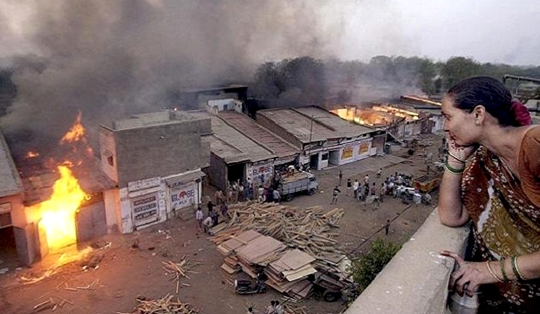
Ahmedabad, Jun 17: Calling the Gulberg massacre as the "darkest day" in the history of civil society, a special SIT court here today sentenced 11 convicts to life imprisonment in the case of burning alive of 69 people, including former Congress MP Eshan Jafri in the 2002 post-Godhra violence.
Gulberg1

Rejecting the demand for death sentence for all the convicts, the court said life imprisonment for the 11 will be till death if the state does not exercise power to remit the sentence.

The court awarded ten year jail term to one of the 13 convicted for lesser offences while 12 others have been given seven-year sentence each. The prosecution had argued that all the 24 convicts should be given death penalty.

While describing the massacre as the darkest day in the history of civil society, Special court Judge P B Desai refused death penalty saying, "If you look at all aspects, no previous antecedent has been placed on record".

Post the incident, 90 per cent of the accused were released on bail, yet no complaints against them have been given even by victims, and there is no record to show that they committed any offence during the time of bail, the judge further said, while giving reasons why he thought that this was not a fit case to give capital punishment to the convicts.

The court said it has decided to award imprisonment for life without any time frame to 11 accused, who have been convicted for murder, while requesting the state not to use its power to remit the sentence after 14 years of imprisonment.

"CrPC provisions give power to the state to remit sentence after 14 years jail, section 433-A imposes some restriction on that power. In case the state does not exercise power to remit the sentence, life imprisonment will mean that it is till death," the court said.

"I cannot add beyond what has been prescribed under section 302, it is not necessary for a state to exercise power to remit sentence, state may not exercise power of remittance," the judge said, adding the court's direction cannot be binding as he cannot take away the executive powers of the state.

As regards the 13 others accused convicted for lesser offences not including murder (302), the court awarded 10 years imprisonment to one Mangilal Jain, while 12 others were awarded seven-year sentence each.

The Gulberg Society massacre, which took place here on February 28, 2002 when Narendra Modi was the Gujarat Chief Minister, shook the nation when a mob of 400 people set about attacking the society in the heart of Ahmedabad and killed the residents including Jafri.

It was one of the nine cases of the 2002 Gujarat riots probed by the Supreme Court-appointed SIT.

"All the sentences will run concurrently as the Supreme Court has laid it down clearly that if the crime had single purpose, sentences given for different sections of IPC should run concurrently," the court said.

The prosecution and the victims had demanded that sentences awarded to all the accused should not run concurrently as all the 24 convicts will have to spend their entire life behind bars.

Earlier on June 2, the court had convicted 11 persons for murder and other offences, while 13 others, including VHP leader Atul Vaidya, were charged with lesser offences. It had acquitted 36 others in the case.

Those given life sentence in the case are - Kailash Dhobi, Yogendra Shekhawat, Jayesh Jingar, Krishna Kalal, Jayesh Parmar, Raju Tiwari, Bharat Rajput, Dinesh Sharma, Narayan Tank, Lakhansinh Chudasama and Bharat Taili.

One Mangilal Jain, who was convicted for lesser offence, has been sentenced to 10 years jail term.

Besides, VHP leader Atul Vaid, Mukesh Jingar, Prakash Padhiyar, Surendrasinh Chauhan, Dilip Parmar, Babu Marwadi, Manish Jain, Dharmesh Shukla, Kapil Mishra, Suresh Dhobi, Ambesh Jingar and Sandeep Punjabi have been sentenced to seven years imprisonment each.

During the argument on quantum of sentence, special public prosecutor and counsel for Supreme Court-appointed Special Investigation Team (SIT), R C Kodekar had asked the court for nothing less than death sentence or jail term till death for all 24 convicts.

Lawyer for the victims, S M Vora, also sought maximum punishment for the accused and argued that sentencing for each offence should not run concurrently so that they spend their entire life in jail.

However, lawyer of the accused, Abhay Bhardwaj, has refuted the demand of capital punishment or maximum punishment in his arguments saying that the incident was spontaneous and there were enough provocations for it.

The Gulberg society massacre was one of the nine cases of 2002 Gujarat riots probed by the SC-appointed SIT.

The incident had taken place a day after S-6 coach of Sabarmati Express was burnt near Godhra train station in which 58 'kar sevaks' returning from Ayodhya were killed.

During the course of trial, as many as 338 witnesses were cross-examined, with four different judges having presided over the case.

Comments

Ahmed Ali K
 - 
Friday, 17 Jun 2016

Death sentence?
for what?
Is he a non Hindu?

Jaleel S
 - 
Friday, 17 Jun 2016

Rarest of rare judgement...

Add new comment

  • Coastaldigest.com reserves the right to delete or block any comments.
  • Coastaldigset.com is not responsible for its readers’ comments.
  • Comments that are abusive, incendiary or irrelevant are strictly prohibited.
  • Please use a genuine email ID and provide your name to avoid reject.
Agencies
January 15,2020

New Delhi, Jan 15: Suspended Deputy Superintendent of J&K Police Davinder Singh had ferried Hizbul Mujahideen terrorist Naveed Babu to Jammu last year also and facilitated his return to Shopian after "rest and recuperation", officials interrogating him said here Tuesday.

"Meri mati maari gayi thi (I must have lost my mind to do what I did)," an interrogator quoted Singh as saying after the DSP failed to impress them with his theory of catching a big terrorist.

Singh was arrested last Saturday along with Naveed Babu alias Babar Azam, a resident of Nazneenpora in South Kashmir's Shopian district, and his associate Asif Ahmad.

He is believed to have taken Rs 12 lakh for smuggling the two to Chandigarh for providing them accommodation for a couple of months, officials said. The officials, who have been spending considerable time questioning Singh, said there have been many inconsistencies in his statements and everything was being crosschecked and corroborated with the confessions of captured militants who have been kept in different rooms at an interrogation centre in South Kashmir.

During questioning it emerged that Singh had taken them to Jammu in 2019 also, the officials said.

In a tone laced with sarcasm, they said the DSP was taking the militants for "rest and recuperation".

Naveed told the interrogators that they used to stay in the hilly regions to avoid the J&K police and left the areas to escape harsh winters, they said.

The official said the DSP's bank accounts and other assets were being verified by the police and papers were being collected, amid speculations that the case may be handed over to the National Investigation Agency (NIA).

Going into the service history of Singh, majority of retired and serving officials of the JKP spoken to referred to a proverb -- coming events cast their shadows long before -- to say that if action had been taken against the officer during his probation period, such things would not have happened.

Recruited in 1990 as a sub-inspector, Singh along with another probationary officer were subject of an internal enquiry where some narcotics had been seized from a truck. However, the contraband was sold by Singh and another sub-inspector, the officials recalled.

There was a move to dismiss them from the service which was stalled by an Inspector General rank officer purely on humanitarian ground and the duo was shifted to the Special Operations Group, a team of policemen engaged in counter-militancy offensive.

However, he could not last there for long and was shifted this time to the police lines only to be rehabilitated in 1997 again in the SOG.

During this period, he was posted in Budgam and is alleged to have indulged in extortion for which he was sent back to the police lines.

His proper rehabilitation began in 2015 by the then Director General of Police K Rajendra, who posted him in district headquarters of Shopian and Pulwama, the officials said.

However, after some alleged wrongdoing during his stint in Pulwama, the then Director General of Police S P Vaid transferred him in August 2018 to the sensitive Anti-Hijacking Unit in Srinagar, though the move was opposed by some other officers.

An advocate, Irfan Ahmad Mir, was driving the vehicle when they were caught by the police on National Highway in Kulgam district.

The advocate, who has also been arrested, had travelled to Pakistan five times on an Indian passport.

Comments

Add new comment

  • Coastaldigest.com reserves the right to delete or block any comments.
  • Coastaldigset.com is not responsible for its readers’ comments.
  • Comments that are abusive, incendiary or irrelevant are strictly prohibited.
  • Please use a genuine email ID and provide your name to avoid reject.
News Network
February 18,2020

New Delhi, Feb 18: India emerged as the world's fifth-largest economy by overtaking the UK and France in 2019, says a report.

A US-based think tank World Population Review in its report said that India is developing into an open-market economy from its previous autarkic policies.

"India's economy is the fifth-largest in the world with a GDP of $2.94 trillion, overtaking the UK and France in 2019 to take the fifth spot," it said.

The size of the UK economy is $2.83 trillion and that of France is $2.71 trillion.

The report further said that in purchasing power parity (PPP) terms, India's GDP (PPP) is $10.51 trillion, exceeding that of Japan and Germany. Due to India's high population, India's GDP per capita is $2,170 (for comparison, the US is $62,794).

India's real GDP growth, however, it said is expected to weaken for the third straight year from 7.5 per cent to 5 per cent.

The report observed that India's economic liberalisation began in the early 1990s and included industrial deregulation, reduced control on foreign trade and investment, and privatisation of state-owned enterprises.

"These measures have helped India accelerate economic growth," it said.

India's service sector is the fast-growing sector in the world accounting for 60 per cent of the economy and 28 per of employment, the report said, adding that manufacturing and agriculture are two other significant sectors of the economy.

The US-based World Population Review is an independent organisation without any political affiliations.

Comments

Add new comment

  • Coastaldigest.com reserves the right to delete or block any comments.
  • Coastaldigset.com is not responsible for its readers’ comments.
  • Comments that are abusive, incendiary or irrelevant are strictly prohibited.
  • Please use a genuine email ID and provide your name to avoid reject.
News Network
May 14,2020

London, May 14: Vijay Mallya on Thursday lost his application seeking leave to appeal in the UK Supreme Court, in a setback for the embattled liquor tycoon who last month lost his High Court appeal against an extradition order to India on charges of fraud and money laundering related to unrecovered loans to his now-defunct Kingfisher Airlines.

The 64-year-old businessman had 14 days to file this application to seek permission to move the higher court on the High Court judgment from April 20, which dismissed his appeal against a Westminster Magistrates' Court's extradition order certified by the UK Home Secretary.

The latest ruling will now go back for re-certification and the process of extradition should be triggered within 28 days.

The UK Crown Prosecution Service (CPS) said Mallya's appeal to certify a point of law was rejected on all three counts, of hearing oral submissions, grant a certificate on the questions as drafted, and grant permission to appeal to the Supreme Court.

The Indian government's response to the appeal application had been submitted earlier this week.

The leave to appeal to the Supreme Court is on a point of law of general public importance, which according to experts is a very high threshold that is not often met.

Comments

Add new comment

  • Coastaldigest.com reserves the right to delete or block any comments.
  • Coastaldigset.com is not responsible for its readers’ comments.
  • Comments that are abusive, incendiary or irrelevant are strictly prohibited.
  • Please use a genuine email ID and provide your name to avoid reject.