


11 get life term in Gulberg society massacre case

June 17, 2016

Ahmedabad, Jun 17: Calling the Gulberg massacre as the "darkest day" in the history of civil society, a special SIT court here today sentenced 11 convicts to life imprisonment in the case of burning alive of 69 people, including former Congress MP Eshan Jafri in the 2002 post-Godhra violence.
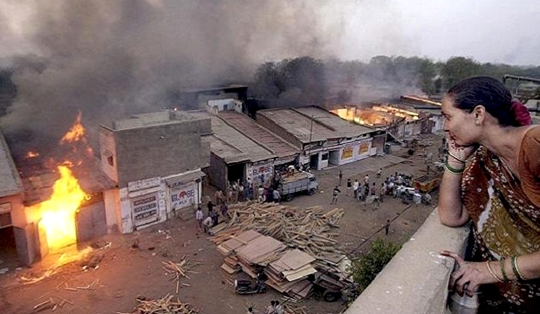
Gulberg1

Rejecting the demand for death sentence for all the convicts, the court said life imprisonment for the 11 will be till death if the state does not exercise power to remit the sentence.

The court awarded ten year jail term to one of the 13 convicted for lesser offences while 12 others have been given seven-year sentence each. The prosecution had argued that all the 24 convicts should be given death penalty.

While describing the massacre as the darkest day in the history of civil society, Special court Judge P B Desai refused death penalty saying, "If you look at all aspects, no previous antecedent has been placed on record".

Post the incident, 90 per cent of the accused were released on bail, yet no complaints against them have been given even by victims, and there is no record to show that they committed any offence during the time of bail, the judge further said, while giving reasons why he thought that this was not a fit case to give capital punishment to the convicts.

The court said it has decided to award imprisonment for life without any time frame to 11 accused, who have been convicted for murder, while requesting the state not to use its power to remit the sentence after 14 years of imprisonment.

"CrPC provisions give power to the state to remit sentence after 14 years jail, section 433-A imposes some restriction on that power. In case the state does not exercise power to remit the sentence, life imprisonment will mean that it is till death," the court said.

"I cannot add beyond what has been prescribed under section 302, it is not necessary for a state to exercise power to remit sentence, state may not exercise power of remittance," the judge said, adding the court's direction cannot be binding as he cannot take away the executive powers of the state.

As regards the 13 others accused convicted for lesser offences not including murder (302), the court awarded 10 years imprisonment to one Mangilal Jain, while 12 others were awarded seven-year sentence each.

The Gulberg Society massacre, which took place here on February 28, 2002 when Narendra Modi was the Gujarat Chief Minister, shook the nation when a mob of 400 people set about attacking the society in the heart of Ahmedabad and killed the residents including Jafri.

It was one of the nine cases of the 2002 Gujarat riots probed by the Supreme Court-appointed SIT.

"All the sentences will run concurrently as the Supreme Court has laid it down clearly that if the crime had single purpose, sentences given for different sections of IPC should run concurrently," the court said.

The prosecution and the victims had demanded that sentences awarded to all the accused should not run concurrently as all the 24 convicts will have to spend their entire life behind bars.

Earlier on June 2, the court had convicted 11 persons for murder and other offences, while 13 others, including VHP leader Atul Vaidya, were charged with lesser offences. It had acquitted 36 others in the case.

Those given life sentence in the case are - Kailash Dhobi, Yogendra Shekhawat, Jayesh Jingar, Krishna Kalal, Jayesh Parmar, Raju Tiwari, Bharat Rajput, Dinesh Sharma, Narayan Tank, Lakhansinh Chudasama and Bharat Taili.

One Mangilal Jain, who was convicted for lesser offence, has been sentenced to 10 years jail term.

Besides, VHP leader Atul Vaid, Mukesh Jingar, Prakash Padhiyar, Surendrasinh Chauhan, Dilip Parmar, Babu Marwadi, Manish Jain, Dharmesh Shukla, Kapil Mishra, Suresh Dhobi, Ambesh Jingar and Sandeep Punjabi have been sentenced to seven years imprisonment each.

During the argument on quantum of sentence, special public prosecutor and counsel for Supreme Court-appointed Special Investigation Team (SIT), R C Kodekar had asked the court for nothing less than death sentence or jail term till death for all 24 convicts.

Lawyer for the victims, S M Vora, also sought maximum punishment for the accused and argued that sentencing for each offence should not run concurrently so that they spend their entire life in jail.

However, lawyer of the accused, Abhay Bhardwaj, has refuted the demand of capital punishment or maximum punishment in his arguments saying that the incident was spontaneous and there were enough provocations for it.

The Gulberg society massacre was one of the nine cases of 2002 Gujarat riots probed by the SC-appointed SIT.

The incident had taken place a day after S-6 coach of Sabarmati Express was burnt near Godhra train station in which 58 'kar sevaks' returning from Ayodhya were killed.

During the course of trial, as many as 338 witnesses were cross-examined, with four different judges having presided over the case.

Comments

Ahmed Ali K
 - 
Friday, 17 Jun 2016

Death sentence?
for what?
Is he a non Hindu?

Jaleel S
 - 
Friday, 17 Jun 2016

Rarest of rare judgement...

Add new comment

  • Coastaldigest.com reserves the right to delete or block any comments.
  • Coastaldigset.com is not responsible for its readers’ comments.
  • Comments that are abusive, incendiary or irrelevant are strictly prohibited.
  • Please use a genuine email ID and provide your name to avoid reject.
News Network
March 29,2020

Thiruvananthapuram, Mar 29: Kerala Chief Minister Pinarayi Vijayan on Saturday expressed his concern over the ''non-cooperation from the Karnataka Government in removing the roadblocks erected by them in the roads bordering Malapuram district''.

Addressing a press conference at the Government Secretariat, the Chief Minister said, "Karnataka has not heeded to our request to remove the roadblocks. I have been trying to contact their Chief Minister B S Yeddyurappa but not able to reach him."

"We have briefed the Union Minister D V Sadananda Gowda and he has offered to resolve the issue. Our Chief Secretary has also briefed the Central Cabinet Secretary and we expect a resolution soon," he added.

Comments

Add new comment

  • Coastaldigest.com reserves the right to delete or block any comments.
  • Coastaldigset.com is not responsible for its readers’ comments.
  • Comments that are abusive, incendiary or irrelevant are strictly prohibited.
  • Please use a genuine email ID and provide your name to avoid reject.
News Network
June 18,2020

New Delhi, Jun 18: The Delhi High Court Thursday asked the Delhi Police to file status report on a plea by Jamia Coordination Committee member Safoora Zargar, who was arrested under the anti-terror law --UAPA -- seeking bail in a case related to communal violence in northeast Delhi during protests against the Citizenship Amendment Act in February.

Zargar, M Phil student of Jamia Millia Islamia University, is more than four months pregnant.

Justice Rajiv Shakdher issued notice to the police and asked it to file a status report on the bail plea.

The high court listed the matter for further hearing on June 22.

Zargar, who was arrested by the Special Cell of Delhi Police on April 10, has challenged the June 4 order of the trial court denying her bail in the case.

The trial court, in its order, had said “when you choose to play with embers, you cannot blame the wind to have carried the spark a bit too far and spread the fire.”

It had said that during the course of investigation a larger conspiracy was discernible and if there was prima evidence of conspiracy, acts and statements made by any one of the conspirators, it is admissible against all.

The court had said that even if there was no direct act of violence attributable to the accused (Zargar), she cannot shy away from her liability under the provisions of the Unlawful Activities (Prevention) Act (UAPA).

However, the trial court had asked the concerned jail superintendent to provide adequate medical aid and the assistance to Zargar.

The police had earlier claimed that Zargar allegedly blocked a road near Jaffrabad metro station during the anti-CAA protests and instigated people that led to the riots in the area.

It further claimed that she was allegedly part of the “premediated conspiracy” to incite communal riots in northeast Delhi in February.

Communal clashes had broken out in northeast Delhi on February 24 after violence between citizenship law supporters and protesters spiralled out of control leaving at least 53 people dead and scores injured.

Comments

Add new comment

  • Coastaldigest.com reserves the right to delete or block any comments.
  • Coastaldigset.com is not responsible for its readers’ comments.
  • Comments that are abusive, incendiary or irrelevant are strictly prohibited.
  • Please use a genuine email ID and provide your name to avoid reject.
Agencies
July 18,2020

New Delhi, Jul 18: National carrier Air India on Friday said that it is in a ‘very challenging financial’ situation and is taking recourse to several initiatives, with a view to ensuring the continuance of its operations.

The airline, in a statement, noted that it has introduced the partially voluntary 'Leave Without Pay' (LWP) scheme on July 14.

"The scheme primarily enables employees to avail the benefits of proceeding on leave without pay on a voluntary basis. The LWP scheme has been introduced for grant of leave without pay and allowances for permanent employees for a period of six months or two years, which is extendable upto 5 years," the statement said.

"Air India had brought out similar scheme earlier... Several hundred employees have, in the past, availed of the LWP Scheme."

As per the statement, in the wake of the ongoing Covid-19 pandemic, there may be employees who are unable to attend their office duties in person on account of personal reasons.

"The LWP scheme enables employees to take a break from their office responsibility for a defined period of time with the approval of the management, while retaining their employment with the company," the statement said.

"They will continue to avail facilities such as passage, medical and housing at specified rates."

Accordingly, the LWP scheme provides the opportunity to employees to take up alternative employment with the approval of the management during the period of the said leave, the airline said.

"The LWP scheme is a win-win situation for both the management as well as employees as it provides flexibility to employees and simultaneously reduces the wage bill for the company," the statement said.

"It is important to note here that the Covid-19 outbreak has very seriously impacted the airline sector and currently, the airline operations of the company are a small fraction of the prior Covid level operations."

The airline said that employees are encouraged to apply for availing the benefit of the scheme, in the prescribed format, by August 15.

"The only addition in this scheme as compared to the earlier LWP scheme is that the management can pass an order requiring the employees to go on leave for a period of six months or two years (extendable upto 5 years) compulsorily taking into consideration 'Suitability, Efficiency, Competence, Quality of performance, Health, Non-availability of employee and Redundancy'," the statement said.

Furthermore, the airline said that this provision has been introduced for use, "very sparingly", with a view to ensuring that the overall efficiency of the organisation, improves and the management will ensure that this will be implemented with complete fairness and transparency as per prescribed procedure.

Consequent to the announcement of the scheme, Air India unions are discussing their strategy against the move which might involve legal recourse.

An Air India union leader on Friday told IANS: "This is going to affect the livelihood of many. Why not every employee of AI take LWP a few days every month. This way the burden can be shared."

"The motive of the top management is to save their money by snatching money from lower employees."

According to Air India PIM document, as on November 1, 2019, the airline, on a standalone basis (without subsidiaries), had around 14,000 employees, including fixed term contract staff.

The development comes as the Centre has re-initiated the airline's divestment plan with new norms.

Interestingly, this time, it has sweetened the deal by substantially reducing the debt on the airline's account books and offered a 100 per cent stake in the loss-making airline.

The last date for bid submission to acquire Air India has also been extended to August 31.

Comments

Add new comment

  • Coastaldigest.com reserves the right to delete or block any comments.
  • Coastaldigset.com is not responsible for its readers’ comments.
  • Comments that are abusive, incendiary or irrelevant are strictly prohibited.
  • Please use a genuine email ID and provide your name to avoid reject.