


11 get life term in Gulberg society massacre case

June 17, 2016

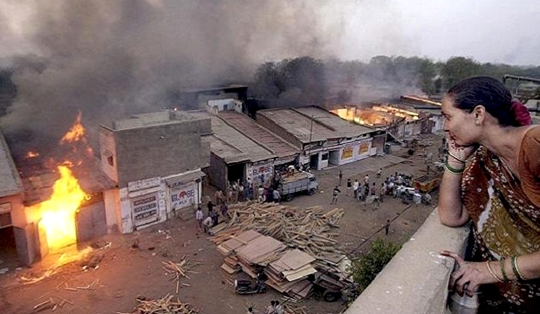
Ahmedabad, Jun 17: Calling the Gulberg massacre as the "darkest day" in the history of civil society, a special SIT court here today sentenced 11 convicts to life imprisonment in the case of burning alive of 69 people, including former Congress MP Eshan Jafri in the 2002 post-Godhra violence.
Gulberg1

Rejecting the demand for death sentence for all the convicts, the court said life imprisonment for the 11 will be till death if the state does not exercise power to remit the sentence.

The court awarded ten year jail term to one of the 13 convicted for lesser offences while 12 others have been given seven-year sentence each. The prosecution had argued that all the 24 convicts should be given death penalty.

While describing the massacre as the darkest day in the history of civil society, Special court Judge P B Desai refused death penalty saying, "If you look at all aspects, no previous antecedent has been placed on record".

Post the incident, 90 per cent of the accused were released on bail, yet no complaints against them have been given even by victims, and there is no record to show that they committed any offence during the time of bail, the judge further said, while giving reasons why he thought that this was not a fit case to give capital punishment to the convicts.

The court said it has decided to award imprisonment for life without any time frame to 11 accused, who have been convicted for murder, while requesting the state not to use its power to remit the sentence after 14 years of imprisonment.

"CrPC provisions give power to the state to remit sentence after 14 years jail, section 433-A imposes some restriction on that power. In case the state does not exercise power to remit the sentence, life imprisonment will mean that it is till death," the court said.

"I cannot add beyond what has been prescribed under section 302, it is not necessary for a state to exercise power to remit sentence, state may not exercise power of remittance," the judge said, adding the court's direction cannot be binding as he cannot take away the executive powers of the state.

As regards the 13 others accused convicted for lesser offences not including murder (302), the court awarded 10 years imprisonment to one Mangilal Jain, while 12 others were awarded seven-year sentence each.

The Gulberg Society massacre, which took place here on February 28, 2002 when Narendra Modi was the Gujarat Chief Minister, shook the nation when a mob of 400 people set about attacking the society in the heart of Ahmedabad and killed the residents including Jafri.

It was one of the nine cases of the 2002 Gujarat riots probed by the Supreme Court-appointed SIT.

"All the sentences will run concurrently as the Supreme Court has laid it down clearly that if the crime had single purpose, sentences given for different sections of IPC should run concurrently," the court said.

The prosecution and the victims had demanded that sentences awarded to all the accused should not run concurrently as all the 24 convicts will have to spend their entire life behind bars.

Earlier on June 2, the court had convicted 11 persons for murder and other offences, while 13 others, including VHP leader Atul Vaidya, were charged with lesser offences. It had acquitted 36 others in the case.

Those given life sentence in the case are - Kailash Dhobi, Yogendra Shekhawat, Jayesh Jingar, Krishna Kalal, Jayesh Parmar, Raju Tiwari, Bharat Rajput, Dinesh Sharma, Narayan Tank, Lakhansinh Chudasama and Bharat Taili.

One Mangilal Jain, who was convicted for lesser offence, has been sentenced to 10 years jail term.

Besides, VHP leader Atul Vaid, Mukesh Jingar, Prakash Padhiyar, Surendrasinh Chauhan, Dilip Parmar, Babu Marwadi, Manish Jain, Dharmesh Shukla, Kapil Mishra, Suresh Dhobi, Ambesh Jingar and Sandeep Punjabi have been sentenced to seven years imprisonment each.

During the argument on quantum of sentence, special public prosecutor and counsel for Supreme Court-appointed Special Investigation Team (SIT), R C Kodekar had asked the court for nothing less than death sentence or jail term till death for all 24 convicts.

Lawyer for the victims, S M Vora, also sought maximum punishment for the accused and argued that sentencing for each offence should not run concurrently so that they spend their entire life in jail.

However, lawyer of the accused, Abhay Bhardwaj, has refuted the demand of capital punishment or maximum punishment in his arguments saying that the incident was spontaneous and there were enough provocations for it.

The Gulberg society massacre was one of the nine cases of 2002 Gujarat riots probed by the SC-appointed SIT.

The incident had taken place a day after S-6 coach of Sabarmati Express was burnt near Godhra train station in which 58 'kar sevaks' returning from Ayodhya were killed.

During the course of trial, as many as 338 witnesses were cross-examined, with four different judges having presided over the case.

Comments

Ahmed Ali K
 - 
Friday, 17 Jun 2016

Death sentence?
for what?
Is he a non Hindu?

Jaleel S
 - 
Friday, 17 Jun 2016

Rarest of rare judgement...

Add new comment

  • Coastaldigest.com reserves the right to delete or block any comments.
  • Coastaldigset.com is not responsible for its readers’ comments.
  • Comments that are abusive, incendiary or irrelevant are strictly prohibited.
  • Please use a genuine email ID and provide your name to avoid reject.
News Network
May 5,2020

New Delhi, May 5: India registered the biggest jump in numbers of COVID-19 cases and deaths, with 3,900 new cases and 195 deaths being reported in the last 24 hours, according to the Ministry of Health and Family Welfare on Tuesday.

"3,900 COVID-19 cases and 195 deaths have been reported in the last 24 hours, the largest spike till now in both," according to the Ministry of Health and Family Welfare.

The total number of confirmed coronavirus cases in India reached 46,433, including 1,568 deaths, according to the Union Ministry of Health and Family Welfare on Tuesday.

According to the latest update by the MoHFW, 12,727 patients in the country have been cured and discharged, or have migrated, as of today morning. At present, there are 32,138 active cases in the country.

Maharashtra with 14,541 cases is the worst-affected state by the disease, while Gujarat with 5,804 cases is second on the list.

Comments

Add new comment

  • Coastaldigest.com reserves the right to delete or block any comments.
  • Coastaldigset.com is not responsible for its readers’ comments.
  • Comments that are abusive, incendiary or irrelevant are strictly prohibited.
  • Please use a genuine email ID and provide your name to avoid reject.
News Network
May 21,2020

Bengaluru, May 21: The COVID-19-induced lockdown saw a spurt in crybercrimes in India with Kerala recording the highest number during the period, according to an analysis of IT security solutions provider K7 Computing.

The report analyses various cyberattacks within India during the pandemic and reveals that threat actors targeted the States with COVID-19-themed attacks aimed at exploiting user trust.

The sudden surge in the frequency of attacks witnessed from February 2020 to mid-April 2020 indicates that scamsters across the world were exploiting the widespread panic around coronavirus at both the individual and corporate level, the company said in a statement.

These attacks aimed to compromise computers and mobile devices to gain access to users confidential data, banking details and cryptocurrency accounts.

The key threats seen during this period ranged from phishing attacks to rogue apps disguised as COVID-19 information apps that targeted users sensitive data.

Phishing attacks were noticed more in Tier-II and Tier-III cities while the metros fared better.

Smaller cities saw over 250 attacks being blocked per 10,000 users.

Users from Ghaziabad and Lucknow seem to have faced almost six and four times the number of attacks, respectively, as Bengaluru users.

In Kerala, regions like Kottayam, Kannur, Kollam, and Kochi saw the highest hits with 462, 374, 236, and 147 attacks respectively, while the state as a whole saw around 2,000 attacks during the period, the highest thus far in the country.

This was followed by Punjab with 207 attacks and Tamil Nadu at 184 attacks, the statement said.

A majority of the recorded attacks were phishing attacks with sophisticated campaigns that could easily snare even the most educated users, it said.

These attacks were aimed at heightening users fears and creating a sense of urgency to take action.

The report noted phishing attacks where scamsters posed as representatives of the United States Department of the Treasury, the World Health Organisation, and the Centres for Disease Control and Prevention.

Users were encouraged to visit links that would automatically download malware on the host computer such as the Agent Tesla keylogger or Lokibot information-stealing malware, infamous banking Trojans such as Trickbot or Zeus Sphinx, and even disastrous ransomware.

Other attacks included infected COVID-19 Android apps like CoronaSafetyMask that scam users with promises of masks for an upfront payment; the spyware app Project Spy; and seemingly genuine apps that are infected with dangerous malware like banking Trojans such as Ginp, Anubis and Cerberus, it was stated.

Comments

Add new comment

  • Coastaldigest.com reserves the right to delete or block any comments.
  • Coastaldigset.com is not responsible for its readers’ comments.
  • Comments that are abusive, incendiary or irrelevant are strictly prohibited.
  • Please use a genuine email ID and provide your name to avoid reject.
Agencies
July 31,2020

Thiruvananthapuram, Jul 31: People offered Eid-al-Adha namaz while ensuring social distancing norms at mosques in Thiruvananthapuram and Mallapuram on Friday.

Kerala Chief Minister Pinarayi Vijayan had on Thursday announced that the Eid-al-Adha prayers can be offered in mosques of the state on Friday with a limited number of people due to the COVID-19 pandemic.

Kerala is celebrating the festival of Eid-al-Adha on Friday.

Eid al-Adha or Bakrid, also known as "Sacrifice Feast" is marked by sacrificing an animal, usually a sheep or a goat to prove their devotion and love for Allah. Post the sacrifice, devotees distribute the offering to family, friends, neighbours and especially to the poor and the needy. 

Comments

Add new comment

  • Coastaldigest.com reserves the right to delete or block any comments.
  • Coastaldigset.com is not responsible for its readers’ comments.
  • Comments that are abusive, incendiary or irrelevant are strictly prohibited.
  • Please use a genuine email ID and provide your name to avoid reject.