


11 get life term in Gulberg society massacre case

June 17, 2016

Ahmedabad, Jun 17: Calling the Gulberg massacre as the "darkest day" in the history of civil society, a special SIT court here today sentenced 11 convicts to life imprisonment in the case of burning alive of 69 people, including former Congress MP Eshan Jafri in the 2002 post-Godhra violence.
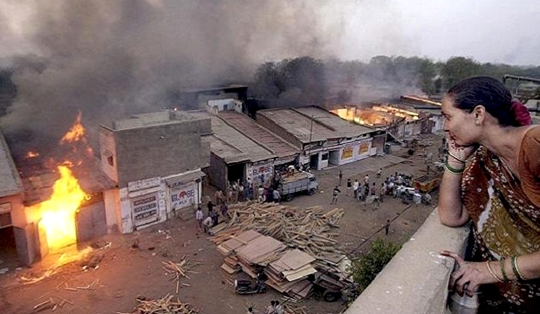
Gulberg1

Rejecting the demand for death sentence for all the convicts, the court said life imprisonment for the 11 will be till death if the state does not exercise power to remit the sentence.

The court awarded ten year jail term to one of the 13 convicted for lesser offences while 12 others have been given seven-year sentence each. The prosecution had argued that all the 24 convicts should be given death penalty.

While describing the massacre as the darkest day in the history of civil society, Special court Judge P B Desai refused death penalty saying, "If you look at all aspects, no previous antecedent has been placed on record".

Post the incident, 90 per cent of the accused were released on bail, yet no complaints against them have been given even by victims, and there is no record to show that they committed any offence during the time of bail, the judge further said, while giving reasons why he thought that this was not a fit case to give capital punishment to the convicts.

The court said it has decided to award imprisonment for life without any time frame to 11 accused, who have been convicted for murder, while requesting the state not to use its power to remit the sentence after 14 years of imprisonment.

"CrPC provisions give power to the state to remit sentence after 14 years jail, section 433-A imposes some restriction on that power. In case the state does not exercise power to remit the sentence, life imprisonment will mean that it is till death," the court said.

"I cannot add beyond what has been prescribed under section 302, it is not necessary for a state to exercise power to remit sentence, state may not exercise power of remittance," the judge said, adding the court's direction cannot be binding as he cannot take away the executive powers of the state.

As regards the 13 others accused convicted for lesser offences not including murder (302), the court awarded 10 years imprisonment to one Mangilal Jain, while 12 others were awarded seven-year sentence each.

The Gulberg Society massacre, which took place here on February 28, 2002 when Narendra Modi was the Gujarat Chief Minister, shook the nation when a mob of 400 people set about attacking the society in the heart of Ahmedabad and killed the residents including Jafri.

It was one of the nine cases of the 2002 Gujarat riots probed by the Supreme Court-appointed SIT.

"All the sentences will run concurrently as the Supreme Court has laid it down clearly that if the crime had single purpose, sentences given for different sections of IPC should run concurrently," the court said.

The prosecution and the victims had demanded that sentences awarded to all the accused should not run concurrently as all the 24 convicts will have to spend their entire life behind bars.

Earlier on June 2, the court had convicted 11 persons for murder and other offences, while 13 others, including VHP leader Atul Vaidya, were charged with lesser offences. It had acquitted 36 others in the case.

Those given life sentence in the case are - Kailash Dhobi, Yogendra Shekhawat, Jayesh Jingar, Krishna Kalal, Jayesh Parmar, Raju Tiwari, Bharat Rajput, Dinesh Sharma, Narayan Tank, Lakhansinh Chudasama and Bharat Taili.

One Mangilal Jain, who was convicted for lesser offence, has been sentenced to 10 years jail term.

Besides, VHP leader Atul Vaid, Mukesh Jingar, Prakash Padhiyar, Surendrasinh Chauhan, Dilip Parmar, Babu Marwadi, Manish Jain, Dharmesh Shukla, Kapil Mishra, Suresh Dhobi, Ambesh Jingar and Sandeep Punjabi have been sentenced to seven years imprisonment each.

During the argument on quantum of sentence, special public prosecutor and counsel for Supreme Court-appointed Special Investigation Team (SIT), R C Kodekar had asked the court for nothing less than death sentence or jail term till death for all 24 convicts.

Lawyer for the victims, S M Vora, also sought maximum punishment for the accused and argued that sentencing for each offence should not run concurrently so that they spend their entire life in jail.

However, lawyer of the accused, Abhay Bhardwaj, has refuted the demand of capital punishment or maximum punishment in his arguments saying that the incident was spontaneous and there were enough provocations for it.

The Gulberg society massacre was one of the nine cases of 2002 Gujarat riots probed by the SC-appointed SIT.

The incident had taken place a day after S-6 coach of Sabarmati Express was burnt near Godhra train station in which 58 'kar sevaks' returning from Ayodhya were killed.

During the course of trial, as many as 338 witnesses were cross-examined, with four different judges having presided over the case.

Comments

Ahmed Ali K
 - 
Friday, 17 Jun 2016

Death sentence?
for what?
Is he a non Hindu?

Jaleel S
 - 
Friday, 17 Jun 2016

Rarest of rare judgement...

Add new comment

  • Coastaldigest.com reserves the right to delete or block any comments.
  • Coastaldigset.com is not responsible for its readers’ comments.
  • Comments that are abusive, incendiary or irrelevant are strictly prohibited.
  • Please use a genuine email ID and provide your name to avoid reject.
News Network
June 24,2020

New Delhi, Jun 24: Union Civil Aviation Minister Hardeep Singh Puri on Tuesday said that nearly 1,25,000 Indians have returned from different countries under the Vande Bharat Mission.

He informed that 6,037 people returned to India from overseas on June 23.

"Vande Bharat continues to be a mission of hope and happiness for stranded and distressed Indians around the world. So far, nearly 125K Indians have come back on these evacuation flights and nearly 43K have flown out of India. Today (on Tuesday) 6,037 people returned from different countries," Puri said in a tweet.

As many as 2,50,087 Indian nationals stranded abroad have been repatriated since the beginning of Vande Bharat Mission last month, the Ministry of External Affairs (MEA) said last week.

The Vande Bharat Mission, which started from May 7 to evacuate Indians stranded abroad due to coronavirus pandemic, is in its third phase.
The recent phase commenced on June 11.

Under the third phase, India would have 550 flights including 191 feeder flights.

Comments

Add new comment

  • Coastaldigest.com reserves the right to delete or block any comments.
  • Coastaldigset.com is not responsible for its readers’ comments.
  • Comments that are abusive, incendiary or irrelevant are strictly prohibited.
  • Please use a genuine email ID and provide your name to avoid reject.
News Network
June 11,2020

Washington, Jun 11: Observing that historically India has been a tolerant, respectful country for all religions, a top Trump administration official has said the US is "very concerned" about what is happening in India over religious freedom.

The comments by Samuel Brownback, Ambassador-At-Large for International Religious Freedom, came hours after the release of the "2019 International Religious Freedom Report" on Wednesday.

Mandated by the US Congress, the report documenting major instances of violation of religious freedom across the world was released by Secretary of State Mike Pompeo at the State Department.

India has previously rejected the US religious freedom report, saying it sees no locus standi for a foreign government to pronounce on the state of its citizens' constitutionally protected rights.

"We do remain very concerned about what's taking place in India. It's historically just been a very tolerant, respectful country of religions, of all religions," Mr Brownback said during a phone call with foreign journalists on Wednesday.

The trend lines have been troubling in India because it is such a religious subcontinent and seeing a lot more communal violence, Mr Brownback said. "We're seeing a lot more difficulty. I think really they need to have a - I would hope they would have an - interfaith dialogue starting to get developed at a very high level in India, and then also deal with the specific issues that we identified as well," he said.

"It really needs a lot more effort on this topic in India, and my concern is, too, that if those efforts are not put forward, you're going to see a growth in violence and increased difficulty within the society writ large," said the top American diplomat.

Responding to a question, Mr Brownback said he hoped minority faiths are not blamed for the COVID-19 spread and that they would have access to healthcare amid the crisis.

Prime Minister Narendra Modi has criticised any form of discrimination, saying the COVID-19 pandemic affects everyone equally. "COVID-19 does not see race, religion, colour, caste, creed, language or border before striking. Our response and conduct thereafter should attach primacy to unity and brotherhood," PM Modi said in a post on LinkedIn in February.

The government, while previously rejecting the US religious freedom report, had said: "India is proud of its secular credentials, its status as the largest democracy and a pluralistic society with a longstanding commitment to tolerance and inclusion".

"The Indian Constitution guarantees fundamental rights to all its citizens, including its minority communities… We see no locus standi for a foreign entity/government to pronounce on the state of our citizens' constitutionally protected rights," the Foreign Ministry said in June last year.

According to the Home Ministry, 7,484 incidents of communal violence took place between 2008 and 2017, in which more than 1,100 people were killed.

Comments

Add new comment

  • Coastaldigest.com reserves the right to delete or block any comments.
  • Coastaldigset.com is not responsible for its readers’ comments.
  • Comments that are abusive, incendiary or irrelevant are strictly prohibited.
  • Please use a genuine email ID and provide your name to avoid reject.
Agencies
May 3,2020

Lucknow, May 3:Holding the Tablighi Jamaat responsible for the spread of COVID-19, Uttar Pradesh Chief Minister Yogi Adityanath on Saturday said that being infected with a virus is not a crime but to hide it is definitely a crime.

Speaking at a programme of a news channel, Adityanath said, "The role of Tablighi Jamaat was most condemnable. To get a disease is not a crime but to hide a disease which is infectious is definitely a crime. And this crime has been done by those associated with the Tablighi Jamaat."

"In Uttar Pradesh and other places where the spread of the coronavirus has been seen, Tablighi Jamaat is behind it. Had they not hidden the disease and went about like its carriers, then perhaps we would have controlled the coronavirus outbreak to a large extend," he said.

The chief minister said action would be taken against them for the "crime that they have committed".

A Tablighi Jamaat congregation in Delhi in March turned out to be a major source of COVID-19 cases, with those who attended the meet returned home in different parts of the country after being infected with the deadly virus.

Comments

Add new comment

  • Coastaldigest.com reserves the right to delete or block any comments.
  • Coastaldigset.com is not responsible for its readers’ comments.
  • Comments that are abusive, incendiary or irrelevant are strictly prohibited.
  • Please use a genuine email ID and provide your name to avoid reject.