


11 get life term in Gulberg society massacre case

June 17, 2016

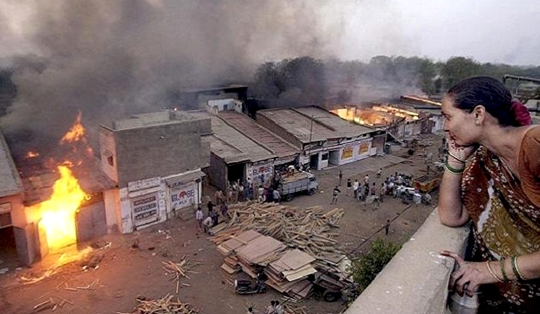
Ahmedabad, Jun 17: Calling the Gulberg massacre as the "darkest day" in the history of civil society, a special SIT court here today sentenced 11 convicts to life imprisonment in the case of burning alive of 69 people, including former Congress MP Eshan Jafri in the 2002 post-Godhra violence.
Gulberg1

Rejecting the demand for death sentence for all the convicts, the court said life imprisonment for the 11 will be till death if the state does not exercise power to remit the sentence.

The court awarded ten year jail term to one of the 13 convicted for lesser offences while 12 others have been given seven-year sentence each. The prosecution had argued that all the 24 convicts should be given death penalty.

While describing the massacre as the darkest day in the history of civil society, Special court Judge P B Desai refused death penalty saying, "If you look at all aspects, no previous antecedent has been placed on record".

Post the incident, 90 per cent of the accused were released on bail, yet no complaints against them have been given even by victims, and there is no record to show that they committed any offence during the time of bail, the judge further said, while giving reasons why he thought that this was not a fit case to give capital punishment to the convicts.

The court said it has decided to award imprisonment for life without any time frame to 11 accused, who have been convicted for murder, while requesting the state not to use its power to remit the sentence after 14 years of imprisonment.

"CrPC provisions give power to the state to remit sentence after 14 years jail, section 433-A imposes some restriction on that power. In case the state does not exercise power to remit the sentence, life imprisonment will mean that it is till death," the court said.

"I cannot add beyond what has been prescribed under section 302, it is not necessary for a state to exercise power to remit sentence, state may not exercise power of remittance," the judge said, adding the court's direction cannot be binding as he cannot take away the executive powers of the state.

As regards the 13 others accused convicted for lesser offences not including murder (302), the court awarded 10 years imprisonment to one Mangilal Jain, while 12 others were awarded seven-year sentence each.

The Gulberg Society massacre, which took place here on February 28, 2002 when Narendra Modi was the Gujarat Chief Minister, shook the nation when a mob of 400 people set about attacking the society in the heart of Ahmedabad and killed the residents including Jafri.

It was one of the nine cases of the 2002 Gujarat riots probed by the Supreme Court-appointed SIT.

"All the sentences will run concurrently as the Supreme Court has laid it down clearly that if the crime had single purpose, sentences given for different sections of IPC should run concurrently," the court said.

The prosecution and the victims had demanded that sentences awarded to all the accused should not run concurrently as all the 24 convicts will have to spend their entire life behind bars.

Earlier on June 2, the court had convicted 11 persons for murder and other offences, while 13 others, including VHP leader Atul Vaidya, were charged with lesser offences. It had acquitted 36 others in the case.

Those given life sentence in the case are - Kailash Dhobi, Yogendra Shekhawat, Jayesh Jingar, Krishna Kalal, Jayesh Parmar, Raju Tiwari, Bharat Rajput, Dinesh Sharma, Narayan Tank, Lakhansinh Chudasama and Bharat Taili.

One Mangilal Jain, who was convicted for lesser offence, has been sentenced to 10 years jail term.

Besides, VHP leader Atul Vaid, Mukesh Jingar, Prakash Padhiyar, Surendrasinh Chauhan, Dilip Parmar, Babu Marwadi, Manish Jain, Dharmesh Shukla, Kapil Mishra, Suresh Dhobi, Ambesh Jingar and Sandeep Punjabi have been sentenced to seven years imprisonment each.

During the argument on quantum of sentence, special public prosecutor and counsel for Supreme Court-appointed Special Investigation Team (SIT), R C Kodekar had asked the court for nothing less than death sentence or jail term till death for all 24 convicts.

Lawyer for the victims, S M Vora, also sought maximum punishment for the accused and argued that sentencing for each offence should not run concurrently so that they spend their entire life in jail.

However, lawyer of the accused, Abhay Bhardwaj, has refuted the demand of capital punishment or maximum punishment in his arguments saying that the incident was spontaneous and there were enough provocations for it.

The Gulberg society massacre was one of the nine cases of 2002 Gujarat riots probed by the SC-appointed SIT.

The incident had taken place a day after S-6 coach of Sabarmati Express was burnt near Godhra train station in which 58 'kar sevaks' returning from Ayodhya were killed.

During the course of trial, as many as 338 witnesses were cross-examined, with four different judges having presided over the case.

Comments

Ahmed Ali K
 - 
Friday, 17 Jun 2016

Death sentence?
for what?
Is he a non Hindu?

Jaleel S
 - 
Friday, 17 Jun 2016

Rarest of rare judgement...

Add new comment

  • Coastaldigest.com reserves the right to delete or block any comments.
  • Coastaldigset.com is not responsible for its readers’ comments.
  • Comments that are abusive, incendiary or irrelevant are strictly prohibited.
  • Please use a genuine email ID and provide your name to avoid reject.
News Network
June 23,2020

New Delhi, Jun 23: The meeting between Indian Army's 14 Corps Commander Lt Gen Harinder Singh and his Chinese counterpart got over after around 11 hours, sources said.

"Today's meeting between the Corps Commander-level officers of India and China is over. The meeting which started at 11:30 am went on for around 11 hours. More details awaited," sources said.

The meeting started at around 11:30 am at Moldo on the Chinese side of Line of Actual Control (LAC) opposite Chushul to defuse the tensions in Eastern Ladakh sector due to Chinese military build-up, the sources said.

This is the second meeting between the two corps commanders. They had met on June 6 and had agreed to disengage at multiple locations. India had asked the Chinese side to go back to pre-May 4 military positions along the LAC.

The Chinese side had not given any response to the Indian proposal and not even shown intent on the ground to withdraw troops from rear positions where they have amassed over 10,000 troops.

India is also likely to discuss the change in rules of engagement on the LAC where the forces have been empowered to use firearms in extraordinary circumstances, sources had said.

They said India will also ask China to honour the commitment given during June 6 talks to disengage in the Galwan valley completely and other places.

The build-up of Chinese air assets including strategic bombers by the PLA Air Force in fields near Indian territory close to Ladakh is also likely to figure in discussions.

India and China have been involved in talks to ease the ongoing border tensions since last month.

However, last week as many as 20 Indian soldiers lost their lives in the face-off in the Galwan Valley after an attempt by the Chinese troops to unilaterally change the status quo during the de-escalation in eastern Ladakh.

The Indian intercepts have revealed that the Chinese side suffered 43 casualties including dead and seriously injured in the violent clash.

Comments

Add new comment

  • Coastaldigest.com reserves the right to delete or block any comments.
  • Coastaldigset.com is not responsible for its readers’ comments.
  • Comments that are abusive, incendiary or irrelevant are strictly prohibited.
  • Please use a genuine email ID and provide your name to avoid reject.
Agencies
February 5,2020

New Delhi, Feb 5: Following is the chronology of events in the 2012 Nirbhaya gang rape and murder case in which the Delhi High Court on Wednesday said the all the four convicts have to be hanged together, not separately.

- Dec 16, 2012: Paramedical student gang-raped and brutally assaulted by six men in a private bus and thrown out of the moving vehicle along with her male friend. The victims admitted to Safdarjung Hospital.

- Dec 17: Widespread protests erupt demanding stringent action.

- Police identify the accused - bus driver Ram Singh, his brother Mukesh Kumar, Vinay Sharma and Pawan Gupta.

- Dec 18: Ram Singh and three others arrested.

- Dec 20: Victim's friend testifies.

- Dec 21: A delinquent juvenile nabbed from Anand Vihar bus terminal in Delhi. Victim's friend identifies Mukesh as one of the culprits. Police conduct raids in Haryana and Bihar to nab the sixth accused, Akshay Kumar.

- Dec 21-22: Akshay arrested in Aurangabad district of Bihar and brought to Delhi. Victim records statement before the SDM in hospital.

- Dec 26: Following a cardiac arrest, victim flown to Singapore's Mount Elizabeth Hospital by the government.

- Dec 29: Victim succumbs to injuries and other medical conditions. Police add murder charge in the FIR.

- Jan 2, 2013: The then Chief Justice of India Altamas Kabir inaugurates fast track court (FTC) for speedy trial in sexual offence cases.

- Jan 3: Police file charge sheet against five adults accused of murder, gang-rape, attempt to murder, kidnapping, unnatural offences and dacoity.

- Jan 17: FTC starts proceedings against the five adult accused.

- Jan 28: Juvenile Justice Board (JJB) says minority of the juvenile accused is proved.

- Feb 2: FTC frames charges against five adult accused.

- Feb 28: JJB frames charges against the minor.

- Mar 11: Ram Singh commits suicide in Tihar Jail.

- Jul 8: FTC completes recording of testimonies of prosecution witnesses.

- Jul 11: Delhi High Court allows three international news agencies to cover the trial in the case.

- Aug 22: FTC begins hearing final arguments in trial against four adult accused.

- Aug 31: JJB convicts the minor for gang-rape and murder and awards three-year term at probation home.

- Sep 3: FTC concludes trial. Reserves verdict.

- Sep 10: Court convicts Mukesh, Vinay, Akshay, Pawan of 13 offences including gang-rape, unnatural offence and murder of the girl and attempt to murder her male friend.

- Sep 13: Court awards death penalty to all 4 convicts.

- Sep 23: HC begins hearing the convicts' death sentence reference sent to it by the trial court.

- Jan 3, 2014: HC reserves verdict on convicts' appeals.

- Mar 13: HC upholds death penalty to the 4 convicts.

- Mar 15: SC stays execution of 2 convicts, Mukesh and Pawan, after they file appeals. Later, stays execution of other convicts also.

- Apr 15: SC directs police to produce the dying declaration of the victim.

- Feb 3, 2017: SC says it would hear afresh the aspect of awarding death penalty to the convicts.

- Mar 27: SC reserves verdict on their appeals.

- May 5: SC upholds death penalty to four convicts, says the case falls under the category of 'rarest of rare' and the offence created "tsunami of shock".

- Nov 8: Mukesh, one of the four death row convicts in the case, moves SC seeking review of its verdict upholding the capital punishment awarded to him.

- Dec 12: Delhi Police opposes Mukesh's plea in SC.

- Dec 15: Convicts Vinay Sharma and Pawan Kumar Gupta move SC for review of its verdict.

- May 4, 2018: SC reserves order on review plea of Vinay and Pawan.

- Jul 9: SC dismisses review pleas of three convicts.

- Feb, 2019: Victim's parents move Delhi court for issuance of death warrants of the four convicts

- Dec 10, 2019: Akshay moves plea in SC seeking review of his death penalty.

- Dec 13: Victim's mother moves SC opposing review plea of convict

- Dec 18: SC dismisses Akshay's review plea.

- Delhi govt seeks death warrants for execution of death sentence to the 4 convicts

- Delhi court directs Tihar authorities to issue notice to convicts to avail their remaining legal remedies.

- Dec 19: Delhi HC dismisses plea of Pawan Kumar Gupta claiming he was a juvenile at the time of the offence.

- Jan 6, 2020: Delhi court dismisses complaint filed by Pawan's father seeking FIR against sole witness

- Jan 7: Delhi court orders 4 convicts to be hanged on January 22 at 7 am in Tihar jail.

- Jan 14: SC rejects curative petition of Vinay and Mukesh Kumar.

Mukesh files mercy petition before President

- Jan 17: President Ram Nath Kovind rejects mercy plea of Mukesh.

- Trial court issues death warrants again with execution date as February 1, 6 am.

- Jan 25: Mukesh moves SC against rejection of mercy plea.

- Jan 28: SC hears arguments, reserves verdict

- Jan 29: Convict Akshya Kumar approaches SC with curative petition

- SC rejects plea of Mukesh challenging rejection of his mercy plea.

- Jan 30: SC dismisses curative plea of Akshay Kumar Singh.

- Jan 31: SC dismisses plea filed by Pawan seeking review of its order rejecting his juvenility claim.

- Delhi court again postpones execution of the black warrants till further order.

- Feb 1: Centre moves HC against the trial court order.

- Feb 2: HC reserves judgement on Centre's plea.

- Feb 5: HC dismisses Centre plea against trial court order; says all 4 convicts have to be hanged together. It directs the convicts to pursue all legal remedies within a week, failing which the authorities ordered to take action in accordance with law.

Comments

Add new comment

  • Coastaldigest.com reserves the right to delete or block any comments.
  • Coastaldigset.com is not responsible for its readers’ comments.
  • Comments that are abusive, incendiary or irrelevant are strictly prohibited.
  • Please use a genuine email ID and provide your name to avoid reject.
News Network
February 14,2020

London, Feb 14: Liquor tycoon Vijay Mallya once again asked the Indian banks to take back 100 per cent of the principal amount owed to them at the end of his three-day British High Court appeal on Thursday against an extradition order to India.

The 64-year-old former Kingfisher Airlines boss, wanted in India on charges of fraud and money laundering amounting to an alleged Rs 9,000 crores in unpaid bank loans, said the Enforcement Directorate (ED) and the Central Bureau of Investigation (CBI) are fighting over the same assets and not treating him reasonably in the process.

“I request the banks with folded hands, take 100 per cent of your principal back, immediately,” he said outside the Royal Courts of Justice in London.

“The Enforcement Directorate attached the assets on the complaint by the banks that I was not paying them. I have not committed any offenses under the PMLA (Prevention of Money Laundering Act) that the Enforcement Directorate should suo moto attach my assets," he said.

"I am saying, please banks take your money. The ED is saying no, we have a claim over these assets. So, the ED on the one side and the banks on the other are fighting over the same assets,” he added.

Asked about heading back to India, he noted: “I should be where my family is, where my interests are.

"If the CBI and the ED are going to be reasonable, it’s a different story. What all they are doing to me for the last four years is totally unreasonable.”

Lord Justice Stephen Irwin and Justice Elisabeth Laing, the two-member bench presiding over the appeal, concluded hearing the arguments in the case and said they will be handing down their verdict at a later date after considering the oral as well as written submissions in the “very dense” case over the next few weeks.

On a day of heated arguments between Mallya’s barrister, Clare Montgomery, and Crown Prosecution Service (CPS) counsel Mark Summers, arguing on behalf of the Indian government, both sides clashed over the prima facie case of fraud and deception against Mallya.

“We submit that he lied to get the loans, then did something with the money he wasn’t supposed to and then refused to give back the money. All this could be perceived by a jury as patently dishonest conduct,” said Summers.

“What they [Kingfisher Airlines] were saying [to the banks] about profitability going forward was knowingly wrong,” he said, as he took the High Court through evidence to counter Mallya’s lawyers’ claims that Westminster Magistrates Court Judge Emma Arbuthnot had fallen into error when she found a case to answer in the Indian courts against Mallya.

Mallya, who remains on bail on an extradition warrant, is not required to attend the hearings but has been in court to observe the proceedings since the three-day appeal opened on Tuesday. A key defence to disprove a prima facie case of fraud and misrepresentation on his part has revolved around the fact that Kingfisher Airlines was the victim of economic misfortune alongside other Indian airlines.

However, the CPS has argued that “there is enough in the 32,000 pages of overall evidence to fulfil the [extradition] treaty obligations that there is a case to answer”. “There is not just a prima facie case but overwhelming evidence of dishonesty… and given the volume and depth of evidence the District Judge [Arbuthnot] had before her, the judgment is comprehensive and detailed with the odd error but nothing that impacts the prima facie case,” said Summers.

At the start of the appeal, Mallya’s counsel claimed Arbuthnot did not look at all of the evidence because if she had, she would not have fallen into the multiple errors that permeate her judgment. The High Court must establish if the magistrates’ court had in fact fallen short on a point of law in its verdict in favour of extradition.

Representatives from the Enforcement Directorate (ED) and Central Bureau of Investigation (CBI), as well as the Indian High Commission in London, have been present in court to take notes during the course of the appeal hearing.

Mallya had received permission to appeal against his extradition order signed off by former UK home secretary Sajid Javid last February only on one ground, which challenges the Indian government's prima facie case against him of fraudulent intentions in acquiring bank loans.

At the end of a year-long extradition trial at Westminster Magistrates’ Court in London in December 2018, Judge Arbuthnot had found “clear evidence of dispersal and misapplication of the loan funds” and accepted a prima facie case of fraud and a conspiracy to launder money against Mallya, as presented by the CPS on behalf of the Indian government.

Mallya remains on bail since his arrest on an extradition warrant in April 2017 involving a bond worth 650,000 pounds and other restrictions on his travel while he contests that ruling.

Comments

Add new comment

  • Coastaldigest.com reserves the right to delete or block any comments.
  • Coastaldigset.com is not responsible for its readers’ comments.
  • Comments that are abusive, incendiary or irrelevant are strictly prohibited.
  • Please use a genuine email ID and provide your name to avoid reject.