


11 get life term in Gulberg society massacre case

June 17, 2016

Ahmedabad, Jun 17: Calling the Gulberg massacre as the "darkest day" in the history of civil society, a special SIT court here today sentenced 11 convicts to life imprisonment in the case of burning alive of 69 people, including former Congress MP Eshan Jafri in the 2002 post-Godhra violence.
Gulberg1

Rejecting the demand for death sentence for all the convicts, the court said life imprisonment for the 11 will be till death if the state does not exercise power to remit the sentence.

The court awarded ten year jail term to one of the 13 convicted for lesser offences while 12 others have been given seven-year sentence each. The prosecution had argued that all the 24 convicts should be given death penalty.

While describing the massacre as the darkest day in the history of civil society, Special court Judge P B Desai refused death penalty saying, "If you look at all aspects, no previous antecedent has been placed on record".

Post the incident, 90 per cent of the accused were released on bail, yet no complaints against them have been given even by victims, and there is no record to show that they committed any offence during the time of bail, the judge further said, while giving reasons why he thought that this was not a fit case to give capital punishment to the convicts.

The court said it has decided to award imprisonment for life without any time frame to 11 accused, who have been convicted for murder, while requesting the state not to use its power to remit the sentence after 14 years of imprisonment.

"CrPC provisions give power to the state to remit sentence after 14 years jail, section 433-A imposes some restriction on that power. In case the state does not exercise power to remit the sentence, life imprisonment will mean that it is till death," the court said.

"I cannot add beyond what has been prescribed under section 302, it is not necessary for a state to exercise power to remit sentence, state may not exercise power of remittance," the judge said, adding the court's direction cannot be binding as he cannot take away the executive powers of the state.

As regards the 13 others accused convicted for lesser offences not including murder (302), the court awarded 10 years imprisonment to one Mangilal Jain, while 12 others were awarded seven-year sentence each.

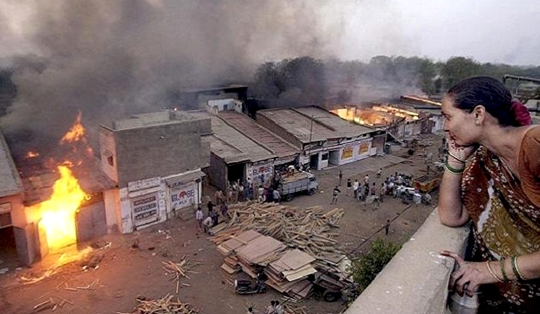
The Gulberg Society massacre, which took place here on February 28, 2002 when Narendra Modi was the Gujarat Chief Minister, shook the nation when a mob of 400 people set about attacking the society in the heart of Ahmedabad and killed the residents including Jafri.

It was one of the nine cases of the 2002 Gujarat riots probed by the Supreme Court-appointed SIT.

"All the sentences will run concurrently as the Supreme Court has laid it down clearly that if the crime had single purpose, sentences given for different sections of IPC should run concurrently," the court said.

The prosecution and the victims had demanded that sentences awarded to all the accused should not run concurrently as all the 24 convicts will have to spend their entire life behind bars.

Earlier on June 2, the court had convicted 11 persons for murder and other offences, while 13 others, including VHP leader Atul Vaidya, were charged with lesser offences. It had acquitted 36 others in the case.

Those given life sentence in the case are - Kailash Dhobi, Yogendra Shekhawat, Jayesh Jingar, Krishna Kalal, Jayesh Parmar, Raju Tiwari, Bharat Rajput, Dinesh Sharma, Narayan Tank, Lakhansinh Chudasama and Bharat Taili.

One Mangilal Jain, who was convicted for lesser offence, has been sentenced to 10 years jail term.

Besides, VHP leader Atul Vaid, Mukesh Jingar, Prakash Padhiyar, Surendrasinh Chauhan, Dilip Parmar, Babu Marwadi, Manish Jain, Dharmesh Shukla, Kapil Mishra, Suresh Dhobi, Ambesh Jingar and Sandeep Punjabi have been sentenced to seven years imprisonment each.

During the argument on quantum of sentence, special public prosecutor and counsel for Supreme Court-appointed Special Investigation Team (SIT), R C Kodekar had asked the court for nothing less than death sentence or jail term till death for all 24 convicts.

Lawyer for the victims, S M Vora, also sought maximum punishment for the accused and argued that sentencing for each offence should not run concurrently so that they spend their entire life in jail.

However, lawyer of the accused, Abhay Bhardwaj, has refuted the demand of capital punishment or maximum punishment in his arguments saying that the incident was spontaneous and there were enough provocations for it.

The Gulberg society massacre was one of the nine cases of 2002 Gujarat riots probed by the SC-appointed SIT.

The incident had taken place a day after S-6 coach of Sabarmati Express was burnt near Godhra train station in which 58 'kar sevaks' returning from Ayodhya were killed.

During the course of trial, as many as 338 witnesses were cross-examined, with four different judges having presided over the case.

Comments

Ahmed Ali K
 - 
Friday, 17 Jun 2016

Death sentence?
for what?
Is he a non Hindu?

Jaleel S
 - 
Friday, 17 Jun 2016

Rarest of rare judgement...

Add new comment

  • Coastaldigest.com reserves the right to delete or block any comments.
  • Coastaldigset.com is not responsible for its readers’ comments.
  • Comments that are abusive, incendiary or irrelevant are strictly prohibited.
  • Please use a genuine email ID and provide your name to avoid reject.
News Network
April 14,2020

Thiruvananthapuram, Apr 14: The Kerala government on Monday requested Prime Minister Narendra Modi to arrange special flights to the Gulf to bring back non resident Keralites stranded there due to the lockdown.

In a letter to Modi, Chief Minister Pinarayi Vijayan said many Keralites who had gone on visit visas and in search of employment were finding it difficult to continue there without jobs.

"While we appreciate the constraints faced in allowing international travel as the threat of COVID-19 has not yet receded, it is requested that special consideration to their needs be given and at an earliest opportune time, the Government of India consider arranging special flights to bring these people back," Vijayan said in the letter.

All International health protocols can be followed while extending this facility, he said and assured that testing and quarantine needs of Keralites who are returning would be undertaken by the state government. During the video conferencing the Prime Minister had with Chief Ministers on April 11, this matter had been broght to Modi's notice, Vijayan said.

Comments

Add new comment

  • Coastaldigest.com reserves the right to delete or block any comments.
  • Coastaldigset.com is not responsible for its readers’ comments.
  • Comments that are abusive, incendiary or irrelevant are strictly prohibited.
  • Please use a genuine email ID and provide your name to avoid reject.
News Network
February 6,2020

Feb 6: India has been ranked 40th out of 53 countries on a global intellectual property index, even as the country has shown improvement in terms of scores when it comes to the protection of IP and copyright issues, a top American industry body said on Wednesday.

India was placed at 36th position among 50 countries in 2019.

India's score, however, increased from 36.04 per cent (16.22 out of 45) in 2019 to 38.46 per cent (19.23 out of 50) in 2020, a 2.42 per cent jump in an absolute score.

However, India's relative score increased by 6.71 per cent, according to the International IP Index released by Global Innovation Policy Center or GIPC of the US Chambers of Commerce.

This year, it finds itself on the 40th place among 53 countries. Two new Index economies (Greece and the Dominican Republic) scored ahead of India. The Philippines, and Ukraine leapfrogged India.

"Since the release of the 2016 National IPR Policy, the government of India has made a focused effort to support investments in innovation and creativity through increasingly robust IP protection and enforcement," the GIPC said.

Since 2016, India has improved the speed of processing for patent and trademark applications, increased awareness of IP rights among Indian innovators and creators, and facilitated the registration and enforcement of those rights, it added.

According to the eighth edition of the annual report, India's score on the Chamber's International IP Index demonstrates the country's growing investment in IP-driven innovation and creativity. The Index specifically highlights a number of reforms over the last year that strengthen India's overall IP ecosystem, it said.

"In 2019, the Delhi High Court used dynamic injunctions to disable access to copyright-infringing content online, resulting in an increase in India's score on two of the copyright-related indicators," it said.

"The use of these injunctions places India alongside global leaders in copyright enforcement, including Singapore and the UK. As a result, India scores ahead of 24 other economies in the copyright indicators," the report said.

The Delhi High Court also issued a series of judgements that provide clarity on existing statutes related to trademark protection online, resulting in a score increase on one of the trademark-related indicators, it added.

The courts issued two precedential rulings that raised the bar for the damages awarded in IP-infringement cases and may provide a deterrent for future infringement. This resulted in an increase in score on one of the trademark-related indicators, it said.

Global Innovation Policy Center or GIPC said India also continues to score well in the Systemic Efficiency indicator, scoring ahead of 28 other economies in these indicators.

"This is a result of a concerted effort by the Indian government to consult with stakeholders during IP policy formation and create greater awareness about the importance of IP protection,” it said adding that India also remains a leader in the use of targeted incentives and IP assets for small and medium-sized enterprises (SMEs).

“To continue this upward trajectory, much work remains to be done to introduce transformative changes to India’s overall IP framework and take serious steps to consistently implement strong IP standards," the report said.

GIPC has identified several challenges for India. Prominent among them being patentability requirements, patent enforcement, compulsory licensing, patent opposition, regulatory data protection, transparency in reporting seizures by customs, and Singapore Treaty of Law of TMs and Patent Law Treaty.

"We are encouraged that Indian policymakers seem to recognize this Index as a valuable resource in their efforts to strengthen the country’s promising innovation ecosystem and enhance its competitiveness in an increasingly knowledge-based global economy,” the report said.

Observing that no other economy stands to gain more from strong Indian IP than India itself, the report said for example, no industry has been hurt more by copyright violations in India than the country’s own Bollywood industry, which loses almost USD3 billion to piracy each year.

"The number one way the Modi administration can demonstrate its commitment to the success of the Atal Innovation Mission, Accelerating Growth for New India’s Innovations, Make in India, Digital India, and Startup India is to strengthen its IP framework in ways that promote the legal and regulatory certainty necessary for greater R&D investment, high-value jobs, and greater innovative and creative outputs,” it said.

"Strong IP standards can further solidify India's position as the world’s fastest-growing economy, bolstering its reputation as a destination for doing business, foreign businesses’ ability to invest and make in India, thereby supporting the growth of India’s own innovative and creative industries," the report said.

Comments

Add new comment

  • Coastaldigest.com reserves the right to delete or block any comments.
  • Coastaldigset.com is not responsible for its readers’ comments.
  • Comments that are abusive, incendiary or irrelevant are strictly prohibited.
  • Please use a genuine email ID and provide your name to avoid reject.
News Network
February 24,2020

New Delhi, Feb 24: The shared values between India and the US are "discrimination, bigotry, and hostility towards refugees and asylum seekers", Amnesty International USA said in a joint statement with Amnesty International India ahead of US President Donald Trump's visit to India on Monday.

Trump, accompanied by his wife Melania, daughter Ivanka and son-in-law Jared Kushner as well as senior officials of his administration, landed in Ahmedabad on the first leg of his two-day visit to India.

"Anti-Muslim sentiment permeates the policies of both U.S. and Indian leaders. For decades, the U.S.-India relationship was anchored by claims of shared values of human rights and human dignity. Now, those shared values are discrimination, bigotry, and hostility towards refugees and asylum seekers,” Margaret Huang, Amnesty International USA’s executive director, was quoted as saying in the statement.

It was a reference to the anti-CAA protests in India, the internet lockdown in Jammu and Kashmir and the Muslim ban expansion by President Trump affecting Nigeria, Eritrea, Myanmar, Kyrgyzstan, Sudan and Tanzania, the statement said.

It added that Amnesty International USA’s researchers travelled to Lebanon and Jordan to conduct nearly 50 interviews with refugees that as a result of the previous version of the ban have been stranded in countries where they face restrictive policies, increasingly hostile environments, and lack the same rights as permanent residents or citizens.

The statement also came down hard on the Indian government, hitting out at the Citizenship (Amendment) Act (CAA) 2019 and saying it legitimises discrimination based on religious grounds.

It criticised statements such as “identify them (the protestors) by their clothes” or “shoot the traitors” by Prime Minister Modi and his party workers. Such remarks "peddled the narrative of fear and division that has fuelled further violence", it said.

“The internet and political lockdown in Kashmir has lasted for months and the enactment of CAA and the crackdown on protests has shown a leadership that is lacking empathy and a willingness to engage. We call on President Trump and Prime Minister Modi to work with the international community and address our concerns in their bilateral conversations,” Avinash Kumar, executive director, Amnesty International India said in the statement.

Comments

Add new comment

  • Coastaldigest.com reserves the right to delete or block any comments.
  • Coastaldigset.com is not responsible for its readers’ comments.
  • Comments that are abusive, incendiary or irrelevant are strictly prohibited.
  • Please use a genuine email ID and provide your name to avoid reject.