


11 get life term in Gulberg society massacre case

June 17, 2016

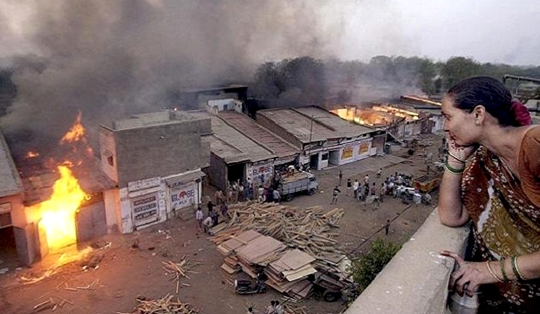
Ahmedabad, Jun 17: Calling the Gulberg massacre as the "darkest day" in the history of civil society, a special SIT court here today sentenced 11 convicts to life imprisonment in the case of burning alive of 69 people, including former Congress MP Eshan Jafri in the 2002 post-Godhra violence.
Gulberg1

Rejecting the demand for death sentence for all the convicts, the court said life imprisonment for the 11 will be till death if the state does not exercise power to remit the sentence.

The court awarded ten year jail term to one of the 13 convicted for lesser offences while 12 others have been given seven-year sentence each. The prosecution had argued that all the 24 convicts should be given death penalty.

While describing the massacre as the darkest day in the history of civil society, Special court Judge P B Desai refused death penalty saying, "If you look at all aspects, no previous antecedent has been placed on record".

Post the incident, 90 per cent of the accused were released on bail, yet no complaints against them have been given even by victims, and there is no record to show that they committed any offence during the time of bail, the judge further said, while giving reasons why he thought that this was not a fit case to give capital punishment to the convicts.

The court said it has decided to award imprisonment for life without any time frame to 11 accused, who have been convicted for murder, while requesting the state not to use its power to remit the sentence after 14 years of imprisonment.

"CrPC provisions give power to the state to remit sentence after 14 years jail, section 433-A imposes some restriction on that power. In case the state does not exercise power to remit the sentence, life imprisonment will mean that it is till death," the court said.

"I cannot add beyond what has been prescribed under section 302, it is not necessary for a state to exercise power to remit sentence, state may not exercise power of remittance," the judge said, adding the court's direction cannot be binding as he cannot take away the executive powers of the state.

As regards the 13 others accused convicted for lesser offences not including murder (302), the court awarded 10 years imprisonment to one Mangilal Jain, while 12 others were awarded seven-year sentence each.

The Gulberg Society massacre, which took place here on February 28, 2002 when Narendra Modi was the Gujarat Chief Minister, shook the nation when a mob of 400 people set about attacking the society in the heart of Ahmedabad and killed the residents including Jafri.

It was one of the nine cases of the 2002 Gujarat riots probed by the Supreme Court-appointed SIT.

"All the sentences will run concurrently as the Supreme Court has laid it down clearly that if the crime had single purpose, sentences given for different sections of IPC should run concurrently," the court said.

The prosecution and the victims had demanded that sentences awarded to all the accused should not run concurrently as all the 24 convicts will have to spend their entire life behind bars.

Earlier on June 2, the court had convicted 11 persons for murder and other offences, while 13 others, including VHP leader Atul Vaidya, were charged with lesser offences. It had acquitted 36 others in the case.

Those given life sentence in the case are - Kailash Dhobi, Yogendra Shekhawat, Jayesh Jingar, Krishna Kalal, Jayesh Parmar, Raju Tiwari, Bharat Rajput, Dinesh Sharma, Narayan Tank, Lakhansinh Chudasama and Bharat Taili.

One Mangilal Jain, who was convicted for lesser offence, has been sentenced to 10 years jail term.

Besides, VHP leader Atul Vaid, Mukesh Jingar, Prakash Padhiyar, Surendrasinh Chauhan, Dilip Parmar, Babu Marwadi, Manish Jain, Dharmesh Shukla, Kapil Mishra, Suresh Dhobi, Ambesh Jingar and Sandeep Punjabi have been sentenced to seven years imprisonment each.

During the argument on quantum of sentence, special public prosecutor and counsel for Supreme Court-appointed Special Investigation Team (SIT), R C Kodekar had asked the court for nothing less than death sentence or jail term till death for all 24 convicts.

Lawyer for the victims, S M Vora, also sought maximum punishment for the accused and argued that sentencing for each offence should not run concurrently so that they spend their entire life in jail.

However, lawyer of the accused, Abhay Bhardwaj, has refuted the demand of capital punishment or maximum punishment in his arguments saying that the incident was spontaneous and there were enough provocations for it.

The Gulberg society massacre was one of the nine cases of 2002 Gujarat riots probed by the SC-appointed SIT.

The incident had taken place a day after S-6 coach of Sabarmati Express was burnt near Godhra train station in which 58 'kar sevaks' returning from Ayodhya were killed.

During the course of trial, as many as 338 witnesses were cross-examined, with four different judges having presided over the case.

Comments

Ahmed Ali K
 - 
Friday, 17 Jun 2016

Death sentence?
for what?
Is he a non Hindu?

Jaleel S
 - 
Friday, 17 Jun 2016

Rarest of rare judgement...

Add new comment

  • Coastaldigest.com reserves the right to delete or block any comments.
  • Coastaldigset.com is not responsible for its readers’ comments.
  • Comments that are abusive, incendiary or irrelevant are strictly prohibited.
  • Please use a genuine email ID and provide your name to avoid reject.
News Network
May 4,2020

Munbai/New Delhi, May 4: India expects bad debts at its banks could double after the coronavirus crisis brought the economy to a sudden halt, a senior government official and four top bankers said.

Indian banks are already grappling with 9.35 trillion rupees ($123 billion) of soured loans, which was equivalent to about 9.1% of their total assets at the end of September 2019.

"There is a considered view in the government that bank non-performing assets (NPAs) could double to 18-20% by the end of the fiscal year, as 20-25% of outstanding loans face a risk of default," the official with direct knowledge of the matter said.

A fresh surge in bad debt could hit credit growth and delay India's recovery from the coronavirus pandemic.

"These are unprecedented times and the way it's going we can expect banks to report double the amount of NPAs from what we've seen in earlier quarters," the finance head of a top public sector bank told Reuters.

The official and bankers declined to be named as they were not officially authorized to discuss the matter with media.

India's finance ministry declined to comment, while the Reserve Bank of India and Indian Banks' Association, the main industry body, did not immediately respond to emails seeking comment.

The Indian economy has ground to a standstill amid a 40-day nationwide lockdown to rein in the spread of coronavirus cases.

The lockdown has now been extended by a further two weeks, but the government has begun to ease some restrictions in districts that are relatively unscathed by the virus.

India has so far recorded nearly 40,000 cases of the coronavirus and more than 1,300 deaths from COVID-19, the respiratory disease caused by the coronavirus.

'RIDING THE TIGER'

Bankers fear it is unlikely that the economy will fully open up before June or July, and loans, especially those to small- and medium-sized businesses which constitute nearly 20% of overall credit, may be among the worst affected.

This is because all 10 of India's largest cities fall in high-risk red zones, where restrictions will remain stringent.

A report by Axis Bank said that these red zones, which contribute significantly to India's economy, account for roughly 83% of the overall loans made by its banks as of December.

One of the sources, an executive director of a public sector bank, said that economic growth had been sluggish and risks had been heightened, even ahead of the coronavirus crisis.

"Now we have this Black Swan event which means without any meaningful government stimulus, the economy will be in tatters for several more quarters," he said.

McKinsey & Co last month forecast India's economy could contract by around 20% in the three months through June, if the lockdown was extended to mid-May, and growth in the fiscal year was likely to fall 2% to 3%.

Bankers say the only way to stem the steep rise in bad loans is if the RBI significantly relaxes bad asset recognition rules.

Banks have asked the central bank to allow all loans to be categorized as NPAs only after 180 days, which is double the current 90-day window.

"The lockdown is like riding the tiger, once we get off it we'll be in a difficult position," a senior private sector banker said.

Comments

Add new comment

  • Coastaldigest.com reserves the right to delete or block any comments.
  • Coastaldigset.com is not responsible for its readers’ comments.
  • Comments that are abusive, incendiary or irrelevant are strictly prohibited.
  • Please use a genuine email ID and provide your name to avoid reject.
News Network
April 5,2020

New Delhi, Apr 5: Joining efforts to fight COVID-19, the Defence Research and Development Organisation (DRDO) has designed a full-body disinfection chamber and a special face protection mask for healthcare professionals, officials said.

The special chamber called 'PSE' has been designed by Vehicle Research Development Establishment (VRDE), Ahmednagar, a DRDO Laboratory.

The walk through enclosure is designed for personnel decontamination, one person at a time. It is a portable system equipped with sanitiser and soap dispenser, officials said.

The decontamination is started using a foot pedal at the entry. On entering the chamber, electrically-operated pump creates a disinfectant mist of hypo sodium chloride for disinfecting, the DRDO said in a statement.

The mist spray is calibrated for an operation of 25 seconds and stops automatically indicating completion of operation. As per procedure, personnel undergoing disinfection will need to keep their eyes closed while inside the chamber, it said.

The system consists of roof mounted and bottom tanks with a total of 700 litres capacity. Approximately 650 personnel can pass through the chamber for disinfection until the refill is required, the DRDO said.

The system has see-through glass panels on side walls for monitoring purpose and is fitted with lights for illumination during night-time operations, it added.

This system can be used for disinfection of personnel at the areas of controlled ingress and egress such as entry and exit to hospitals, malls, office buildings and critical installations, officials said.

Also, Research Centre Imarat (RCI), Hyderabad, and Terminal Ballistics Research Laboratory (TBRL), Chandigarh, have developed face protection mask for healthcare professionals handling COVID-19 patients, the DRDO added.

Its light weight construction makes it convenient for comfortable wear for long duration. This design uses commonly available A4 size Over-Head Projection (OHP) film for face protection, it said.

One thousand face shields are being produced daily in TBRL and provided to Postgraduate Institute of Medical Education and Research (PGIMER), Chandigarh, it said.

Similarly, 100 are produced at RCI and these have been handed over to Employees' State Insurance Corporation (ESIC), Hyderabad. A demand of 10,000 shields has been received from PGIMER and ESIC hospitals based on successful user trials, the DRDO added.

Comments

Add new comment

  • Coastaldigest.com reserves the right to delete or block any comments.
  • Coastaldigset.com is not responsible for its readers’ comments.
  • Comments that are abusive, incendiary or irrelevant are strictly prohibited.
  • Please use a genuine email ID and provide your name to avoid reject.
Agencies
February 7,2020

Thiruvananthapuram, Feb 7: Kerala Finance Minister T M Thomas Isaac on Friday began presenting the fifth budget of the CPI(M)-led LDF government for the 2020-21 fiscal by making remarks against the Citizenship Amendment Act and the unanimous resolution passed by the state assembly against it.

Stating the amended act was posing a threat to the basic credentials of the Constitution, he said the country was witnessing the biggest protests ever in the post-Independence era.

Students and women are at the forefront of the anti- CAA agitations and the hope of the country lies in the youth who hit the streets vowing they would not let the country down, he said.

Coming down heavily on the BJP-led NDA government at the Centre, Isaac said a communalised government machinery, leaders who talk only about "disgust and hatred" and their party workers who consider violence as their duty was the current reality in the country.

"Generally speaking, it is the present India...The concerns triggered by Citizenship Amendment Act (CAA) and the National Register of Citizens (NRC) are beyond words. The fear of detention centres are hanging above the head of over 19 lakh people of Assam who have lived as Indians till yesterday," he said.

Quoting from a poem 'Fear' by a 15-year old boy from Wayanad Dhruvath Gautham who wrote 'fear is country and silence is an ornament!,' Isaac said "even the imagination of our children is now filled with fear".

Referring to the stringent opposition raised by the Left government in the state against the CAA and NRC, the finance minister lavished praise on the joint protests led by the ruling LDF and opposition UDF against the central act.

Setting aside political differences, the rival fronts in the state had joined hands to protest when the country had faced existential threat which had become a model for other states, he said.

When Chief Minister Pinarayi Vijayan and Leader of the Opposition Ramesh Chennithala jointly protested at the same venue against CAA, Kerala became a model to other states, the senior leader added.

The state showcased the same unity while passing a resolution requesting the centre to repeal the CAA and filing a suit in the apex court against this under the Article 130, he said.

"The country's economy is heading towards a severe economic crisis like that witnessed in 2009," he said.

Earlier, the references to anti-CAA protests had found a place in the Pinarayi Vijayan government's policy address also.

While presenting the policy address in the House, Governor Arif Mohammed Khan had read out references to anti- CAA resolution passed by the house, despite disagreeing with it.

Reading out the the anti-CAA stand of the state government, the Governor said "our citizenship can never be on the basis of religion as this goes against the grain of secularism which is part of the basic structure of our constitution.

Comments

Add new comment

  • Coastaldigest.com reserves the right to delete or block any comments.
  • Coastaldigset.com is not responsible for its readers’ comments.
  • Comments that are abusive, incendiary or irrelevant are strictly prohibited.
  • Please use a genuine email ID and provide your name to avoid reject.