


11 get life term in Gulberg society massacre case

June 17, 2016

Ahmedabad, Jun 17: Calling the Gulberg massacre as the "darkest day" in the history of civil society, a special SIT court here today sentenced 11 convicts to life imprisonment in the case of burning alive of 69 people, including former Congress MP Eshan Jafri in the 2002 post-Godhra violence.
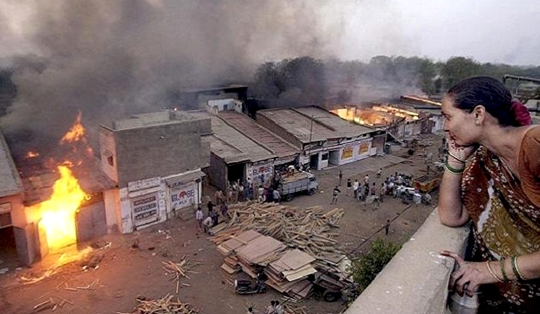
Gulberg1

Rejecting the demand for death sentence for all the convicts, the court said life imprisonment for the 11 will be till death if the state does not exercise power to remit the sentence.

The court awarded ten year jail term to one of the 13 convicted for lesser offences while 12 others have been given seven-year sentence each. The prosecution had argued that all the 24 convicts should be given death penalty.

While describing the massacre as the darkest day in the history of civil society, Special court Judge P B Desai refused death penalty saying, "If you look at all aspects, no previous antecedent has been placed on record".

Post the incident, 90 per cent of the accused were released on bail, yet no complaints against them have been given even by victims, and there is no record to show that they committed any offence during the time of bail, the judge further said, while giving reasons why he thought that this was not a fit case to give capital punishment to the convicts.

The court said it has decided to award imprisonment for life without any time frame to 11 accused, who have been convicted for murder, while requesting the state not to use its power to remit the sentence after 14 years of imprisonment.

"CrPC provisions give power to the state to remit sentence after 14 years jail, section 433-A imposes some restriction on that power. In case the state does not exercise power to remit the sentence, life imprisonment will mean that it is till death," the court said.

"I cannot add beyond what has been prescribed under section 302, it is not necessary for a state to exercise power to remit sentence, state may not exercise power of remittance," the judge said, adding the court's direction cannot be binding as he cannot take away the executive powers of the state.

As regards the 13 others accused convicted for lesser offences not including murder (302), the court awarded 10 years imprisonment to one Mangilal Jain, while 12 others were awarded seven-year sentence each.

The Gulberg Society massacre, which took place here on February 28, 2002 when Narendra Modi was the Gujarat Chief Minister, shook the nation when a mob of 400 people set about attacking the society in the heart of Ahmedabad and killed the residents including Jafri.

It was one of the nine cases of the 2002 Gujarat riots probed by the Supreme Court-appointed SIT.

"All the sentences will run concurrently as the Supreme Court has laid it down clearly that if the crime had single purpose, sentences given for different sections of IPC should run concurrently," the court said.

The prosecution and the victims had demanded that sentences awarded to all the accused should not run concurrently as all the 24 convicts will have to spend their entire life behind bars.

Earlier on June 2, the court had convicted 11 persons for murder and other offences, while 13 others, including VHP leader Atul Vaidya, were charged with lesser offences. It had acquitted 36 others in the case.

Those given life sentence in the case are - Kailash Dhobi, Yogendra Shekhawat, Jayesh Jingar, Krishna Kalal, Jayesh Parmar, Raju Tiwari, Bharat Rajput, Dinesh Sharma, Narayan Tank, Lakhansinh Chudasama and Bharat Taili.

One Mangilal Jain, who was convicted for lesser offence, has been sentenced to 10 years jail term.

Besides, VHP leader Atul Vaid, Mukesh Jingar, Prakash Padhiyar, Surendrasinh Chauhan, Dilip Parmar, Babu Marwadi, Manish Jain, Dharmesh Shukla, Kapil Mishra, Suresh Dhobi, Ambesh Jingar and Sandeep Punjabi have been sentenced to seven years imprisonment each.

During the argument on quantum of sentence, special public prosecutor and counsel for Supreme Court-appointed Special Investigation Team (SIT), R C Kodekar had asked the court for nothing less than death sentence or jail term till death for all 24 convicts.

Lawyer for the victims, S M Vora, also sought maximum punishment for the accused and argued that sentencing for each offence should not run concurrently so that they spend their entire life in jail.

However, lawyer of the accused, Abhay Bhardwaj, has refuted the demand of capital punishment or maximum punishment in his arguments saying that the incident was spontaneous and there were enough provocations for it.

The Gulberg society massacre was one of the nine cases of 2002 Gujarat riots probed by the SC-appointed SIT.

The incident had taken place a day after S-6 coach of Sabarmati Express was burnt near Godhra train station in which 58 'kar sevaks' returning from Ayodhya were killed.

During the course of trial, as many as 338 witnesses were cross-examined, with four different judges having presided over the case.

Comments

Ahmed Ali K
 - 
Friday, 17 Jun 2016

Death sentence?
for what?
Is he a non Hindu?

Jaleel S
 - 
Friday, 17 Jun 2016

Rarest of rare judgement...

Add new comment

  • Coastaldigest.com reserves the right to delete or block any comments.
  • Coastaldigset.com is not responsible for its readers’ comments.
  • Comments that are abusive, incendiary or irrelevant are strictly prohibited.
  • Please use a genuine email ID and provide your name to avoid reject.
Agencies
June 8,2020

Lucknow, Jun 8: The coronavirus which has now been assigned a gender, is being worshipped in Uttar Pradesh also after Bihar as superstition run deep. Women in some villages in Tumkuhiraj, Kasia, Hata, Captanganj and Khadda tehsil in Kushinagar district have started worshipping 'Corona Mai' and are pleading with her to spare lives.

These women have dug a small pit in the field, filled it with water and each one offers nine cloves and nine 'laddoos' to 'Corona Mai' to appease her.

Women from adjoining villages are now flocking to the 'temple' to pray to 'Corona Mai'.

Some local people have appealed to the district administration to stop such activities which spread superstition and misinformation.

Radhey Lal, a school teacher in Kasia, said, "The authorities must stop such activities which promote superstition. Everyone knows that there is no cure for corona and this kind of activities must be stopped."

Comments

Add new comment

  • Coastaldigest.com reserves the right to delete or block any comments.
  • Coastaldigset.com is not responsible for its readers’ comments.
  • Comments that are abusive, incendiary or irrelevant are strictly prohibited.
  • Please use a genuine email ID and provide your name to avoid reject.
Agencies
January 15,2020

Mumbai, Jan 15: Michael Debabrata Patra took over as Deputy Governor of the Reserve Bank of India (RBI) on Wednesday.

He was an Executive Director of India's central bank before being elevated to the post of Deputy Governor.

An RBI release said that as Deputy Governor, Patra will look after Monetary Policy Department including Forecasting and Modelling Unit (MPD/MU), Financial Markets Operations Department (FMOD), Financial Markets Regulation Department.

He will also look after Market Intelligence (FMRD/MI), International Department (Intl. D), Department of Economic and Policy Research (DEPR), Department of Statistics and Information Management (including Data and Information Management Unit) (DSIM/DIMU), Corporate Strategy and Budget Department (CSBD) and Financial Stability Unit.

Patra, a career central banker since 1985, has worked in various positions in the Reserve Bank of India.

As Executive Director, he was a member of the Monetary Policy Committee (MPC) of RBI, which is invested with the responsibility of monetary policy decision making in India. He will continue to be an ex-officio member of the MPC as Deputy Governor.

Prior to this, he was Principal Adviser of the Monetary Policy Department, Reserve Bank of India between July 2012 and October 2014.

He has worked in the International Monetary Fund (IMF) as Senior Adviser to Executive Director (India) during December 2008 to June 2012, when he actively engaged in the work of the IMF's Executive Board through the period of the global financial crisis and the ongoing Euro area sovereign debt crisis.

The release said that his book "The Global Economic Crisis through an Indian Looking Glass" vividly captures this experience.

He has also published papers in the areas of inflation, monetary policy, international trade and finance, including exchange rates and the balance of payments.

A fellow of the Harvard University where he undertook post-doctoral research in the area of financial stability, he has a PhD in Economics from the Indian Institute of Technology, Mumbai.

He will hold the post for three years or until further orders. The post fell vacant after Viral Acharya resigned on July 23 last year.

Comments

Add new comment

  • Coastaldigest.com reserves the right to delete or block any comments.
  • Coastaldigset.com is not responsible for its readers’ comments.
  • Comments that are abusive, incendiary or irrelevant are strictly prohibited.
  • Please use a genuine email ID and provide your name to avoid reject.
Agencies
June 12,2020

New Delhi, Jun 12: The Supreme Court on Friday slammed the Delhi government on news reports showing deplorable condition of medical wards in Delhi, where dead bodies were not only in wards, but were also found in lobby and waiting areas.

The apex court termed the situation in Delhi "horrendous, horrific and pathetic". It slammed the Arvind Kejriwal-led Delhi government for its handling of dead bodies, terming it "very sorry state of affairs".

A bench of Justices Ashok Bhushan, SK Kaul and MR Shah took suo moto cognizance of the ill-treatment being meted out to Covid patients in hospitals and also the undignified way in which dead bodies of Covid patients were being handled.

Solicitor general Tushar Mehta, representing the Centre, said there was a case in Delhi where dead bodies were found alongside patients, who were undergoing treatment.

Justice Shah questioned Mehta, "So what have you done?"

The bench termed the situation in Delhi "horrendous, horrific and pathetic", and reproached the government for patients being placed alongside stacks of dead bodies in the hospitals. The bench noted that patients' families aren't even informed about deaths and in some cases, families haven't been able to attend the last rites, too.

The bench noted that there is a problem with the way the pandemic was being fought in the national capital.

"The number of tests conducted are low in Delhi compared to Chennai and Mumbaia...Why are tests so less in Delhi?" the bench said.

"Nobody should be denied testing onn technical reasons...simplify procedure so more and more can test for Covid," said the bench.

The top court pointed out that it is the duty of the state to conduct testing so that more people know about their health status.

The top court also noted that the situation is grim even in Maharashtra, Tamil Nadu and West Bengal.

Comments

Add new comment

  • Coastaldigest.com reserves the right to delete or block any comments.
  • Coastaldigset.com is not responsible for its readers’ comments.
  • Comments that are abusive, incendiary or irrelevant are strictly prohibited.
  • Please use a genuine email ID and provide your name to avoid reject.