


11 get life term in Gulberg society massacre case

June 17, 2016

Ahmedabad, Jun 17: Calling the Gulberg massacre as the "darkest day" in the history of civil society, a special SIT court here today sentenced 11 convicts to life imprisonment in the case of burning alive of 69 people, including former Congress MP Eshan Jafri in the 2002 post-Godhra violence.
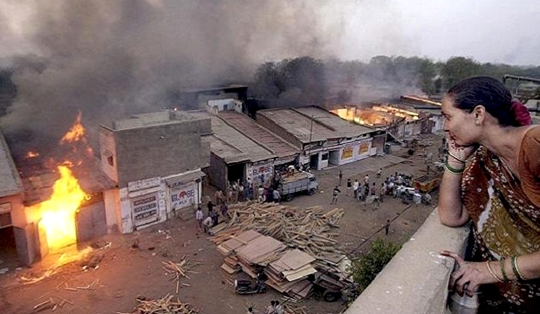
Gulberg1

Rejecting the demand for death sentence for all the convicts, the court said life imprisonment for the 11 will be till death if the state does not exercise power to remit the sentence.

The court awarded ten year jail term to one of the 13 convicted for lesser offences while 12 others have been given seven-year sentence each. The prosecution had argued that all the 24 convicts should be given death penalty.

While describing the massacre as the darkest day in the history of civil society, Special court Judge P B Desai refused death penalty saying, "If you look at all aspects, no previous antecedent has been placed on record".

Post the incident, 90 per cent of the accused were released on bail, yet no complaints against them have been given even by victims, and there is no record to show that they committed any offence during the time of bail, the judge further said, while giving reasons why he thought that this was not a fit case to give capital punishment to the convicts.

The court said it has decided to award imprisonment for life without any time frame to 11 accused, who have been convicted for murder, while requesting the state not to use its power to remit the sentence after 14 years of imprisonment.

"CrPC provisions give power to the state to remit sentence after 14 years jail, section 433-A imposes some restriction on that power. In case the state does not exercise power to remit the sentence, life imprisonment will mean that it is till death," the court said.

"I cannot add beyond what has been prescribed under section 302, it is not necessary for a state to exercise power to remit sentence, state may not exercise power of remittance," the judge said, adding the court's direction cannot be binding as he cannot take away the executive powers of the state.

As regards the 13 others accused convicted for lesser offences not including murder (302), the court awarded 10 years imprisonment to one Mangilal Jain, while 12 others were awarded seven-year sentence each.

The Gulberg Society massacre, which took place here on February 28, 2002 when Narendra Modi was the Gujarat Chief Minister, shook the nation when a mob of 400 people set about attacking the society in the heart of Ahmedabad and killed the residents including Jafri.

It was one of the nine cases of the 2002 Gujarat riots probed by the Supreme Court-appointed SIT.

"All the sentences will run concurrently as the Supreme Court has laid it down clearly that if the crime had single purpose, sentences given for different sections of IPC should run concurrently," the court said.

The prosecution and the victims had demanded that sentences awarded to all the accused should not run concurrently as all the 24 convicts will have to spend their entire life behind bars.

Earlier on June 2, the court had convicted 11 persons for murder and other offences, while 13 others, including VHP leader Atul Vaidya, were charged with lesser offences. It had acquitted 36 others in the case.

Those given life sentence in the case are - Kailash Dhobi, Yogendra Shekhawat, Jayesh Jingar, Krishna Kalal, Jayesh Parmar, Raju Tiwari, Bharat Rajput, Dinesh Sharma, Narayan Tank, Lakhansinh Chudasama and Bharat Taili.

One Mangilal Jain, who was convicted for lesser offence, has been sentenced to 10 years jail term.

Besides, VHP leader Atul Vaid, Mukesh Jingar, Prakash Padhiyar, Surendrasinh Chauhan, Dilip Parmar, Babu Marwadi, Manish Jain, Dharmesh Shukla, Kapil Mishra, Suresh Dhobi, Ambesh Jingar and Sandeep Punjabi have been sentenced to seven years imprisonment each.

During the argument on quantum of sentence, special public prosecutor and counsel for Supreme Court-appointed Special Investigation Team (SIT), R C Kodekar had asked the court for nothing less than death sentence or jail term till death for all 24 convicts.

Lawyer for the victims, S M Vora, also sought maximum punishment for the accused and argued that sentencing for each offence should not run concurrently so that they spend their entire life in jail.

However, lawyer of the accused, Abhay Bhardwaj, has refuted the demand of capital punishment or maximum punishment in his arguments saying that the incident was spontaneous and there were enough provocations for it.

The Gulberg society massacre was one of the nine cases of 2002 Gujarat riots probed by the SC-appointed SIT.

The incident had taken place a day after S-6 coach of Sabarmati Express was burnt near Godhra train station in which 58 'kar sevaks' returning from Ayodhya were killed.

During the course of trial, as many as 338 witnesses were cross-examined, with four different judges having presided over the case.

Comments

Ahmed Ali K
 - 
Friday, 17 Jun 2016

Death sentence?
for what?
Is he a non Hindu?

Jaleel S
 - 
Friday, 17 Jun 2016

Rarest of rare judgement...

Add new comment

  • Coastaldigest.com reserves the right to delete or block any comments.
  • Coastaldigset.com is not responsible for its readers’ comments.
  • Comments that are abusive, incendiary or irrelevant are strictly prohibited.
  • Please use a genuine email ID and provide your name to avoid reject.
Agencies
March 15,2020

New Delhi, Mar 15: The new rules for debit and credit cards to increase security and reduce frauds kick in from Monday. In January, the Reserve Bank of India (RBI) had issued new rules to improve user convenience and increase the security of card transactions. These rules will help in curbing the misuse of debit and credit cards.

RBI has directed banks to allow only domestic card transactions at ATMs and PoS terminals in India at the time of issuance/reissuance of card. For international transactions, online transactions, card-not-present transactions and contactless transactions, customers will have to separately set up services on their card.

These rules will be applicable for new cards from March 16. Those with old cards can decide whether to disable any of these features.

As per the existing rules, these services used to come automatically with the card, but now it will start at the request of the customer.

Debit or credit card customers who have not yet done any online transaction, contactless transaction or international transaction with the card, then these services on the card will automatically stop from March 16.

The Reserve Bank has asked all banks to provide mobile banking, net banking option to enable limit and enable and disable service 24 hours a day, seven days a week.

If the customer makes any change in the status of the card, the bank will alert the customer through SMS/email and send the information.

Issuers shall provide to all cardholders facility to switch on/off and set/modify transaction limits (within the overall card limit, if any, set by the issuer) for all types of transactions -- domestic and international, at PoS/ATMs/online transactions/contactless transactions, etc.,

The provisions, however, are not mandatory for prepaid gift cards and those used at mass transit systems.

The latest instructions come in the wake of rising instances of cyber frauds and the huge increase in the use of cards.

Comments

Add new comment

  • Coastaldigest.com reserves the right to delete or block any comments.
  • Coastaldigset.com is not responsible for its readers’ comments.
  • Comments that are abusive, incendiary or irrelevant are strictly prohibited.
  • Please use a genuine email ID and provide your name to avoid reject.
News Network
April 16,2020

Thiruvananthapuram, Apr 16: Seven fresh cases of COVID-19 were reported from Kerala on Thursday, taking the total number of active cases to 147 in the state,even as over 88,000 people are under observation.

On Wednesday, only one positive case had been reported, thelowest in weeks.

While Kannur reported four cases, two were from Kozhikode and one from Kasaragod, Chief Minister Pinarayi Vijayan told reportershere.

Five of those affected had come from abroad, while two have got it through contact with infected people.

Samples of 27 people, including 24 from the worst affected Kasaragod, have turned negative on Thursday.

He said 394 coronavirus cases have so farbeen detected from the state.

Over 80,000 people are under observation, including 532 in various hospitals.

Vijayan said 17,400 samples have been sent for testing of which 16,459 have returned negative.

Comments

Add new comment

  • Coastaldigest.com reserves the right to delete or block any comments.
  • Coastaldigset.com is not responsible for its readers’ comments.
  • Comments that are abusive, incendiary or irrelevant are strictly prohibited.
  • Please use a genuine email ID and provide your name to avoid reject.
News Network
January 18,2020

New Delhi, Jan 18: Asha Devi, the mother of the 2012 Delhi gang-rape victim, on Saturday slammed senior lawyer Indira Jaising for her suggestion that she should forgive her daughter's rapists.

"Who is Indira Jaising to give me such a suggestion? The whole country wants the convicts to be executed. Just because of people like her, justice is not done with rape victims," Asha Devi said here.

"Cannot believe how Indira Jaising even dared to suggest this. I met her many times over the years in Supreme Court, not even once has she asked for my well being and today she is speaking for the convicts. Such people earn their livelihoods by supporting rapists, hence rape incidents do not stop," she added.

Asha Devi further accused Jaising of using "the garb of human rights" to make a living.

'People like her keep earning money under the garb of human rights. I do not need her suggestions... Just because of people who think like her incidents like rape keep happening, she is a disgrace to women," she said.

Earlier yesterday, Indira Jaising, through a tweet, had urged Asha Devi to forgive the perpetrators and had used the example of Congress interim president Sonia Gandhi, who had forgiven Nalini, one of the convicts who was given the death penalty by the courts.

"While I fully identify with the pain of Asha Devi I urge her to follow the example of Sonia Gandhi who forgave Nalini and said she did not want the death penalty for her. We are with you but against the death penalty," Jaising's tweet read.

Comments

Add new comment

  • Coastaldigest.com reserves the right to delete or block any comments.
  • Coastaldigset.com is not responsible for its readers’ comments.
  • Comments that are abusive, incendiary or irrelevant are strictly prohibited.
  • Please use a genuine email ID and provide your name to avoid reject.