


11 get life term in Gulberg society massacre case

June 17, 2016

Ahmedabad, Jun 17: Calling the Gulberg massacre as the "darkest day" in the history of civil society, a special SIT court here today sentenced 11 convicts to life imprisonment in the case of burning alive of 69 people, including former Congress MP Eshan Jafri in the 2002 post-Godhra violence.
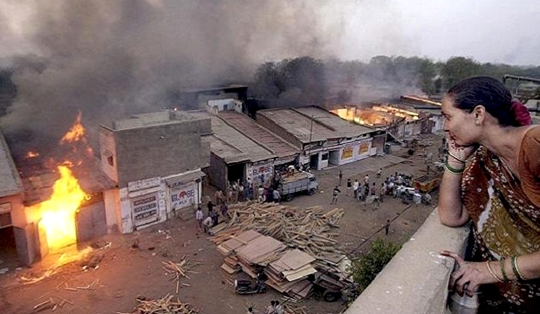
Gulberg1

Rejecting the demand for death sentence for all the convicts, the court said life imprisonment for the 11 will be till death if the state does not exercise power to remit the sentence.

The court awarded ten year jail term to one of the 13 convicted for lesser offences while 12 others have been given seven-year sentence each. The prosecution had argued that all the 24 convicts should be given death penalty.

While describing the massacre as the darkest day in the history of civil society, Special court Judge P B Desai refused death penalty saying, "If you look at all aspects, no previous antecedent has been placed on record".

Post the incident, 90 per cent of the accused were released on bail, yet no complaints against them have been given even by victims, and there is no record to show that they committed any offence during the time of bail, the judge further said, while giving reasons why he thought that this was not a fit case to give capital punishment to the convicts.

The court said it has decided to award imprisonment for life without any time frame to 11 accused, who have been convicted for murder, while requesting the state not to use its power to remit the sentence after 14 years of imprisonment.

"CrPC provisions give power to the state to remit sentence after 14 years jail, section 433-A imposes some restriction on that power. In case the state does not exercise power to remit the sentence, life imprisonment will mean that it is till death," the court said.

"I cannot add beyond what has been prescribed under section 302, it is not necessary for a state to exercise power to remit sentence, state may not exercise power of remittance," the judge said, adding the court's direction cannot be binding as he cannot take away the executive powers of the state.

As regards the 13 others accused convicted for lesser offences not including murder (302), the court awarded 10 years imprisonment to one Mangilal Jain, while 12 others were awarded seven-year sentence each.

The Gulberg Society massacre, which took place here on February 28, 2002 when Narendra Modi was the Gujarat Chief Minister, shook the nation when a mob of 400 people set about attacking the society in the heart of Ahmedabad and killed the residents including Jafri.

It was one of the nine cases of the 2002 Gujarat riots probed by the Supreme Court-appointed SIT.

"All the sentences will run concurrently as the Supreme Court has laid it down clearly that if the crime had single purpose, sentences given for different sections of IPC should run concurrently," the court said.

The prosecution and the victims had demanded that sentences awarded to all the accused should not run concurrently as all the 24 convicts will have to spend their entire life behind bars.

Earlier on June 2, the court had convicted 11 persons for murder and other offences, while 13 others, including VHP leader Atul Vaidya, were charged with lesser offences. It had acquitted 36 others in the case.

Those given life sentence in the case are - Kailash Dhobi, Yogendra Shekhawat, Jayesh Jingar, Krishna Kalal, Jayesh Parmar, Raju Tiwari, Bharat Rajput, Dinesh Sharma, Narayan Tank, Lakhansinh Chudasama and Bharat Taili.

One Mangilal Jain, who was convicted for lesser offence, has been sentenced to 10 years jail term.

Besides, VHP leader Atul Vaid, Mukesh Jingar, Prakash Padhiyar, Surendrasinh Chauhan, Dilip Parmar, Babu Marwadi, Manish Jain, Dharmesh Shukla, Kapil Mishra, Suresh Dhobi, Ambesh Jingar and Sandeep Punjabi have been sentenced to seven years imprisonment each.

During the argument on quantum of sentence, special public prosecutor and counsel for Supreme Court-appointed Special Investigation Team (SIT), R C Kodekar had asked the court for nothing less than death sentence or jail term till death for all 24 convicts.

Lawyer for the victims, S M Vora, also sought maximum punishment for the accused and argued that sentencing for each offence should not run concurrently so that they spend their entire life in jail.

However, lawyer of the accused, Abhay Bhardwaj, has refuted the demand of capital punishment or maximum punishment in his arguments saying that the incident was spontaneous and there were enough provocations for it.

The Gulberg society massacre was one of the nine cases of 2002 Gujarat riots probed by the SC-appointed SIT.

The incident had taken place a day after S-6 coach of Sabarmati Express was burnt near Godhra train station in which 58 'kar sevaks' returning from Ayodhya were killed.

During the course of trial, as many as 338 witnesses were cross-examined, with four different judges having presided over the case.

Comments

Ahmed Ali K
 - 
Friday, 17 Jun 2016

Death sentence?
for what?
Is he a non Hindu?

Jaleel S
 - 
Friday, 17 Jun 2016

Rarest of rare judgement...

Add new comment

  • Coastaldigest.com reserves the right to delete or block any comments.
  • Coastaldigset.com is not responsible for its readers’ comments.
  • Comments that are abusive, incendiary or irrelevant are strictly prohibited.
  • Please use a genuine email ID and provide your name to avoid reject.
News Network
March 27,2020

New Delhi, Mar 27: Cabinet Secretary Rajiv Gauba has asked states to urgently strengthen the surveillance of international travellers who entered the country before the lockdown as there appeared to be a "gap" between the actual monitoring for COVID-19 and the total arrivals.

In a letter to chief secretaries of all States and Union Territories, Gauba said such a gap in monitoring of international passengers for coronavirus "may seriously jeopardise the efforts to contain the spread of COVID-19", given that many amongst the persons who have tested positive so far in India have history of international travel.

"As you are aware, we initiated screening of international incoming passengers at the airports with effect from January 18, 2020. I have been informed that up to March 23, 2020, cumulatively, Bureau Of Immigration has shared details of more than 15 lakh incoming international passengers with the States/UTs for monitoring for COVID-19.

"However, there appears to be a gap between the number of international passengers who need to be monitored by the States/UTs and the actual number of passengers being monitored," Gauba said in his letter.

The government had started monitoring of all international passengers who have arrived in India in last two months in the wake of the coronavirus outbreak.

Gauba said,"it is important that all international passengers are put under close surveillance to prevent the spread of the epidemic."

He said the Ministry of Health and Family Welfare (MoHFW) has repeatedly emphasised the importance of monitoring, and requested the states and UTs to take immediate steps in this regard.

"I would, therefore, like to request you to ensure that concerted and sustained action is taken urgently to put such passengers under surveillance immediately as per MoHFW guidelines," he said.

The cabinet secretary also urged the chief secretaries to actively involve the district authorities in this effort.The screening of international incoming passengers at airports was done from January 18 in a phased manner.

The Central and state governments have unleashed unprecedented and extraordinary measures to contain the spread of the fast-spreading coronavirus, which has already infected more than 700 people in the country and claimed at least 17 lives.

A nationwide lockdown was also announced by Prime Minister Narendra Modi on Tuesday for 21 days.

Comments

Add new comment

  • Coastaldigest.com reserves the right to delete or block any comments.
  • Coastaldigset.com is not responsible for its readers’ comments.
  • Comments that are abusive, incendiary or irrelevant are strictly prohibited.
  • Please use a genuine email ID and provide your name to avoid reject.
News Network
January 27,2020

Jaipur, Jan 27: Senior Congress leader Shashi Tharoor said that if the Citizenship Amendment Act leads to the implementation of the NPR and the NRC, it would be a complete victory for Pakistan's founding father, Muhammad Ali Jinnah.

He said that Jinnah's idea of a country was already winning in India with the contentious Citizenship Amendment Act (CAA) coming into effect, but asserted that there was still a choice available.

"I would not say Jinnah has completely won, but I would say Jinnah is winning. There is still a choice available to the nation between Jinnah's idea of a country and Gandhiji's idea of a country," he said on the sidelines of the Jaipur Literature Festival on Sunday.

The CAA came into force in India in December amid protests across the country and around the world.

The MP from Thiruvananthapuram said that the amended Citizenship Act took Jinnah's logic by declaring that religion shall be the basis of nationhood, reaffirming that Gandhi's idea is that all religions are equal .

"The CAA is, if you are talking Tennis, you would say one set up or big first set lead for Jinnah. But the next step would be if the CAA would lead to the National Population Register (NPR) and the National Register of Citizens (NRC). If that happens, then you would consider that Jinnah's victory is complete," he said.

The CAA seeks to grant citizenship to migrants belonging to Hindu, Sikh, Buddhist, Christian, Jain and Parsi communities who came to India from Pakistan, Bangladesh and Afghanistan on or before December 31, 2014.

On the BJP's defence that the NPR was carried out during the UPA regime, Tharoor said that the Congress government had utilised a decision of the NDA government led by former prime minister Atal Bihari Vajpayee.

"It never asked where were your parents born. It never authorised the enumerators to note on the margin 'dubious citizenship', a term used in the NPR rules crafted by this government. That is purely BJP's invention," he said.

If we go around this country authorising people to interview all the citizens, or identify some who have 'dubious citizenship', you can be pretty sure which Indians are going to be found on the 'dubious citizenship', he said.

"That will principally be one community that is not mentioned in the CAA. And if that happens, then it is indeed Jinnah's victory.

"From wherever he is, he can point to this place and say, 'see I was right in the 1940. We are separate nations and Muslims deserved their own country because Hindus cannot be just'," Tharoor said.

Speaking about the Delhi election, the three-time MP said that the maximum development in the national capital happened under the Congress government.

"What Sheila Dikshit did in her 15 years as Chief Minister of Delhi, no other leader could do it before or after her," he said.

Comments

Add new comment

  • Coastaldigest.com reserves the right to delete or block any comments.
  • Coastaldigset.com is not responsible for its readers’ comments.
  • Comments that are abusive, incendiary or irrelevant are strictly prohibited.
  • Please use a genuine email ID and provide your name to avoid reject.
Agencies
June 21,2020

New Delhi, June 21: Diesel prices rise to record high after 60 paise hike in rates, petrol up 35 paise; rates up by Rs 8.88 and Rs 7.97 in 15 days.

Petrol price in Delhi was hiked to Rs 79.23 per litre from Rs 78.88, while diesel rates were increased to Rs 78.27 a litre from Rs 77.67, according to a price notification of state oil marketing companies. 

In Bengaluru, petrol will be costlier by 37 paise at Rs 81.81 per litre, while diesel will cost 57 paise more per litre at Rs 74.43.

Rates have been increased across the country and vary from state to state depending on the incidence of local sales tax or VAT.

The 15th daily increase in rates since oil companies on June 7 restarted revising prices in line with costs after ending an 82-day hiatus in rate revision, has taken diesel prices to a new high. The petrol price too is at a two-year high.

Over 63 per cent of the retail selling price of diesel is taxes. Out of the total tax incidence of Rs 49.43 per litre, Rs 31.83 is by way of central excise and Rs 17.60 is VAT. 

Petrol in Mumbai costs Rs 86.04 per litre and diesel is priced at Rs 76.69.

Prior to the current rally, the peak diesel rates had touched was on October 16, 2018 when prices had climbed to Rs 75.69 per litre in Delhi. The highest-ever petrol price was on October 4, 2018 when rates soared to Rs 84 a litre in Delhi.

When rates had peaked in October 2018, the government had cut excise duty on petrol and diesel by Rs 1.50 per litre each. State-owned oil companies were asked to absorb another Re 1 a litre to help cut retail rates by Rs 2.50 a litre.

Oil companies had quickly recouped the Re 1 and the government in July 2019 raised excise duty by Rs 2 a litre.

The government on March 14 hiked excise duty on petrol and diesel by Rs 3 per litre each and then again on May 5 by a record Rs 10 per litre in case of petrol and Rs 13 on diesel. The two hikes gave the government Rs 2 lakh crore in additional tax revenues.

Oil PSUs Indian Oil Corp (IOC), Bharat Petroleum Corp Ltd (BPCL) and Hindustan Petroleum Corp Ltd (HPCL), instead of passing on the excise duty hikes to customers, adjusted them against the fall in the retail rates that was warranted because of a decline in international oil prices to two-decade lows.

International oil prices have since rebounded and oil firms are now adjusting retail rates in line with them.

In 15 days of hike, petrol price has gone up by Rs 7.97 per litre and diesel by Rs 8.88 a litre.

Comments

Add new comment

  • Coastaldigest.com reserves the right to delete or block any comments.
  • Coastaldigset.com is not responsible for its readers’ comments.
  • Comments that are abusive, incendiary or irrelevant are strictly prohibited.
  • Please use a genuine email ID and provide your name to avoid reject.