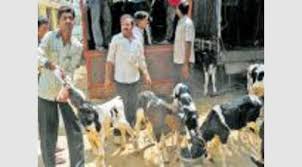
14 calves die while transportation, 115 cattle seized; one held

April 20, 2016

Hassan, Apr 20: Acting on a tip off, the police intercepted four vehicles and rescued 115 cattle that were being transported to slaughter houses at Baraguru handpost near Channarayapatna in Hassan on Tuesday. However, 14 calves died of asphyxiation, it is said.

cattlePolice seized the vehicles and the driver of one of them (from Yasin Nagar in Holenarsipur) has been taken into custody. The other three drivers fled the scene, abandoning the vehicles.

The police were checking the vehicles when they received the tip-off. Upon seeing the police, the drivers stopped the vehicles and took to their heels. The police were successful in nabbing one person.

The vehicles and the cattle were brought to the police station. There were eight buffaloes, seven cows and the remaining were calves. The mouth and legs of the animals were tied with ropes. Fourteen calves died due to asphyxiation.

The local residents fed the rescued animals with water and milk. The animals were later shifted to Pinjrapole care centre in Mysuru.

Comments

Mohammed SS
 - 
Wednesday, 20 Apr 2016

Bajranghes and RSS must be behind this, now they don't get money for their booze

Siddik Uchil
 - 
Wednesday, 20 Apr 2016

Very sad news. The culprits should be punished.

Add new comment

  • Coastaldigest.com reserves the right to delete or block any comments.
  • Coastaldigset.com is not responsible for its readers’ comments.
  • Comments that are abusive, incendiary or irrelevant are strictly prohibited.
  • Please use a genuine email ID and provide your name to avoid reject.
News Network
January 4,2020

Tumakuru, Jan 4: Three people were burnt alive and four others sustained injuries in a head-on collision between a four-wheeler (Omni van) and a private bus on NH-206 near Doddaguni in Gubbi taluk of Tumakuru district in the early hours of Saturday.

Police said that Narasamma’s relatives and villagers were taking her to a hospital in Nittur when a private bus, heading to Shivamogga from Bengaluru, collided with the van on the tank bund road near Doddguni around 0200 hrs. The two vehicles caught fire and Vasanthkumar, Ramaiah and Narasamma were burnt alive in the van. The passengers in the private bus escaped unhurt.

The deceased were identified as Vasanthkumar (23), Ramaiah (62) and Narsamma (60) of N Hosahalli in Gubbi taluk, whereas the injured were identified as Ravikumar (23), Radhamani (30), Narasimha Murthy (40) and Gowramma (28).

Comments

Add new comment

  • Coastaldigest.com reserves the right to delete or block any comments.
  • Coastaldigset.com is not responsible for its readers’ comments.
  • Comments that are abusive, incendiary or irrelevant are strictly prohibited.
  • Please use a genuine email ID and provide your name to avoid reject.
News Network
February 23,2020

The euphoria over the claim that around 3,000 tonnes of gold reserves, worth Rs 12 trillion, have been discovered in Uttar Pradesh’s Sonbhadra district could not last even 24 hours, with the Geological Survey of India (GSI) clarifying on Saturday there had been no such discovery.

The GSI, headquartered in Kolkata, rebutted the claims of the Uttar Pradesh Directorate of Geology and Mining (UPDGM), and said “miscommunication” must have led to the wrong reporting of facts.

M Sridhar, director general of the GSI, said nobody in the agency gave any such data. He said 52,806 tonnes of gold ore was found in Sonbhadra district during the exploration work in 1998-2000. From this reserve, only 160 kg of gold can be extracted.

“There must have been some miscommunication of facts because of which the gold ore deposits have been overestimated. We have written a letter to Uttar Pradesh (UPDGM), stating the facts. The GSI has not estimated such kind of vast resource of gold deposits in Sonbhadra,” Sridhar said.

ALSO READ: 2,900-tonne gold mine found in Sonbhadra, 4 times that of India's reserves

The UPDGM had said on Friday that gold deposits were found in Son Pahadi and Hardi areas of the district. Sridhar said while gold ore was found in the area during the GSI’s exploration work in 1998-2000, it had told the state government about the discovery in November last year.

Under the new regulation, which came into effect from 2015, the GSI has to inform the state government when ore deposits are discovered. Earlier, no such action was mandatory. In its report, the GSI estimated that only 3.03 gm of gold can be extracted from a tonne of ore. It also clarified that even the extraction amount was tentative and could not be established for certain.

Moreover, Sridhar said the deposits were spread across only 0.5 sq km in forest land, which made the mining of ore economically unviable. “When there are several mines nearby, we can club it into a block and then it makes sense to mine the ore. But in this case, the deposits are too small to make it viable for any company to mine it,” he said. The GSI usually prioritises its exploration work based on the needs of the Centre. While strategic minerals like tin, cobalt, lithium, beryllium, germanium, gallium, indium, tantalum, niobium, selenium, and bismuth are atop the list in GSI exploration, gold is another commodity on its priority list.

According to the World Gold Council, India has reserves of 630 tonnes of gold.

Comments

Add new comment

  • Coastaldigest.com reserves the right to delete or block any comments.
  • Coastaldigset.com is not responsible for its readers’ comments.
  • Comments that are abusive, incendiary or irrelevant are strictly prohibited.
  • Please use a genuine email ID and provide your name to avoid reject.
News Network
May 19,2020

Bengaluru, May 19: Containment zones in Karnataka will be much smaller in size under the latest lockdown norms. However, rules and loopholes will be tightened and action against violators will be stringent in order to check the spread of the disease.

Revised guidelines issued by the Centre to the state, reveal containment zones are delineated based on mapping of cases and contacts. Intensive action will be carried out in these areas with the aim of breaking the chain of transmission. Therefore, the area of a containment zone should be appropriately defined by the district administration/local urban bodies with technical inputs at local level.

The health department is considering shrinking the size of containment zones from the existing 100 metres to open up more space for economic activities. Medical education minister K Sudhakar, also a member of the Covid taskforce, said additional chief secretary (health department) Javed Akthar will issue a new definition of a containment zone after the Covid-19 taskforce holds its next meeting.

“We are planning to further shrink it and restrict containment zones to an apartment complex, independent house or even a lane where the Covid-19 patient resides,” Sudhakar said. He went on to say bigger containment zones will impede businesses and normal activities in the vicinity, something which the government wants to avoid.

The minister said Karnataka will also do away with colour-coding districts. “With restrictions being relaxed for almost all activities, it does not make sense to pursue with colour codes. It is either containment zone or outside containment zone,” he said.

In rural areas, the minister said containment zones will be identified by the taluk heads. Government sources say it is difficult to restrict activities to certain areas or smaller location in rural areas as farmers and people will have to travel to the outskirts of their villages for their livelihood.

An official said, a containment operation (large outbreak or cluster) is deemed successful when no case is reported in 28 days from the containment zone.

Comments

Add new comment

  • Coastaldigest.com reserves the right to delete or block any comments.
  • Coastaldigset.com is not responsible for its readers’ comments.
  • Comments that are abusive, incendiary or irrelevant are strictly prohibited.
  • Please use a genuine email ID and provide your name to avoid reject.