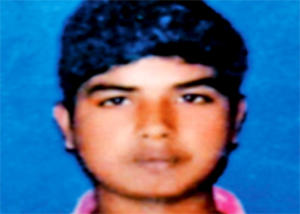
14-yr-old Muslim boy, 15-yr-old Hindu girl fall in love; her elders kill him, bury in backyard

[email protected] (News Network)
July 22, 2016

Muzaffarnagar, Jul 22: Police have arrested three persons of a Hindu family for killing their 14-year-old Muslim neighbour and burying him in the backyard of their house after a 15-year-old female member of their family fell in love with him, here in Uttar Pradesh.

lover1In fact the Hindu and Muslim families had been living as neighbours for two decades, sharing a single wall that separated their houses. When the Muzaffarnagar riots broke out, the violence left their bond untouched.

On Thursday, in what sent shock waves through Muzaffarnagar, the police dug out the body of Irshad, the school-going teenager, from the compound of the Sainis. According to police the family members of the girl kidnapped the boy, killed and buried him quietly. Two brothers of the girl and an uncle have been arrested in connection with the case.

Shakeel Ahmad had filed a missing person report at Jansath police station on Tuesday after his son didn't return home even by late evening. The boy had never done that before. But it took investigators little time to piece the sordid puzzle together. Somebody had seen Irshad and the girl walking together a few days back. After that it didn't take cops long to follow clues that led to the Sainis' backyard.

"We felt something was fishy when the boy's call detail report (CDR) revealed that he had been in constant touch with one specific person. Interestingly, both sim cards were registered in Irshad's name, which means the youth had given that number to the girl. Further investigations revealed that it was a girl in the neighbourhood with whom he was communicating," said SSP Deepak Kumar.

"Questioning of the brothers of the girl confirmed that the boy was strangulated soon after he was abducted on Monday night. His body was hidden in a shallow pit in a plot that belonged to the uncle of the girl. We recovered the body and have arrested Pawan and Mohan Saini, the brothers, along with the uncle."

Ahmad, still to recover from the loss of his son, said, "These people shared the wall of our house. They were our neighbours. They could have brought the matter to us and we would have reprimanded our son. He didn't deserve this fate. He was just a little boy."

Not taking any chances as the incident happened in Kawal, the village many regard as the epicenter of the Muzaffarnagar riots of 2103 that left 63 dead and more than 50,000 homeless, the district administration rushed a contingent of PAC and police force from five stations to the area that's classified as hyper-sensitive.

As news of the murder spread on Thursday morning, tension began building up, forcing IG (Meerut zone) Sujeet Pandey to promptly order deployment of additional force in Kawal. The situation, though simmering with tension, is under control. "It was a race against time," SSP Kumar said. "We couldn't have waited for long as things could have gone out of control, what with the reputation of Kawal."

Jamshed Ahmad, pradhan of Kawal, said, "We still haven't got over what happened here three years ago. This was uncalled for. We have to do everything in our power not to let things go wrong again."

Comments

L K Monu Borkala
 - 
Friday, 22 Jul 2016

Shameless animals can do anything for the sake of religion. very very sad and painful incident. so young he is and how can they kill this boy?? they could have informed their parents...Yaa Allah Save the humanity....

Add new comment

  • Coastaldigest.com reserves the right to delete or block any comments.
  • Coastaldigset.com is not responsible for its readers’ comments.
  • Comments that are abusive, incendiary or irrelevant are strictly prohibited.
  • Please use a genuine email ID and provide your name to avoid reject.
Ram Puniyani
February 10,2020

Noam Chomsky is one of the leading peace workers in the world. In the wake of America’s attack on Vietnam, he brought out his classic formulation, ‘manufacturing consent’. The phrase explains the state manipulating public opinion to have the public approve of it policies—in this case, the attack of the American state on Vietnam, which was then struggling to free itself from French colonial rule.

In India, we are witness to manufactured hate against religious minorities. This hatred serves to enhance polarisation in society, which undermines India’s democracy and Constitution and promotes support for a Hindu nation. Hate is being manufactured through multiple mechanisms. For example, it manifests in violence against religious minorities. Some recent ghastly expressions of this manufactured hate was the massive communal violence witnessed in Mumbai (1992-93), Gujarat (2002), Kandhamal (2008) and Muzaffarnagar (2013). Its other manifestation was in the form of lynching of those accused of having killed a cow or consumed beef. A parallel phenomenon is the brutal flogging, often to death, of Dalits who deal with animal carcasses or leather.

Yet another form of this was seen when Shambhulal Regar, indoctrinated by the propaganda of Hindu nationalists, burned alive Afrazul Khan and shot the video of the heinous act. For his brutality, he was praised by many. Regar was incited into the act by the propaganda around love jihad. Lately, we have the same phenomenon of manufactured hate taking on even more dastardly proportions as youth related to Hindu nationalist organisations have been caught using pistols, while police authorities look on.

Anurag Thakur, a BJP minster in the central government recently incited a crowd in Delhi to complete his chant of what should happen to ‘traitors of the country...” with a “they should be shot”. Just two days later, a youth brought a pistol to the site of a protest at Jamia Millia Islamia university and shouted “take Azaadi!” and fired it. One bullet hit a student of Jamia. This happened on 30 January, the day Nathuram Godse had shot Mahatma Gandhi in 1948. A few days later, another youth fired near the site of protests against the CAA and NRC at Shaheen Bagh. Soon after, he said that in India, “only Hindus will rule”.

What is very obvious is that the shootings by those associated with Hindu nationalist organisations are the culmination of a long campaign of spreading hate against religious minorities in India in general and against Muslims in particular. The present phase is the outcome of a long and sustained hate campaign, the beginning of which lies in nationalism in the name of religion; Muslim nationalism and Hindu nationalism. This sectarian nationalism picked up the communal view of history and the communal historiography which the British introduced in order to pursue their ‘divide and rule’ policy.

In India what became part of “social common sense” was that Muslim kings had destroyed Hindu temples, that Islam was spread by force, and that it is a foreign religion, and so on. Campaigns, such as the one for a temple dedicated to the Hindu god Rama to be built at the site where the Babri masjid once stood, further deepened the idea of a Muslim as a “temple-destroyer”. Aurangzeb, Tipu Sultan and other Muslim kings were tarnished as the ones who spread Islam by force in the subcontinent. The tragic Partition, which was primarily due to British policies, and was well-supported by communal streams also, was entirely attributed to Muslims. The Kashmir conflict, which is the outcome of regional, ethnic and other historical issues, coupled with the American policy of supporting Pakistan’s ambitions of regional hegemony, (which also fostered the birth of Al-Qaeda), was also attributed to the Muslims.

With recurring incidents of communal violence, these falsehoods went on going deeper into the social thinking. Violence itself led to ghettoisation of Muslims and further broke inter-community social bonds. On the one hand, a ghettoised community is cut off from others and on the other hand the victims come to be presented as culprits. The percolation of this hate through word-of-mouth propaganda, media and re-writing of school curricula, had a strong impact on social attitudes towards the minorities.

In the last couple of decades, the process of manufacturing hate has been intensified by the social media platforms which are being cleverly used by the communal forces. Swati Chaturvedi’s book, I Am a Troll: Inside the Secret World of the BJP’s Digital Army, tells us how the BJP used social media to spread hate. Whatapp University became the source of understanding for large sections of society and hate for the ‘Other’, went up by leaps and bounds. To add on to this process, the phenomenon of fake news was shrewdly deployed to intensify divisiveness.

Currently, the Shaheen Bagh movement is a big uniting force for the country; but it is being demonised as a gathering of ‘anti-nationals’. Another BJP leader has said that these protesters will indulge in crimes like rape. This has intensified the prevalent hate.

While there is a general dominance of hate, the likes of Shambhulal Regar and the Jamia shooter do get taken in by the incitement and act out the violence that is constantly hinted at. The deeper issue involved is the prevalence of hate, misconceptions and biases, which have become the part of social thinking.

These misconceptions are undoing the amity between different religious communities which was built during the freedom movement. They are undoing the fraternity which emerged with the process of India as a nation in the making. The processes which brought these communities together broadly drew from Gandhi, Bhagat Singh and Ambedkar. It is these values which need to be rooted again in the society. The communal forces have resorted to false propaganda against the minorities, and that needs to be undone with sincerity.

Combating those foundational misconceptions which create hatred is a massive task which needs to be taken up by the social organisations and political parties which have faith in the Indian Constitution and values of freedom movement. It needs to be done right away as a priority issue in with a focus on cultivating Indian fraternity yet again.


Comments

Add new comment

  • Coastaldigest.com reserves the right to delete or block any comments.
  • Coastaldigset.com is not responsible for its readers’ comments.
  • Comments that are abusive, incendiary or irrelevant are strictly prohibited.
  • Please use a genuine email ID and provide your name to avoid reject.
News Network
April 4,2020

Bengaluru, Apr 4: Sixteen coronavirus cases have

been confirmed in Karnataka, taking the total number of the affected in the state to 144, the Health department said here on Saturday.

A 75-year old man, who is a resident of Bagalkote, who was confirmed positive on Friday and was being treated at a designated hospital in the district, expired last night.

"Till this evening, 144 COVID-19 positive cases have been confirmed in the state, which includes four deaths and 11 discharges," the health department said in a bulletin.

Out of the 129 active cases, 126 patients (including 1 pregnant woman) are in isolation at designated hospitals and are stable and three in Intensive Care Units (one on oxygen and two on Ventilators), it said.

Among the total of 144 cases detected and confirmed so far, eight are transit passengers of Kerala who landed in airports in Karnataka and are being treated in the state, it said.

Comments

Add new comment

  • Coastaldigest.com reserves the right to delete or block any comments.
  • Coastaldigset.com is not responsible for its readers’ comments.
  • Comments that are abusive, incendiary or irrelevant are strictly prohibited.
  • Please use a genuine email ID and provide your name to avoid reject.
News Network
June 25,2020

Bengaluru, Jun 24: Dr K Sudhakar on Wednesday held a video conference with senior officials to review the preparedness for conducting of SSLC examinations safely which is beginning from Thursday.

"8,48,203 students will appear for the SSLC examination starting tomorrow in 2,879 centres across the state. All the guidelines issues by state government must be followed strictly" Sudhakar said in the meeting.

"It is the collective responsibility of officials of all departments to ensure that every student is safe, from the time he or she leaves home for the exam centre and returns home after the exams. The vehicles used to ferry students, where public transport is not available, must be sanitised properly. The surroundings near exam centres, exam halls, toilets must be sanitised properly. Social distancing must be maintained in the exam hall and mask must be provided to all students," he said.

The minister also said that since the students have been asked to arrive at exam centre at 7:30 in the morning, a small biscuit packet must be provided to each student so that they don't feel hungry during the exam and till they return home after the exam.

"Thermal scanning of every student should be done before allowing inside the exam hall. In case there is fever those students must be made to write exam in separate room. Separate exam halls must be arranged for students in quarantine areas and if it's not feasible they must be allowed to write exam in September. District administrations must disseminate information about precautionary measures taken to build confidence among parents," the minister said.

Sudhakar instructed the officials to work in coordination with the Education Department and other departments.

Stating that there are 458 containment zones in Bengaluru, the minister asked the officials to be extra cautious in these areas and make arrangements to ensure health department staff can take students to the nearest health center if anybody is found ill during the exam.

Education Minister Suresh Kumar, Additional Chief Secretary Javed Akhtar, Education Secretary, Secretary of Medical Education Department, BBMP officials, Health Experts and others were present.

Comments

Add new comment

  • Coastaldigest.com reserves the right to delete or block any comments.
  • Coastaldigset.com is not responsible for its readers’ comments.
  • Comments that are abusive, incendiary or irrelevant are strictly prohibited.
  • Please use a genuine email ID and provide your name to avoid reject.