19-year-old Nischal becomes youngest Chartered Accountant in India

July 24, 2015

Hyderabad, Jul 24: 19-year-old? Nischal Narayanam has become the youngest person in India to clear the Chartered Accountancy exam, The Hindu reports. The Common Proficiency Test is considered one of the toughest exams in the country.

young CA

19-year-old Nischal becomes youngest Chartered Accountant in India

Despite clearing the exam, Narayanam cannot enrol in the Institute of Chartered Accountants of India this year as they don't allow members below the age of 21 years.

Padmavathy, his mother first saw his talent with numbers when Narayanam was nine years old. “He was passionate about numbers and I was amazed at his skills” she told media persons.

To hone his skills, Padmavathy sought out mentors from around the world. "He has mentors from across the world and is trained in methodologies of several countries in Mathematics and Memory,” she told the newspaper.  She herself has a Ph.D in Sanskrit from Osmania University.

Narayanam is also the youngest graduate in Osmania University, from where he received his B. Com and M.Com degrees.

He has to credit other titles as well including the youngest 'Double Guinness World Record holder' in the category of memory and the youngest World Memory Champion. He is recognised by the National Geographic Channel one of the '7 brilliant brains of the world'. 

If that's not enough, he has been invited as a special invitee and speaker at the Global Conference in Shanghai by Deloitte International, the audit firm where he did his articleship for CA.

Comments

ethel ng
 - 
Saturday, 9 Jul 2016

Just awesome topic ! Thanks for sharing , I also found a useful service for forms filling. I am sure at least once in your life you had to fill out a form .

Add new comment

  • Coastaldigest.com reserves the right to delete or block any comments.
  • Coastaldigset.com is not responsible for its readers’ comments.
  • Comments that are abusive, incendiary or irrelevant are strictly prohibited.
  • Please use a genuine email ID and provide your name to avoid reject.
coastaldigest.com web desk
June 18,2020

Vijayapura, June 18: Shoukat Ali Sumbad, a local farmer, has donated land for the construction of Chennamma memorial, modelled on the Kittur fort, at Sindagi town in Vijayapura to celebrate the town's connect with the valorous Lingayat queen who fought the British in 1824.

Basava Jaya Mrutyunjaya Swamiji of Lingayat Panchamasali Peetha Kudala Sangam said Shoukat Ali came forward to donate his land adjacent to the state highway when local authorities failed to provide land for the memorial. 

"The committee led by Basava Jaya Mrutyunjaya Swamiji sought a 15x10 plot but when I went through their plan of constructing a model of Kittur fort, I decided to donate 425 sq ft," said the 61-year-old farmer. 

"Rani Chennamma is the pride of every Indian, irrespective of caste and creed, and my contribution is nothing compared to her sacrifice for the nation," he added.

Shoukat Ali, who lives in the neighbouring town of Almel, said he is a man of modest means but proud to make the contribution. "I own nine acres of land in Almel. I have six sons and two daughters. Two of my sons run small businesses in Mumbai. Ten of us live in a small house in Almel," he said.

“I also work as a broker to sell or buy sites. I had bought 15 guntas of land in Sindagi for my children some 15 years ago. When our MLA MC Managuli and Swamiji sought land for the memorial, my entire family agreed wholeheartedly” Shoukat Ali said.

“As Chennamma’s history is linked to Sindagi, there has been a demand for a memorial here since 2008, but the town municipal council failed to provide land due to political and technical reasons,” said Swamiji. 

“There were plans to observe a Sindagi bandh in the first week of June to protest the indifference of authorities. But then Sumbad gave us his land. We have formed a committee to construct a model of Kittur fort and a bronze statue of Chennamma at a cost of Rs 28 lakh,” he added.

Comments

Add new comment

  • Coastaldigest.com reserves the right to delete or block any comments.
  • Coastaldigset.com is not responsible for its readers’ comments.
  • Comments that are abusive, incendiary or irrelevant are strictly prohibited.
  • Please use a genuine email ID and provide your name to avoid reject.
News Network
August 9,2020

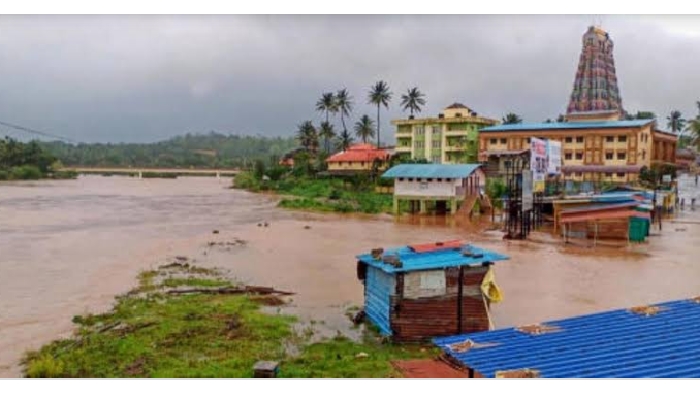
Bengaluru, Aug 9: Swollen rivers and flood-like situation continue to threaten lives and property in several parts of Karnataka that have been ravaged by torrential rains over the last few days.

Though there has been a respite from the downpour in some parts, rivers continue to flow above the danger mark, inundating low lying areas in several parts of Malnad, coastal and interior Karnataka.

There are also reports of continued landslides in hilly areas of Kodagu and Chikkamagaluru.

In Dakshina Kannada, heavy rains have submerged several areas in Bantwala and Belthangady, among others, with the Netravati river overflowing and also water being released from nearby dams.

Officials said incessant rains in Cauvery river catchment areas have led to increased inflow in the Krishna Raja Sagara dam in Mandya district. Water is being released from it and people living in low lying areas have been warned, they said.

There is also a flood-like situation in Najanagudu and nearby areas of Mysuru as the swollen Kapila river has inundated roads connecting Ooty in neighbouring Tamil Nadu, with water being released from Kabini dam.

There has been some respite from heavy rains in certain parts of Kodagu, which has been ravaged by floods and landslides. However, several areas of the district continue to be in deluge with the Cauvery and Lakshmana Tirtha rivers overflowing due to rains in the hilly areas.

There are also reports of landslides in some parts of the district.

Meanwhile, continuing rains are hampering the search operation by NDRF and authorities to locate five people, including the priest at Talacauvery, the origin of the river Cauvery, who had gone missing due to massive landslides at Bramhagiri hills on Wednesday night.

There are also reports of landslides at a few places in Charmadi ghat region of Chikkamagaluru and the road connecting to Dakshina Kannada has been closed temporarily.

Though Belagavi district has had some respite from the heavy rains, flood like situation continues to persist as the Krishna river and its tributaries are swollen due to continued inflows because of rains in neighbouring Maharashtra.

Inflow has also increased to the Tungabhadra dam of Ballari district due to rains in the catchment areas of Shivamogga and Chikkamagaluru.

Authorities have alerted people living in low lying areas about opening dam gates to release water anytime with rising inflow.

There is a similar flood like situation in parts of Yadgir, Raichur and Bagalkote districts with water being released from various dams.

The state government has released ₹ 50 crore for emergency relief and has announced ₹ 10,000 as immediate relief each to affected families.

An amount of ₹ 5 lakh has been announced for completely damaged houses, while in the case of partially damaged ones, relief will be distributed considering the extent of damage.

Comments

Add new comment

  • Coastaldigest.com reserves the right to delete or block any comments.
  • Coastaldigset.com is not responsible for its readers’ comments.
  • Comments that are abusive, incendiary or irrelevant are strictly prohibited.
  • Please use a genuine email ID and provide your name to avoid reject.
News Network
July 28,2020

Hounde, Jul 28: Coronavirus and its restrictions are pushing already hungry communities over the edge, killing an estimated 10,000 more young children a month as meager farms are cut off from markets and villages are isolated from food and medical aid, the United Nations warned Monday.

In the call to action shared with The Associated Press ahead of publication, four UN agencies warned that growing malnutrition would have long-term consequences, transforming individual tragedies into a generational catastrophe.

Hunger is already stalking Haboue Solange Boue, an infant from Burkina Faso who lost half her former body weight of 5.5 pounds (2.5 kilograms) in just a month. Coronavirus restrictions closed the markets, and her family sold fewer vegetables. Her mother was too malnourished to nurse.

“My child,” Danssanin Lanizou whispered, choking back tears as she unwrapped a blanket to reveal her baby's protruding ribs.

More than 550,000 additional children each month are being struck by what is called wasting, according to the UN — malnutrition that manifests in spindly limbs and distended bellies. Over a year, that's up 6.7 million from last year's total of 47 million. Wasting and stunting can permanently damage children physically and mentally.

“The food security effects of the COVID crisis are going to reflect many years from now,” said Dr. Francesco Branca, the WHO head of nutrition. “There is going to be a societal effect.”

From Latin America to South Asia to sub-Saharan Africa, more poor families than ever are staring down a future without enough food.

In April, World Food Program head David Beasley warned that the coronavirus economy would cause global famines “of biblical proportions” this year. There are different stages of what is known as food insecurity; famine is officially declared when, along with other measures, 30% of the population suffers from wasting.

The World Food Program estimated in February that one Venezuelan in three was already going hungry, as inflation rendered salaries nearly worthless and forced millions to flee abroad. Then the virus arrived.

“Every day we receive a malnourished child,” said Dr. Francisco Nieto, who works in a hospital in the border state of Tachira.

In May, Nieto recalled, after two months of quarantine, 18-month-old twins arrived with bodies bloated from malnutrition. The children's mother was jobless and living with her own mother. She told the doctor she fed them only a simple drink made with boiled bananas.

“Not even a cracker? Some chicken?” he asked.

“Nothing,” the children's grandmother responded. By the time the doctor saw them, it was too late: One boy died eight days later.

The leaders of four international agencies — the World Health Organization, UNICEF, the World Food Program and the Food and Agriculture Organization — have called for at least dollar 2.4 billion immediately to address global hunger.

But even more than lack of money, restrictions on movement have prevented families from seeking treatment, said Victor Aguayo, the head of UNICEF's nutrition program.

“By having schools closed, by having primary health care services disrupted, by having nutritional programs dysfunctional, we are also creating harm,” Aguayo said. He cited as an example the near-global suspension of Vitamin A supplements, which are a crucial way to bolster developing immune systems.

In Afghanistan, movement restrictions prevent families from bringing their malnourished children to hospitals for food and aid just when they need it most. The Indira Gandhi hospital in the capital, Kabul, has seen only three or four malnourished children, said specialist Nematullah Amiri. Last year, there were 10 times as many.

Because the children don't come in, there's no way to know for certain the scale of the problem, but a recent study by Johns Hopkins University indicated an additional 13,000 Afghans younger than 5 could die.

Afghanistan is now in a red zone of hunger, with severe childhood malnutrition spiking from 690,000 in January to 780,000 — a 13% increase, according to UNICEF.

In Yemen, restrictions on movement have blocked aid distribution, along with the stalling of salaries and price hikes. The Arab world's poorest country is suffering further from a fall in remittances and a drop in funding from humanitarian agencies.

Yemen is now on the brink of famine, according to the Famine Early Warning Systems Network, which uses surveys, satellite data and weather mapping to pinpoint places most in need.

Some of the worst hunger still occurs in sub-Saharan Africa. In Sudan, 9.6 million people live from one meal to the next — a 65% increase from the same time last year.

Lockdowns across Sudanese provinces, as around the world, have dried up work and incomes for millions. With inflation hitting 136%, prices for basic goods have more than tripled.

“It has never been easy but now we are starving, eating grass, weeds, just plants from the earth,” said Ibrahim Youssef, director of the Kalma camp for internally displaced people in war-ravaged south Darfur.

Adam Haroun, an official in the Krinding camp in west Darfur, recorded nine deaths linked with malnutrition, otherwise a rare occurrence, over the past two months — five newborns and four older adults, he said.

Before the pandemic and lockdown, the Abdullah family ate three meals a day, sometimes with bread, or they'd add butter to porridge. Now they are down to just one meal of “millet porridge” — water mixed with grain. Zakaria Yehia Abdullah, a farmer now at Krinding, said the hunger is showing “in my children's faces.”

“I don't have the basics I need to survive,” said the 67-year-old, who who hasn't worked the fields since April. “That means the 10 people counting on me can't survive either.”


Comments

Add new comment

  • Coastaldigest.com reserves the right to delete or block any comments.
  • Coastaldigset.com is not responsible for its readers’ comments.
  • Comments that are abusive, incendiary or irrelevant are strictly prohibited.
  • Please use a genuine email ID and provide your name to avoid reject.