


19-year-old shot dead by JDU leader's son for overtaking his SUV

May 8, 2016

Gaya May 8: A 19-year-old boy was shot dead in Bihar's Gaya on Saturday night allegedly by the son of a Janata Dal (United) politician's son after he overtook the SUV in which he was traveling.
hitrun

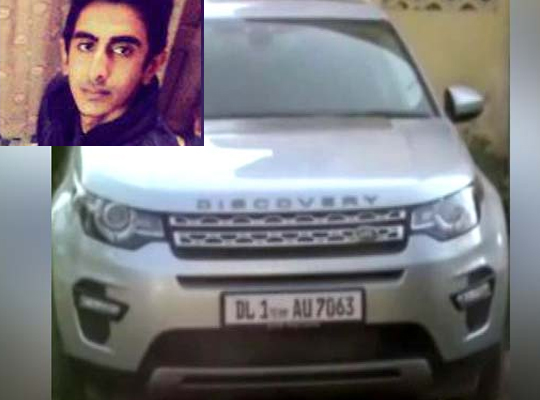
Aditya Sachdeva, the son of a prominent businessman, was travelling in his Swift car with his friend when he allegedly overtook the Range Rover that belonged to JD(U) leader Manorama Devi's family. Her son, Rocky was travelling in it along with a security guard provided by the Bihar Police for the politician.

Aditya's friend who was with him in the car has told the police that soon after they overtook the SUV, Rocky and the guard started firing in the air to stop them.

"We were returning from Bodh Gaya. Soon after we overtook their Range Rover, they started firing in the air and made us stop. Then they forced us to get out of the car and started punching us. When we tried to leave the spot, someone fired and my friend got hit," he said.

Comments

Kaizer
 - 
Monday, 9 May 2016

If india gives him same punishment then assume that india is developed, in india criminals are given more respect than the victims.

Rikaz
 - 
Sunday, 8 May 2016

Insane person. why dont you give him similar punishment....

Priyamani
 - 
Sunday, 8 May 2016

Leave Bihar Campaign :)

Shiva
 - 
Sunday, 8 May 2016

Is controlling criminals important or fighting against Modi important? Nitish and KC Tyagi, please tell us

Prem Sagar
 - 
Sunday, 8 May 2016

Shameless act from a political goonda. BTW had it been a BJP politician's son, CD would have had BJP in the headline. No I am not condoning the act if it was a BJP politician's son involved, I am just talking about how biased this channel is.

Prem Sagar
 - 
Sunday, 8 May 2016

if the leader in the SUV was a BJP leader, your headline would have screamed the word BJP. Bajrangi RSS etc!

Prem Sagar
 - 
Sunday, 8 May 2016

That politician's son is going to be get caught and will soon be released without facing any punishment.
that's how it happens in India!!!

Shivamani
 - 
Sunday, 8 May 2016

in case of BJP politician, headline would have been ' BJP politician shoots 19 year old boy'. Since crime is committed by a non BJP politician, it only says politician in hearing.
This how the journalists manipulate the news.

Sham Singh
 - 
Sunday, 8 May 2016

Biharis Deserves... who voted corrupt Goonda Rajya

Preethi
 - 
Sunday, 8 May 2016

CM Nithish Kumar is in Kerala, he want the Kerala to be made same like Bihar.

Kiran Rao
 - 
Sunday, 8 May 2016

Nitish Kumar is busy trying to cobble up a coalition in his desperate attempt to become the PM of this country. Meanwhile, the state is ruled by Lalu and his sons. So the jungle raj continues in Bihar.

Menazuddin
 - 
Sunday, 8 May 2016

its time to make bihar, up, wb ,delhi and kerala as independent nations. kick all these aholes from rest of india, let them solve their civility issue themselves.
gutter people

Ashik
 - 
Sunday, 8 May 2016

THERE IS TOTAL JUNGLE RAJ PREVAILING IN BIHAR SINCE LAST 25 YEARS DURING RJD- JD(U) MISRULE. NITISH KUMAR IS RUNNING GOVT WITH HELP OF CORRUPT MEDIAS WHO ARE GETTING HUGE MONEY I.E. HUNDREDS OF CRORES PER ANNUM FROM JD(U) GOVT FOR FLASHING ROSY PICTURE OF CORRUPT AND WORST NITISH GOVT. LALOO HAS RETURNED REIGN OF TERROR IN STATE WHERE HIS COMMUNITY IS INDULGED IN MASS ANTI-NATIONAL ACTIVITIES LIKE NAXALISM, MURDERS, DACOITIES, KIDNAPPING ETC. THIS IS BEYOND CAPACITY OF CM TO CONTROL IT. SO PEOPLE OF BIHAR IS BOUND TO SUFFER FOR ELECTING CORRUPT AND WORST PERFORMING GOVT WHEN THERE WILL BE NO PEACE AND PROSPERITY.

Add new comment

  • Coastaldigest.com reserves the right to delete or block any comments.
  • Coastaldigset.com is not responsible for its readers’ comments.
  • Comments that are abusive, incendiary or irrelevant are strictly prohibited.
  • Please use a genuine email ID and provide your name to avoid reject.
News Network
March 25,2020

Bengaluru, Mar 25: The COVID-19 count in Karnataka went up by 10 on Wednesday, reaching 51. The 10 new positives included two girls aged seven and nine who contracted the infection from their father.

The 34-year-old man had returned from Amsterdam on March 19 and tested positive as the 17th confirmed case in Karnataka.

Though his family were kept in isolation and under quarantine in their house, the children developed a cold. They were confirmed for COVID-19 infection while their mother is still negative.

The government remained tightlipped over whether or not a 70-year-old woman from Gouribidanuru who was put under house quarantine and died on Wednesday morning, tested positive for COVID-19. Government officials would neither confirm nor deny anything on the results of tests on the woman.

This evening’s bulletin issued by the Karnataka health department continued to indicate the strong correlation of coronavirus infection and foreign travel.

Among the positive cases identified today were

A 63-year-old Bengaluru man and his 59-year-old wife, with a history of travel to Brazil and Argentina.
Two 26-year-old men with a history of travel to Spain and arrived back in Bengaluru via Dubai.
Two others, a 63-year-old woman and her 69-year-old husband, had a history of travel to Athens and London.
A 34-year-old man, a resident of Udupi, who returned from Dubai
A 37-year old woman, a resident of Chitradurga, with a history of travel to Guyana and arrived back in Bengaluru via Delhi
Speaking to the media, medical education minister K Sudhakar said health officials were apprehensive the positives may go up tonight.

Of the corona positive cases detected in Karnataka so far, three have been discharged after quarantine, and 47 patients are in isolation at designated hospitals in a stable condition. There has been one fatality.

As per a recommendation by the high-level health committee, the government has decided to convert the Bowring Hospital into a coronavirus treatment hospital facility along with the Rajiv Gandhi Hospital for Chest Diseases and Victoria Hospital. 

“The number of positive cases are growing at an alarming rate and the government needs more treatment facilities. The government is for burning of COVID-19 death cases. However, due to some religious practices, it has been decided they would be buried in 8 ft deep pits,'' Dr Sudhakar said.

Comments

Add new comment

  • Coastaldigest.com reserves the right to delete or block any comments.
  • Coastaldigset.com is not responsible for its readers’ comments.
  • Comments that are abusive, incendiary or irrelevant are strictly prohibited.
  • Please use a genuine email ID and provide your name to avoid reject.
News Network
August 4,2020

Bengaluru, Aug 4: With preparations underway for conducting exams for the final semester/ year students in the state, Karnataka Deputy Chief Minister Dr CN Ashwathnarayan on Monday directed the respective universities to conduct exams for the backlog papers as well.

"In the wake of COVID-19, it has been decided to hold exams only for the students of final semester/year courses. It has come to our notice that some universities have decided against conducting exams for final year students who have a backlog to clear from previous semesters. This is unpardonable," the Deputy Chief Minister said.

"Our intention is to see that the final year students finish their course. In the present situation, conducting only final semester exams won't help. We have to help the students in clearing their backlogs," added Ashwathnarayan, directing all universities to compulsorily conduct these exams.

Meanwhile, Ashwathnarayan thanked the staff and officials of various government departments who were responsible for successfully conducting the CET exams even amidst the difficult situation in the wake of COVID-19 pandemic.

"In all, 1,94,419 students had registered for the CET exams, of which 1,75,428 wrote the exams. The percentage of students who took up the exams this year was equivalent to that of the previous years, in normal times," the DCM informed.

"After we successfully conducted the exams, Arunachal Pradesh is going to conduct the Public Service Commission exams on the lines of how we successfully conducted the exams. Likewise, even our KPSC has said it will conduct the exams. We must appreciate the good work of the Karnataka Examination Authority (KEA), which has set an example for others," Ashwathnarayan said.

The deputy chief minister said that 33 colleges in various districts across the state faced shortage of land and that it is the responsibility of the District Commissioners (DCs) to get the lands sanctioned for all these colleges.
In Bagalkot district alone land has not been sanctioned for six degree colleges, he said.

Reacting to this, Bagalkot DC Captain Rajendra assured to look into the matter as soon as he receives the proposal from department officials.

"Similarly, there is shortage of land for five Diploma colleges and 28 ITI colleges in different parts of the state. The DCs must immediately pay attention to this. Once they get the land, buildings will come up within no time," the Karnataka deputy chief minister said.

Comments

Add new comment

  • Coastaldigest.com reserves the right to delete or block any comments.
  • Coastaldigset.com is not responsible for its readers’ comments.
  • Comments that are abusive, incendiary or irrelevant are strictly prohibited.
  • Please use a genuine email ID and provide your name to avoid reject.
Agencies
May 8,2020

Washington D.C., May 8: The prime time for brain development in a child's life is the first year, where the infant spends most of the time asleep. It is the time when neural connections form and sensory memories are encoded.

However, when sleep is disrupted, as occurs more often among children with autism, brain development may be affected, too.

New research led by the University of Washington finds that sleep problems in a baby's first 12 months may not only precede an autism diagnosis but also may be associated with altered growth trajectory in a key part of the brain, the hippocampus.

The study, which was published in the American Journal of Psychiatry, researchers report that in a sample of more than 400 taken of 6- to 12-month-old infants, those who were later diagnosed with autism were more likely to have had difficulty falling asleep.

It also states that this sleep difficulty was associated with altered growth trajectories in the hippocampus.

"The hippocampus is critical for learning and memory, and changes in the size of the hippocampus have been associated with poor sleep in adults and older children.

As many as 80 per cent of the children with autism spectrum disorder have sleep problems," said Annette Estes, director of the UW Autism Center and senior author of the study.

"In our clinical experience, parents have a lot of concerns about their children's sleep, and in our work on early autism intervention, we observed that sleep problems were holding children and families back," added Estes, who is also a UW professor of speech and hearing sciences.

"It could be that altered sleep is part-and-parcel of autism for some children. One clue is that behavioural interventions to improve sleep don't work for all children with autism, even when their parents are doing everything just right. This suggests that there may be a biological component to sleep problems for some children with autism," said Estes.

To consider links among sleep, brain development, and autism, researchers at the IBIS Network looked at MRI scans of 432 infants, surveyed parents about sleep patterns, and measured cognitive functioning using a standardized assessment.

At the outset of the study, infants were classified according to their risk for developing autism: Those who were at higher risk of developing autism -- about two-thirds of the study sample -- had an older sibling who had already been diagnosed.

Infant siblings of children with autism have a 20 per cent chance of developing autism spectrum disorder -- a much higher risk than children in the general population.

In the current study, 127 of the 432 infants were identified as "low risk" at the time the MRI scans were taken because they had no family history of autism.

They later evaluated all the participants at 24 months of age to determine whether they had developed autism. Of the roughly 300 children originally considered "high familial risk," 71 were diagnosed with autism spectrum disorder at that age.

Problems with sleep were more common among the infants later diagnosed with an autism spectrum disorder, as were larger hippocampi. No other subcortical brain structures were affected, including the amygdala, which is responsible for certain emotions and aspects of memory, or the thalamus, a signal transmitter from the spinal cord to the cerebral cortex.

The authors note that while parents reported more sleep difficulties among infants who developed autism compared to those who did not, the differences were very subtle and only observed when looking at group averages across hundreds of infants.

Sleep patterns in the first years of life change rapidly as infants transition from sleeping around the clock to a more adult-like sleep/wake cycle. Until further research is completed, Estes said, it is not possible to interpret challenges with sleep as an early sign of increased risk for autism.

Comments

Add new comment

  • Coastaldigest.com reserves the right to delete or block any comments.
  • Coastaldigset.com is not responsible for its readers’ comments.
  • Comments that are abusive, incendiary or irrelevant are strictly prohibited.
  • Please use a genuine email ID and provide your name to avoid reject.