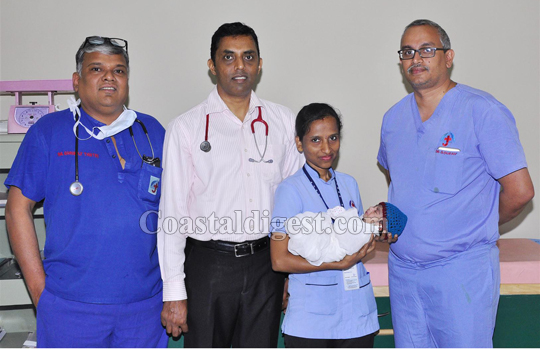
2-day-old baby operated for complex heart problem in Mangaluru

[email protected] (CD Network)
February 8, 2017

Managluru, Feb 8: A 2-days old baby weighing 2.3 kgs was admitted to the NICU at A.J. Hospital & Research Centre in the city in Jan 2017. The baby was diagnosed with transposition of great arteries in the 5th month of pregnancy when a foetal Echo was performed by Dr Prem Alva, Children's Heart Specialist at AJ hospital, Mangaluru.

aj copy

This is a condition where the 2 major blood vessels leaving the heart are connected to the wrong chambers of the heart thus the blood containing oxygen which is required to nourish the body goes back into the lungs instead, requiring urgent surgery.

Even though this condition accounts for approximately 5% of all children born with heart diseases, it is one of the few conditions that require surgery immediately after birth.

The parents counseled by Dr Gourav S Shetty Children's Heart Surgeon at AJ Hospital, Mangalore who has performed more than 200 surgeries of children over a period of 2 years in AJ Hospital explained why this procedure was complex and needed expertise.

It was carried out on a heart smaller than an egg, the 2 major arteries smaller than a little finger and the vessels supplying blood to the heart smaller than ball point refill, all these abnormally coming from the heart needed to be corrected.

After a successful surgery by Dr Gourav S Shetty & his team, Dr Gururaj Tantry,Chief Cardiac Anesthetist & Intensivist, Dr Suhas Anesthetist and his team then successfully managed the baby in ITU.

The baby was discharged on the 7th day from hospital. Follow up was a week later with a healthy baby and very happy parents.

A.J. Hospital & Research Centre is the only Centre in coastal region which has the expertise to conduct such complex surgeries even on the new borns.

Comments

Nawaz.g.h/bantwal
 - 
Thursday, 9 Feb 2017

Congratulation dr prem alwa.and dr gourav shetty..every one pray for him..allah bless u.

Dr.Shafeeq
 - 
Wednesday, 8 Feb 2017

Dr.Gourav, I am proud to be your classmate
Congratulations

B.M.IQBAL
 - 
Wednesday, 8 Feb 2017

Congratulation Dr. Gourav S Shetty.
You Gave a New life to a new born Baby.
We wish you all the best.

Add new comment

  • Coastaldigest.com reserves the right to delete or block any comments.
  • Coastaldigset.com is not responsible for its readers’ comments.
  • Comments that are abusive, incendiary or irrelevant are strictly prohibited.
  • Please use a genuine email ID and provide your name to avoid reject.
Agencies
July 5,2020

The deadly coronavirus that entered India while there was still nip in the air has beaten rising mercury, humid conditions, unique Indian genome and has entered monsoon season with more potency as fresh cases are only breaking all records in the country.

India recorded a single-day spike of record 24,850 new coronavirus cases on Sunday, taking its total tally to 6.73 lakh corona-positive cases.

Top Indian microbiologists were hopeful in March that after the 21-day lockdown, as summer approaches, the rise in temperature would play an important role in preventing the drastic spread of COVID-19 virus in India.

Several virologists hinted that by June this year, the impact of COVID-19 would be less than what it appeared in March-April.

The claims have fallen flat as the virus is mutating fast, becoming more potent than ever.

According to experts, the novel coronavirus is a new virus whose seasonality and response to hot humid weather was never fully understood.

"The theory was based on the fact that high temperatures can kill the virus as in sterilisation techniques used in healthcare. But these are controlled environment conditions. There are many other factors besides temperature, humidity which influence the transmission rate among humans," Dr Anu Gupta, Head, Microbiologist and Infection Control, Fortis Escorts Heart Institute, told IANS.

There is no built-up immunity to COVID-19 in humans.

"Also, asymptomatic people might be passing it to many others unknowingly. New viruses tend not to follow the seasonal trend in their first year," Gupta emphasized.

Globally, as several countries are now experiencing hot weather, the World Health Organization (WHO) reported a record hike in the number of coronavirus cases, with the total rising by 2,12,326 in 24 hours in the highest single-day increase since COVID-19 broke out.

So far over 11 million people worldwide have tested positive for the disease which has led to over 5,25,000 deaths, according to data from Johns Hopkins University. The US remained the worst-hit country with over 28 lakh cases, followed by Brazil with 15.8 lakh.

According to Sandeep Nayar, Senior Consultant and HOD, Respiratory Medicine, Allergy & Sleep Disorders, BLK Super Speciality Hospital in New Delhi, whether temperature plays a role in COVID-19 infection is highly debated.

One school of thought said in the tropical regions of South Asia, the virus might not thrive longer.

"On the other hand, another school of thought has found that novel Coronavirus can survive in a hot and humid environment and tropical climate does not make a difference to the virus. According to them, this is what distinguishes the novel coronavirus from other common viruses, which usually wane in hot weather," stressed Nayar.

Not much has been studied in the past and no definite treatment or vaccine is available to date.

"Every day, new properties and manifestation of the disease come up. As of now, the only way to prevent this monster is by taking appropriate precautions. Hand hygiene, social distancing, cough etiquette and face masks definitely reduce spread of COVID-19 infection," Nayar told IANS.

Not just top Indian health experts, even Indian-American scientists had this theory in mind that sunshine and summer may ebb the spread of the coronavirus.

Ravi Godse, Director of Discharge Planning, UPMC Shadyside Pennsylvania in the US told IANS in April: "In the summer, the humidity can go up as well, meaning more water drops in the air. If the air is saturated with water and somebody sneezes virus droplets into such air, it is likely that the droplets will fall to the ground quicker, making them less infectious. So the short answer is yes, summer/sunshine could be bettera.

According to Dr Puneet Khanna, Head of Respiratory Medicine and Pulmonology, Manipal Hospital, Delhi, COVID-19 death rates are not too different in tropical countries but since the disease affected them late it was yet to show its peak in these areas.

"The virus can survive well in hot and humid countries and this is proven now," he stressed.

Comments

Add new comment

  • Coastaldigest.com reserves the right to delete or block any comments.
  • Coastaldigset.com is not responsible for its readers’ comments.
  • Comments that are abusive, incendiary or irrelevant are strictly prohibited.
  • Please use a genuine email ID and provide your name to avoid reject.
News Network
June 18,2020

Bengaluru, Jun 18: Bruhat Bengaluru Mahanagara Palike (BBMP) has deployed a COVID-19 infection control "surveillance team" to look after travellers coming from other states.

Those coming to Bengaluru Urban and Bengaluru Rural Districts must undergo a 14-day home quarantine.

The Bengaluru Mayor today inaugurated surveillance team at Dr Raj Kumar Glass House.

Deputy Mayor Ramamohan Raju, Health Standing Committee Chairman Manjunath Raju G, Special Commissioners D Randeep, Manjunath, Superintendent of Police Mr Murugan and other officials were also present in the event.

There are 7,944 coronavirus cases in Karnataka including 2,843 active cases and 4,983discharged. 114 patients have succumbed to COVID-19 in the state. 844 positive cases were reported in Bengaluru Urban and 39 in Bengaluru Rural.

Comments

Add new comment

  • Coastaldigest.com reserves the right to delete or block any comments.
  • Coastaldigset.com is not responsible for its readers’ comments.
  • Comments that are abusive, incendiary or irrelevant are strictly prohibited.
  • Please use a genuine email ID and provide your name to avoid reject.
News Network
January 30,2020

Udupi, Jan 30: Fishermen in Udupi’s Malpe have netted ‘spanner crab’, a rare variety of deep sea crab, mostly found in Australia and Hawaiian coast.

Hundreds of onlookers were surprised to the see the catch when it was brought to Malpe harbour by the fisherman Prashanth Kunder and others on Tuesday evening.

Dr Shivakumar Haragi, Assistant Professor at Karnatak University, PG Centre Department of Marine Biology, Karwar identified this crab variety as ‘spanner crab’ and the scientific name of this crab is Ranina Ranina.

Ranina Ranina is mainly nocturnal as it remains active during night and is found buried in sand during the day .It is easily distinguished from other crab species in its habitat due to its red carapace and elongated midsection.

Resembling a frog in its shape, this crab species is found mainly in Africa, Hawaiian coast and also in the Great Barrier Reef, located in the Coral Sea, off the coast of Queensland, Australia. Its lifetime is seven to nine years and each crab weighs around 400-900 grams.

Prashanth Kunder and his associates have also netted a rare fish variety called yellow-edged lyretail. Another unique variety fish netted by Prashanth is epinephelus flavocaeruleus.

Comments

Add new comment

  • Coastaldigest.com reserves the right to delete or block any comments.
  • Coastaldigset.com is not responsible for its readers’ comments.
  • Comments that are abusive, incendiary or irrelevant are strictly prohibited.
  • Please use a genuine email ID and provide your name to avoid reject.