


27 new cities including Mangaluru make it to Smart City list

[email protected] (CD Network)
September 20, 2016

Mangaluru, Sep 20: Mangaluru, Hubbali-Dharwad, Shivamogga and Tumkaru cites from south Indian state of Karnataka made it to the list of 27 Smart Cities that was announced on Tuesday.
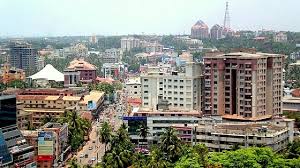
1mangaluruPM Narendra Modi's Lok Sabha constituency Varanasi, Vadodara, Agra, Nagpur, Ajmer, Amritsar, Gwalior, Thane and Thanjavur are some of the other cities that have been named to be developed as smart cities. The 27 cities will require investment of Rs 66,883 crore.

So far, the urban development ministry has selected 60 cities in three rounds and has covered 27 states and Union Territories. Only nine more states and UTs are still to get on board including Uttarakhand and Jammu and Kashmir.
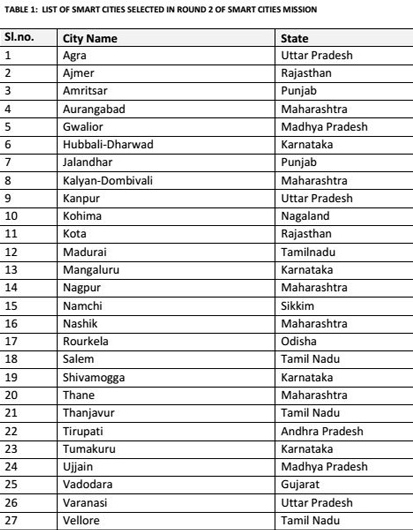
1smartcityA maximum of five cities from Maharashtra have found place in the list of new cities that was released by Union urban development minister M Venkaiah Naidu on Tuesday. Four cities, each from Tamil Nadu and Karnataka, have made it to the list followed by three from Uttar Pradesh and two each from Madhya Pradesh, Punjab and Rajasthan. One city each from Madhya Pradesh, Andhra Pradesh, Odisha, Gujarat, Sikkim and Nagaland has been selected in this round.

According to urban development ministry's estimate, Rs 1.44 lakh crore investment has been proposed by the 60 cities that have been selected so far under their smart city plans. Officials said that 82 projects are already under implementation in the first batch of 20 smart cities and another 113 projects will soon take off the ground. Naidu said in the next one year, one would get to see smart cities taking shape.

Under the Smart City mission, the Central government provides Rs 500 crore for each city over five years with states making matching contribution. The rest of resources will come from loans, public private partnership (PPP), convergence of various schemes of Central and state governments besides own resources of urban local bodies.

So the ministry has tied up multi-lateral lending from agencies DFID of UK and JICA, who have committed $ 500 million each. Similarly, ADB and World Bank have committed $ 1 billion. The New Development Bank (BRICS Bank) has proposed to provide finance for projects up to $ 500 million per city.

Comments

Shantipriya
 - 
Wednesday, 21 Sep 2016

We need SAFE CITIES before SMART CITIES. Accordingly, we need SAFE MANGALORE before SMART MANGALORE.

Once, the people feel and realise that MANGALORE is SAFE, then definitely Smart projects can follow.

Just projecting Smart Mangalore without SAFETY cannot be justified.

As somebody said, we need smart Ministers and smart government authorities to maintain the SAFETY and WELFARE of the MANGALOREAN people

True indian
 - 
Tuesday, 20 Sep 2016

People like viren kotian. Doesn't fit in the smart city. Send him to thailand again.

Rikaz
 - 
Tuesday, 20 Sep 2016

Its a great news for Mangaloreans.

Smarter
 - 
Tuesday, 20 Sep 2016

No need Smart cities , We need smart ministers who can take care of the problems of the society in a smarter way rather then fooling and lying to the society.

Bhageerata Bhaira
 - 
Tuesday, 20 Sep 2016

people of these so called smart cities will pay heavily in the form of tax. This govt is creating tax terrorism against common people and feeding the global tycoons.

Jahnavi
 - 
Tuesday, 20 Sep 2016

I read many articles about smart cities and finally came to a conclusion that i cant understand it fully.

Add new comment

  • Coastaldigest.com reserves the right to delete or block any comments.
  • Coastaldigset.com is not responsible for its readers’ comments.
  • Comments that are abusive, incendiary or irrelevant are strictly prohibited.
  • Please use a genuine email ID and provide your name to avoid reject.
coastaldigest.com web desk
June 27,2020

New Delhi, June 27: The Prime Minister Narendra Modi-led union government of India is not ready to stop all imports from aggressive China in spite of mount calls to boycott Chinese products in India.

The Centre is reportedly considering to stop only non-essential imports from the neighbouring country.

However, the Inward shipment in sectors such as automobiles, pharmaceuticals, certain electronics and others will continue until a domestic alternative is found.

“India will gradually move towards import substitution. It will not happen overnight. In the meantime, attention has to be paid on production and job creation. We cannot throttle our industry. There are certain absolutely essential imports. Needless to say, those will keep going,” official sources said.

Sources said that both the government and the industry are in the process of identifying products that can be domestically manufactured in the medium term. There are certain chemicals, automotive components, handicrafts, cosmetics, agriculture items and certain consumer electronics, which can be manufactured domestically in the short to medium term. The government is doing all it can to raise the capacity of domestic industries.

However, there are certain other imports in the automobile and the pharmaceutical sectors which cannot be done away within the short to medium term. Their domestic production at the moment may not be that cost-effective.

The six-crore strong traders’ body CAIT has been at the forefront of such a demand and has launched a campaign to celebrate Indian Diwali this year with a total absence of Chinese goods.

“Ease of doing business, capital availability at lower rates and globally competitive logistics and energy costs are some of the prerequisites that the government should look into to ensure the growth of the domestic auto component industry,” according to Automotive Component Manufacturers Association of India (ACMA) Director General Vinnie Mehta.

Maruti Suzuki Chairman R C Bhargava said, “People who are boycotting Chinese goods have to remember that in some cases it may lead to their being asked to pay more for the same product."

Meanwhile, domestic rating agency Acuite Ratings & Research has analysed the current import portfolio from China and found 40 sub-sectors have the potential to lower their import dependency on China. These sectors contribute to $33.6 billion worth of imports from China and about 25% of these imports can be substituted by local manufacturing without any significant additional investments.

Comments

Add new comment

  • Coastaldigest.com reserves the right to delete or block any comments.
  • Coastaldigset.com is not responsible for its readers’ comments.
  • Comments that are abusive, incendiary or irrelevant are strictly prohibited.
  • Please use a genuine email ID and provide your name to avoid reject.
News Network
March 25,2020

Bengaluru, Mar 24: The state government on Tuesday published names and addresses of 14,000 people who have been placed under home quarantine, on its website.  

A district wise break up of the home quarantine patients was also provided.  

Notably, the number of coronavirus cases has risen to 41 in the state.

Comments

Add new comment

  • Coastaldigest.com reserves the right to delete or block any comments.
  • Coastaldigset.com is not responsible for its readers’ comments.
  • Comments that are abusive, incendiary or irrelevant are strictly prohibited.
  • Please use a genuine email ID and provide your name to avoid reject.
News Network
May 10,2020

May 10: Azaan is an integral part of the faith, not the gadget, says veteran writer-lyricist Javed Akhtar, asking that the Islamic call to prayer on loudspeakers should be stopped as it causes "discomfort" to others.

In a tweet on Saturday, Akhtar wondered why the practice was 'halaal' (allowed) when it was, for nearly half a century in the country, considered 'haraam' or forbidden.

"In India for almost 50 years Azaan on the loud speak was Haraam. Then it became Halaal and so halaal that there is no end to it, but there should be an end to it. Azaan is fine but loud speaker does cause of discomfort for others. I hope that atleast this time they will do it themselves (sic)," Akhtar tweeted.

When a user asked his opinion on loudspeakers being used in temples, the 75-year-old writer said everyday use of speakers is a cause of concern.

"Whether it's a temple or a mosque, if you're using loudspeakers during a festival, it's fine. But it shouldn't be used everyday in either temples or mosques.

"For more than thousand years Azaan was given without the loud speaker. Azaan is the integral part of your faith, not this gadget," he replied.

Earlier in March, Akhtar had supported the demand to shut mosques amid the coronavirus outbreak in the country, saying even Kaaba and Medina have been closed due to the pandemic.

He had also appealed to the Muslim community to offer prayers from home in the holy month of Ramzan, which began on April 24.

"I request all the Muslim brothers that now that Ramzan is coming, please say your prayers but make sure that this doesn't cause problems to anyone else. The prayers that you do in the mosque, you can do that at home. According to you, the house, the ground, this all has been made by Him. Then you can do your prayers anywhere," he had said.

Comments

Add new comment

  • Coastaldigest.com reserves the right to delete or block any comments.
  • Coastaldigset.com is not responsible for its readers’ comments.
  • Comments that are abusive, incendiary or irrelevant are strictly prohibited.
  • Please use a genuine email ID and provide your name to avoid reject.