


27 new cities including Mangaluru make it to Smart City list

[email protected] (CD Network)
September 20, 2016

Mangaluru, Sep 20: Mangaluru, Hubbali-Dharwad, Shivamogga and Tumkaru cites from south Indian state of Karnataka made it to the list of 27 Smart Cities that was announced on Tuesday.
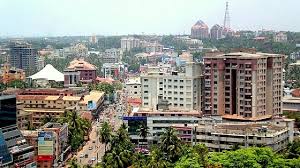
1mangaluruPM Narendra Modi's Lok Sabha constituency Varanasi, Vadodara, Agra, Nagpur, Ajmer, Amritsar, Gwalior, Thane and Thanjavur are some of the other cities that have been named to be developed as smart cities. The 27 cities will require investment of Rs 66,883 crore.

So far, the urban development ministry has selected 60 cities in three rounds and has covered 27 states and Union Territories. Only nine more states and UTs are still to get on board including Uttarakhand and Jammu and Kashmir.
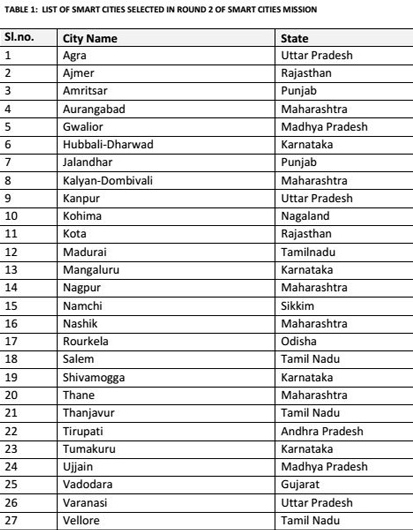
1smartcityA maximum of five cities from Maharashtra have found place in the list of new cities that was released by Union urban development minister M Venkaiah Naidu on Tuesday. Four cities, each from Tamil Nadu and Karnataka, have made it to the list followed by three from Uttar Pradesh and two each from Madhya Pradesh, Punjab and Rajasthan. One city each from Madhya Pradesh, Andhra Pradesh, Odisha, Gujarat, Sikkim and Nagaland has been selected in this round.

According to urban development ministry's estimate, Rs 1.44 lakh crore investment has been proposed by the 60 cities that have been selected so far under their smart city plans. Officials said that 82 projects are already under implementation in the first batch of 20 smart cities and another 113 projects will soon take off the ground. Naidu said in the next one year, one would get to see smart cities taking shape.

Under the Smart City mission, the Central government provides Rs 500 crore for each city over five years with states making matching contribution. The rest of resources will come from loans, public private partnership (PPP), convergence of various schemes of Central and state governments besides own resources of urban local bodies.

So the ministry has tied up multi-lateral lending from agencies DFID of UK and JICA, who have committed $ 500 million each. Similarly, ADB and World Bank have committed $ 1 billion. The New Development Bank (BRICS Bank) has proposed to provide finance for projects up to $ 500 million per city.

Comments

Shantipriya
 - 
Wednesday, 21 Sep 2016

We need SAFE CITIES before SMART CITIES. Accordingly, we need SAFE MANGALORE before SMART MANGALORE.

Once, the people feel and realise that MANGALORE is SAFE, then definitely Smart projects can follow.

Just projecting Smart Mangalore without SAFETY cannot be justified.

As somebody said, we need smart Ministers and smart government authorities to maintain the SAFETY and WELFARE of the MANGALOREAN people

True indian
 - 
Tuesday, 20 Sep 2016

People like viren kotian. Doesn't fit in the smart city. Send him to thailand again.

Rikaz
 - 
Tuesday, 20 Sep 2016

Its a great news for Mangaloreans.

Smarter
 - 
Tuesday, 20 Sep 2016

No need Smart cities , We need smart ministers who can take care of the problems of the society in a smarter way rather then fooling and lying to the society.

Bhageerata Bhaira
 - 
Tuesday, 20 Sep 2016

people of these so called smart cities will pay heavily in the form of tax. This govt is creating tax terrorism against common people and feeding the global tycoons.

Jahnavi
 - 
Tuesday, 20 Sep 2016

I read many articles about smart cities and finally came to a conclusion that i cant understand it fully.

Add new comment

  • Coastaldigest.com reserves the right to delete or block any comments.
  • Coastaldigset.com is not responsible for its readers’ comments.
  • Comments that are abusive, incendiary or irrelevant are strictly prohibited.
  • Please use a genuine email ID and provide your name to avoid reject.
News Network
July 12,2020

Mangaluru, Jul 12: Mangaluru City Corporation Commissioner tested positive for COVID-19 on Sunday.

He was suffering from fever since the last few days and today his swab results came out positive.

He is currently undergoing treatment at a private hospital in the city and his condition is stated to be stable.

Comments

Add new comment

  • Coastaldigest.com reserves the right to delete or block any comments.
  • Coastaldigset.com is not responsible for its readers’ comments.
  • Comments that are abusive, incendiary or irrelevant are strictly prohibited.
  • Please use a genuine email ID and provide your name to avoid reject.
Agencies
July 5,2020

The deadly coronavirus that entered India while there was still nip in the air has beaten rising mercury, humid conditions, unique Indian genome and has entered monsoon season with more potency as fresh cases are only breaking all records in the country.

India recorded a single-day spike of record 24,850 new coronavirus cases on Sunday, taking its total tally to 6.73 lakh corona-positive cases.

Top Indian microbiologists were hopeful in March that after the 21-day lockdown, as summer approaches, the rise in temperature would play an important role in preventing the drastic spread of COVID-19 virus in India.

Several virologists hinted that by June this year, the impact of COVID-19 would be less than what it appeared in March-April.

The claims have fallen flat as the virus is mutating fast, becoming more potent than ever.

According to experts, the novel coronavirus is a new virus whose seasonality and response to hot humid weather was never fully understood.

"The theory was based on the fact that high temperatures can kill the virus as in sterilisation techniques used in healthcare. But these are controlled environment conditions. There are many other factors besides temperature, humidity which influence the transmission rate among humans," Dr Anu Gupta, Head, Microbiologist and Infection Control, Fortis Escorts Heart Institute, told IANS.

There is no built-up immunity to COVID-19 in humans.

"Also, asymptomatic people might be passing it to many others unknowingly. New viruses tend not to follow the seasonal trend in their first year," Gupta emphasized.

Globally, as several countries are now experiencing hot weather, the World Health Organization (WHO) reported a record hike in the number of coronavirus cases, with the total rising by 2,12,326 in 24 hours in the highest single-day increase since COVID-19 broke out.

So far over 11 million people worldwide have tested positive for the disease which has led to over 5,25,000 deaths, according to data from Johns Hopkins University. The US remained the worst-hit country with over 28 lakh cases, followed by Brazil with 15.8 lakh.

According to Sandeep Nayar, Senior Consultant and HOD, Respiratory Medicine, Allergy & Sleep Disorders, BLK Super Speciality Hospital in New Delhi, whether temperature plays a role in COVID-19 infection is highly debated.

One school of thought said in the tropical regions of South Asia, the virus might not thrive longer.

"On the other hand, another school of thought has found that novel Coronavirus can survive in a hot and humid environment and tropical climate does not make a difference to the virus. According to them, this is what distinguishes the novel coronavirus from other common viruses, which usually wane in hot weather," stressed Nayar.

Not much has been studied in the past and no definite treatment or vaccine is available to date.

"Every day, new properties and manifestation of the disease come up. As of now, the only way to prevent this monster is by taking appropriate precautions. Hand hygiene, social distancing, cough etiquette and face masks definitely reduce spread of COVID-19 infection," Nayar told IANS.

Not just top Indian health experts, even Indian-American scientists had this theory in mind that sunshine and summer may ebb the spread of the coronavirus.

Ravi Godse, Director of Discharge Planning, UPMC Shadyside Pennsylvania in the US told IANS in April: "In the summer, the humidity can go up as well, meaning more water drops in the air. If the air is saturated with water and somebody sneezes virus droplets into such air, it is likely that the droplets will fall to the ground quicker, making them less infectious. So the short answer is yes, summer/sunshine could be bettera.

According to Dr Puneet Khanna, Head of Respiratory Medicine and Pulmonology, Manipal Hospital, Delhi, COVID-19 death rates are not too different in tropical countries but since the disease affected them late it was yet to show its peak in these areas.

"The virus can survive well in hot and humid countries and this is proven now," he stressed.

Comments

Add new comment

  • Coastaldigest.com reserves the right to delete or block any comments.
  • Coastaldigset.com is not responsible for its readers’ comments.
  • Comments that are abusive, incendiary or irrelevant are strictly prohibited.
  • Please use a genuine email ID and provide your name to avoid reject.
coastaldigest.com news network
June 5,2020

Bengaluru, Jun 5: Karnataka registered its highest single-day spike of more than 500 new COVID-19 cases, taking the total number of infections in the state to 4,835, the health department said on Friday.

The previous biggest single-day spurt was recorded on June 2 with 388 cases.

Of the 515 fresh cases reported, 482 are returnees from other states, mostly (about 471) from neighboring Maharashtra. Udupi district saw a major spike with over 200 cases today and the total tally of the district breaching seven hundred cases mark, to stand at 768.

As of June 5 evening, cumulatively 4,835 COVID-19 positive cases have been confirmed in the state, which includes 57 deaths and 1,688 discharges, the department said in its bulletin.

It said, out of 3,088 active cases, 3,075 patients are in isolation at designated hospitals and are stable, while 13 are in ICU.

On Friday, 83 patients have been discharged.

According to state COVID-19 war room data, out of the total 4,835 cases, 93 per cent (4,488 cases) are asymptomatic and 7 per cent (347) are symptomatic.

The new cases include 471 from Maharashtra, three from Delhi, two each from Andhra Pradesh, Telangana and Haryana, and one from Tamil Nadu.

While one is with international travel history from Indonesia. Remaining cases include- contacts of patients earlier tested positive, those from containment zones, those who travelled from other districts, and the ones whose contact history is still being traced.

Among the districts where new cases were reported, Udupi accounts for 204 cases, followed by 74 from Yadgir, Vijayapura 53, Kalaburagi 42, Bidar 39, Belagavi 36, Mandya 13, Bengaluru Rural 12, Bengaluru Urban 10, Dakshina Kannada 8, Uttara Kannada 7, three each from Hassan, Dharwad and Chikkaballapura, two each from Ramanagara and Haveri, and one each from Davangere, Bagalkote, Ballari and Kolar.

Udupi district tops the list of positive cases, with a total of 768 infections, followed by Kalaburagi 552 and Bengaluru urban 434.

Among discharges, Bengaluru urban still tops the list with total 271 discharges, followed by Davangere 147 and Mandya 146.

A total of 3,60,720 samples were tested so far, out of which 13,627 were tested on Friday alone.

So far 3,49,951 samples have reported as negative, and out of them 12,797 were reported negative on Friday.

Comments

Add new comment

  • Coastaldigest.com reserves the right to delete or block any comments.
  • Coastaldigset.com is not responsible for its readers’ comments.
  • Comments that are abusive, incendiary or irrelevant are strictly prohibited.
  • Please use a genuine email ID and provide your name to avoid reject.