


27 new cities including Mangaluru make it to Smart City list

[email protected] (CD Network)
September 20, 2016

Mangaluru, Sep 20: Mangaluru, Hubbali-Dharwad, Shivamogga and Tumkaru cites from south Indian state of Karnataka made it to the list of 27 Smart Cities that was announced on Tuesday.
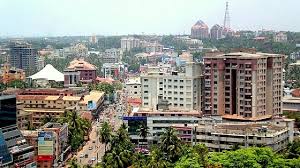
1mangaluruPM Narendra Modi's Lok Sabha constituency Varanasi, Vadodara, Agra, Nagpur, Ajmer, Amritsar, Gwalior, Thane and Thanjavur are some of the other cities that have been named to be developed as smart cities. The 27 cities will require investment of Rs 66,883 crore.

So far, the urban development ministry has selected 60 cities in three rounds and has covered 27 states and Union Territories. Only nine more states and UTs are still to get on board including Uttarakhand and Jammu and Kashmir.
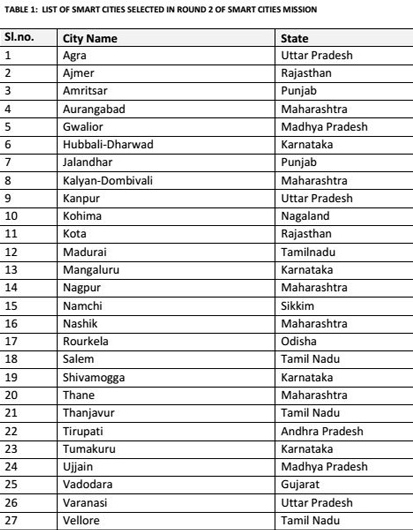
1smartcityA maximum of five cities from Maharashtra have found place in the list of new cities that was released by Union urban development minister M Venkaiah Naidu on Tuesday. Four cities, each from Tamil Nadu and Karnataka, have made it to the list followed by three from Uttar Pradesh and two each from Madhya Pradesh, Punjab and Rajasthan. One city each from Madhya Pradesh, Andhra Pradesh, Odisha, Gujarat, Sikkim and Nagaland has been selected in this round.

According to urban development ministry's estimate, Rs 1.44 lakh crore investment has been proposed by the 60 cities that have been selected so far under their smart city plans. Officials said that 82 projects are already under implementation in the first batch of 20 smart cities and another 113 projects will soon take off the ground. Naidu said in the next one year, one would get to see smart cities taking shape.

Under the Smart City mission, the Central government provides Rs 500 crore for each city over five years with states making matching contribution. The rest of resources will come from loans, public private partnership (PPP), convergence of various schemes of Central and state governments besides own resources of urban local bodies.

So the ministry has tied up multi-lateral lending from agencies DFID of UK and JICA, who have committed $ 500 million each. Similarly, ADB and World Bank have committed $ 1 billion. The New Development Bank (BRICS Bank) has proposed to provide finance for projects up to $ 500 million per city.

Comments

Shantipriya
 - 
Wednesday, 21 Sep 2016

We need SAFE CITIES before SMART CITIES. Accordingly, we need SAFE MANGALORE before SMART MANGALORE.

Once, the people feel and realise that MANGALORE is SAFE, then definitely Smart projects can follow.

Just projecting Smart Mangalore without SAFETY cannot be justified.

As somebody said, we need smart Ministers and smart government authorities to maintain the SAFETY and WELFARE of the MANGALOREAN people

True indian
 - 
Tuesday, 20 Sep 2016

People like viren kotian. Doesn't fit in the smart city. Send him to thailand again.

Rikaz
 - 
Tuesday, 20 Sep 2016

Its a great news for Mangaloreans.

Smarter
 - 
Tuesday, 20 Sep 2016

No need Smart cities , We need smart ministers who can take care of the problems of the society in a smarter way rather then fooling and lying to the society.

Bhageerata Bhaira
 - 
Tuesday, 20 Sep 2016

people of these so called smart cities will pay heavily in the form of tax. This govt is creating tax terrorism against common people and feeding the global tycoons.

Jahnavi
 - 
Tuesday, 20 Sep 2016

I read many articles about smart cities and finally came to a conclusion that i cant understand it fully.

Add new comment

  • Coastaldigest.com reserves the right to delete or block any comments.
  • Coastaldigset.com is not responsible for its readers’ comments.
  • Comments that are abusive, incendiary or irrelevant are strictly prohibited.
  • Please use a genuine email ID and provide your name to avoid reject.
Agencies
May 8,2020

Washington D.C., May 8: The prime time for brain development in a child's life is the first year, where the infant spends most of the time asleep. It is the time when neural connections form and sensory memories are encoded.

However, when sleep is disrupted, as occurs more often among children with autism, brain development may be affected, too.

New research led by the University of Washington finds that sleep problems in a baby's first 12 months may not only precede an autism diagnosis but also may be associated with altered growth trajectory in a key part of the brain, the hippocampus.

The study, which was published in the American Journal of Psychiatry, researchers report that in a sample of more than 400 taken of 6- to 12-month-old infants, those who were later diagnosed with autism were more likely to have had difficulty falling asleep.

It also states that this sleep difficulty was associated with altered growth trajectories in the hippocampus.

"The hippocampus is critical for learning and memory, and changes in the size of the hippocampus have been associated with poor sleep in adults and older children.

As many as 80 per cent of the children with autism spectrum disorder have sleep problems," said Annette Estes, director of the UW Autism Center and senior author of the study.

"In our clinical experience, parents have a lot of concerns about their children's sleep, and in our work on early autism intervention, we observed that sleep problems were holding children and families back," added Estes, who is also a UW professor of speech and hearing sciences.

"It could be that altered sleep is part-and-parcel of autism for some children. One clue is that behavioural interventions to improve sleep don't work for all children with autism, even when their parents are doing everything just right. This suggests that there may be a biological component to sleep problems for some children with autism," said Estes.

To consider links among sleep, brain development, and autism, researchers at the IBIS Network looked at MRI scans of 432 infants, surveyed parents about sleep patterns, and measured cognitive functioning using a standardized assessment.

At the outset of the study, infants were classified according to their risk for developing autism: Those who were at higher risk of developing autism -- about two-thirds of the study sample -- had an older sibling who had already been diagnosed.

Infant siblings of children with autism have a 20 per cent chance of developing autism spectrum disorder -- a much higher risk than children in the general population.

In the current study, 127 of the 432 infants were identified as "low risk" at the time the MRI scans were taken because they had no family history of autism.

They later evaluated all the participants at 24 months of age to determine whether they had developed autism. Of the roughly 300 children originally considered "high familial risk," 71 were diagnosed with autism spectrum disorder at that age.

Problems with sleep were more common among the infants later diagnosed with an autism spectrum disorder, as were larger hippocampi. No other subcortical brain structures were affected, including the amygdala, which is responsible for certain emotions and aspects of memory, or the thalamus, a signal transmitter from the spinal cord to the cerebral cortex.

The authors note that while parents reported more sleep difficulties among infants who developed autism compared to those who did not, the differences were very subtle and only observed when looking at group averages across hundreds of infants.

Sleep patterns in the first years of life change rapidly as infants transition from sleeping around the clock to a more adult-like sleep/wake cycle. Until further research is completed, Estes said, it is not possible to interpret challenges with sleep as an early sign of increased risk for autism.

Comments

Add new comment

  • Coastaldigest.com reserves the right to delete or block any comments.
  • Coastaldigset.com is not responsible for its readers’ comments.
  • Comments that are abusive, incendiary or irrelevant are strictly prohibited.
  • Please use a genuine email ID and provide your name to avoid reject.
News Network
May 27,2020

Bengaluru, May 27: Amid uncertainty caused by the Covid-19 pandemic, which has disrupted school education in Karnataka, the state government is seeking the help of the Union Ministry of Information and Broadcasting to televise classes, a state minister said on Tuesday.

"We request you to provide minimum three channels on the Doordarshan network exclusively for the Department of Public Instruction, Government of Karnataka," Primary and Secondary Education Minister Suresh Kumar said in a letter to Union I&B Minister Prakash Javadekar.

Suggesting co-branding the channels under DD and the state education department, he asked for the channels to be mandatorily transmitted by the cable and DTH operators under the Cable Act.

The state education department has already discussed with Prasar Bharti officials, who, according Kumar, have assured 3+3 hours of timeslots on the education channel Chandana on cost basis.

"We have also made all the necessary arrangements for content creation by the teachers," he said.

Meanwhile, the minister has revealed that television is the best medium for the students as a home learning mode in these challenging times.

"The department of public instruction reviewed various technological options and considered TV as one of the best means for home learning," Kumar said.

In a survey conducted by the education department, it was found out that 95 per cent households had television sets.

Kumar said the state operates government schools in nine languages, including Kannada, English and Urdu.

"To cater to all the students, and considering a long-term strategy to run schools by maintaining social distancing, we are in immediate need of minimum three exclusive channels to teach through TV," he said.

According to Kumar, the Karnataka government is facing hardships to meet the capital expenditure requirements, hence, it is seeking help from the I&B Ministry.

Comments

Add new comment

  • Coastaldigest.com reserves the right to delete or block any comments.
  • Coastaldigset.com is not responsible for its readers’ comments.
  • Comments that are abusive, incendiary or irrelevant are strictly prohibited.
  • Please use a genuine email ID and provide your name to avoid reject.
News Network
July 10,2020

Bengaluru, July 10: The Karnataka government has decided to hold examinations only for the final semester students of undergraduate (UG) and postgraduate (PG) in various universities of state and promote other semester students to the next level without holding any examination.

The decision was taken to safeguarding the students' interest as well as academic career of lakhs of students during the time of Covid-19 pandemic. The significant move by the Higher Education department was announced by Deputy Chief Minister Dr CN Ashwath Narayan who is also the minister for Higher Education.

The DCM announced that the examination for final semester UG and PG students will be conducted as per the guidelines issued by the University Grants Commission (UGC) by the end of September 2020.

As per the latest decision, all students who are either at the beginning or middle semester of their UG and PG courses will be promoted to next semester without any examination. The state government further made it clear that the latest decision would only be applicable for this academic year--2019-20.

The students will be promoted to the next semesters based on academic performances during the previous assessment.

Giving details of the decision, Dr CN Ashwath Narayan told media persons that the decision was taken in the interest of the students. "Keeping in mind the safety of students during Covid-19 pandemic times, the government has taken the decision. We have also discussed with education experts, former Vice Chancellors before arriving at this decision," he said.

The DCM also revealed that Governor Vajubhai Vala who is the Chancellor of all the universities has also given his consent for the decision. Students can call up on the department helpline 080-22341394 for any academic queries.

How will students be promoted?

The students who are pursuing UG and PG courses at mid semester levels will be evaluated internally based on their academic performance along with the marks scored during the previous semester or year.

"Based on this comprehensive evaluation, we will promote the students to next semester. But for the first semester students, they will be promoted entirely based on internal evaluation on academic performance," the Deputy Chief Minister explained.

In case if the students wish to improve their marks further, they can take the exams separately later. This apart, students with backlog subjects have also been allowed to carry those subjects further into the next semester subject to only the present academic year.

Comments

Add new comment

  • Coastaldigest.com reserves the right to delete or block any comments.
  • Coastaldigset.com is not responsible for its readers’ comments.
  • Comments that are abusive, incendiary or irrelevant are strictly prohibited.
  • Please use a genuine email ID and provide your name to avoid reject.