


27 new cities including Mangaluru make it to Smart City list

[email protected] (CD Network)
September 20, 2016

Mangaluru, Sep 20: Mangaluru, Hubbali-Dharwad, Shivamogga and Tumkaru cites from south Indian state of Karnataka made it to the list of 27 Smart Cities that was announced on Tuesday.
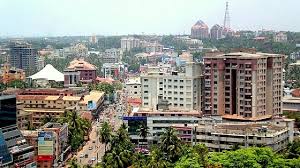
1mangaluruPM Narendra Modi's Lok Sabha constituency Varanasi, Vadodara, Agra, Nagpur, Ajmer, Amritsar, Gwalior, Thane and Thanjavur are some of the other cities that have been named to be developed as smart cities. The 27 cities will require investment of Rs 66,883 crore.

So far, the urban development ministry has selected 60 cities in three rounds and has covered 27 states and Union Territories. Only nine more states and UTs are still to get on board including Uttarakhand and Jammu and Kashmir.
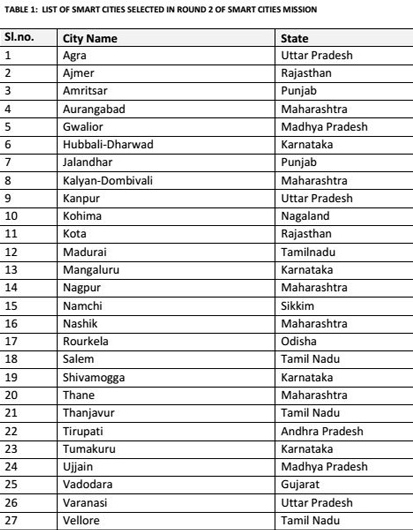
1smartcityA maximum of five cities from Maharashtra have found place in the list of new cities that was released by Union urban development minister M Venkaiah Naidu on Tuesday. Four cities, each from Tamil Nadu and Karnataka, have made it to the list followed by three from Uttar Pradesh and two each from Madhya Pradesh, Punjab and Rajasthan. One city each from Madhya Pradesh, Andhra Pradesh, Odisha, Gujarat, Sikkim and Nagaland has been selected in this round.

According to urban development ministry's estimate, Rs 1.44 lakh crore investment has been proposed by the 60 cities that have been selected so far under their smart city plans. Officials said that 82 projects are already under implementation in the first batch of 20 smart cities and another 113 projects will soon take off the ground. Naidu said in the next one year, one would get to see smart cities taking shape.

Under the Smart City mission, the Central government provides Rs 500 crore for each city over five years with states making matching contribution. The rest of resources will come from loans, public private partnership (PPP), convergence of various schemes of Central and state governments besides own resources of urban local bodies.

So the ministry has tied up multi-lateral lending from agencies DFID of UK and JICA, who have committed $ 500 million each. Similarly, ADB and World Bank have committed $ 1 billion. The New Development Bank (BRICS Bank) has proposed to provide finance for projects up to $ 500 million per city.

Comments

Shantipriya
 - 
Wednesday, 21 Sep 2016

We need SAFE CITIES before SMART CITIES. Accordingly, we need SAFE MANGALORE before SMART MANGALORE.

Once, the people feel and realise that MANGALORE is SAFE, then definitely Smart projects can follow.

Just projecting Smart Mangalore without SAFETY cannot be justified.

As somebody said, we need smart Ministers and smart government authorities to maintain the SAFETY and WELFARE of the MANGALOREAN people

True indian
 - 
Tuesday, 20 Sep 2016

People like viren kotian. Doesn't fit in the smart city. Send him to thailand again.

Rikaz
 - 
Tuesday, 20 Sep 2016

Its a great news for Mangaloreans.

Smarter
 - 
Tuesday, 20 Sep 2016

No need Smart cities , We need smart ministers who can take care of the problems of the society in a smarter way rather then fooling and lying to the society.

Bhageerata Bhaira
 - 
Tuesday, 20 Sep 2016

people of these so called smart cities will pay heavily in the form of tax. This govt is creating tax terrorism against common people and feeding the global tycoons.

Jahnavi
 - 
Tuesday, 20 Sep 2016

I read many articles about smart cities and finally came to a conclusion that i cant understand it fully.

Add new comment

  • Coastaldigest.com reserves the right to delete or block any comments.
  • Coastaldigset.com is not responsible for its readers’ comments.
  • Comments that are abusive, incendiary or irrelevant are strictly prohibited.
  • Please use a genuine email ID and provide your name to avoid reject.
May 9,2020

Mangaluru, May 9: A team of doctors at Mangaluru's Mangala Hospital has developed a 'bubble helmet' that will provide an alternative to patients who need an oxygen mask.

The team was led by Dr Ganapathi, medical director of Mangala Hospital and Mangala Kidney Foundation in the city.

The bubble helmet, which has a special collar attached to it, helps the patients with breathing issues, and to avoid using ventilator facility.

Dr Ganapathi said, "When a patient needs intubation we will be providing them oxygen bubble helmets and we will first give it a trial before we intubate a patient."

"I have converted an ordinary snorkelling mask into a ventilator assist device, this mask can be used as a personal protection device by connecting it to a bacterial viral filter," he added.

Dr Ganapathi said that the connector has been made available in India and a snorkelling mask can be easily converted into a ventilator assist device. And it will make the management of coronavirus patients easy.

Comments

Add new comment

  • Coastaldigest.com reserves the right to delete or block any comments.
  • Coastaldigset.com is not responsible for its readers’ comments.
  • Comments that are abusive, incendiary or irrelevant are strictly prohibited.
  • Please use a genuine email ID and provide your name to avoid reject.
News Network
January 29,2020

Bengaluru, Jan 29: The high court has granted bail to a 37-year-old Bangladeshi woman from the Christian community on the strength of Citizenship (Amendment) Act 2019.

The court cited Section 2 of the amended Citizenship Act 1955, according to which minorities from Pakistan, Bangladesh and Afghanistan who entered India on or before December 31, 2014 should not be treated as illegal immigrants, while granting her bail.

Allowing the petition filed by Archana Purnima Pramanik, an illegal immigrant from Bangladesh, who claims to be staying in India since 2003, justice John Michael Cunha on Monday directed her to furnish a bail bond for Rs 2 lakh to the satisfaction of the investigating officer and cooperate with the probe.

The judge observed the allegations made against her must be proved in a full-dressed trial. Archana was booked for obtaining documents such as PAN and Aadhaar cards and also fraudulently obtaining an Indian passport on March 28 last year. Based on a complaint filed by the assistant passport officer, Archana was arrested on November 7, 2019 and her bail petition was dismissed by a sessions court on December 4, 2019.

Born on March 23, 1983 at Tanore, Rajshahi district of Bangladesh, Archana came to India in 2003 to pursue a career in nursing. After obtaining a diploma in general nursing and midwifery at Ranchi in 2006, she worked in many reputed hospitals.

In 2010, she got married to Rajashekaran Krishnamurthy and the marriage was registered at Ranchi. After the wedding, she moved to Bengaluru and obtained PAN, Aadhaar and voter ID cards.

On April 1, 2019, Archana applied for a visa to Bangladesh for herself and her son. During her journey on May 20, 2019, they were detained at Kolkata airport and released later. However, the regional passport office issued a notice revoking Archana’s passport and she was arrested by RT Nagar police on November 7, 2019.

Comments

Add new comment

  • Coastaldigest.com reserves the right to delete or block any comments.
  • Coastaldigset.com is not responsible for its readers’ comments.
  • Comments that are abusive, incendiary or irrelevant are strictly prohibited.
  • Please use a genuine email ID and provide your name to avoid reject.
News Network
April 2,2020

The current physical distancing guidelines provided by the World Health Organisation (WHO) and by the US Centers for Disease Control and Prevention (CDC) may not be adequate to curb the coronavirus spread, according to a research which says the gas cloud from a cough or sneeze may help virus particles travel up to 8 metres. The research, published in the Journal of the American Medical Association, noted that the the current guidelines issued by the WHO and CDC are based on outdated models from the 1930s of how gas clouds from a cough, sneeze, or exhalation spread.

Study author, MIT associate professor Lydia Bourouiba, warned that droplets of all sizes can travel 23 to 27 feet, or 7-8 metres, carrying the pathogen.

According to Bourouiba, the current guidelines are based on "arbitrary" assumptions of droplet size, "overly simplified", and "may limit the effectiveness of the proposed interventions" against the deadly pandemic.

 She explained that the old guidelines assume droplets to be one of two categories, small or large, taking short-range semi-ballistic trajectories when a person exhales, coughs, or sneezes.

However based on more recent discoveries, the MIT scientist said, sneezes and coughs are made of a puff cloud that carries ambient air, transporting within it clusters of droplets of a wide range of sizes.

Bourouiba warned that this puff cloud, with ambient air entrapped in it, can offer the droplets moisture and warmth that can prevent it from evaporation in the outer environment.

"The locally moist and warm atmosphere within the turbulent gas cloud allows the contained droplets to evade evaporation for much longer than occurs with isolated droplets," she said.

"Under these conditions, the lifetime of a droplet could be considerably extended by a factor of up to 1000, from a fraction of a second to minutes," the researcher explained in the study.

The MIT scientist, who has researched the dynamics of coughs and sneezes for years, added that these droplets settle along the trajectory of a cough or sneeze contaminating surfaces, with their residues staying suspended in the air for hours.

"Even when maximum containment policies were enforced, the rapid international spread of COVID-19 suggests that using arbitrary droplet size cutoffs may not accurately reflect what actually occurs with respiratory emissions, possibly contributing to the ineffectiveness of some procedures used to limit the spread of respiratory disease," Bourouiba wrote in the study

Comments

Add new comment

  • Coastaldigest.com reserves the right to delete or block any comments.
  • Coastaldigset.com is not responsible for its readers’ comments.
  • Comments that are abusive, incendiary or irrelevant are strictly prohibited.
  • Please use a genuine email ID and provide your name to avoid reject.