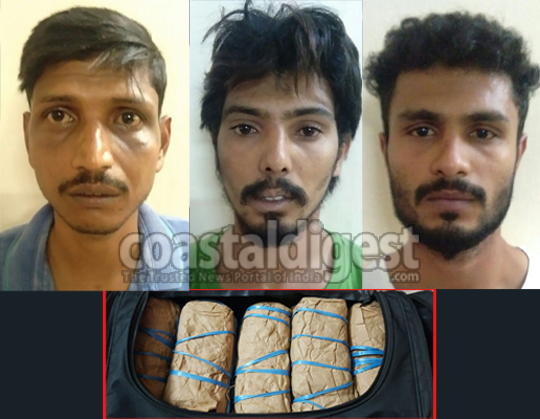
3 held while trying to sell drugs among students; ganja worth Rs 10 lakah seized

CD Network
July 4, 2017

Mangaluru, Jul 4: Three persons have been arrested by the by the sleuths of city crime branch (CCB) of Mangaluru city police on charges of possessing ganja. The police have also recovered a motorbike and three cellphones from the accused.

ganjadealers

The arrested are Ramiz Raja of Naringana, Mohammaed Haneef of Natekal and Iqbal Harris of Belma. A CCB team headed by inspector Sunil Naik picked them from a lodge and recovered 10kg ganja from them. They were making plans to sell it clandestinely to students, police said.

T R Suresh, commissioner of Mangaluru City Police, said the accused had ferried ganja into city from Chittoor for sale to customers especially students. "They were in the process of making smaller packets of ganja for easy sale among potential buyers," he said. Value of the drug and other property seized is Rs 3 lakh.

Among the accused, Ramiz is wanted in a case of vandalism at a hotel in Toudugoli Cross under Konaje PS in 2016 as well an earlier offence of selling ganja. He was out on bail in this second offence.

Suresh said police have credible information about the persons who intended to buy ganja from the accused and suitable action will also be initiated against them. A case has been registered at Mangaluru North police station.

Comments

Mohammed Musta…
 - 
Friday, 7 Jul 2017

Congrats ifti.... He's my class mate at St gerosa jeppu

M M adyar
 - 
Friday, 7 Jul 2017

Far from truth.... Something fishy

VK
 - 
Friday, 7 Jul 2017

Rss not safe in india. should go to Israel.

Fayaz
 - 
Friday, 7 Jul 2017

wasn't this guy a rowdysheeter?

Add new comment

  • Coastaldigest.com reserves the right to delete or block any comments.
  • Coastaldigset.com is not responsible for its readers’ comments.
  • Comments that are abusive, incendiary or irrelevant are strictly prohibited.
  • Please use a genuine email ID and provide your name to avoid reject.
Ram Puniyani
January 14,2020

In the beginning of January 2020 two very disturbing events were reported from Pakistan. One was the attack on Nankana Sahib, the holy shrine where Sant Guru Nanak was born. While one report said that the place has been desecrated, the other stated that it was a fight between two Muslim groups. Prime Minister of Pakistan Imran Khan condemned the incident and the main accused Imran Chisti was arrested. The matter related to abduction and conversion of a Sikh girl Jagjit Kaur, daughter of Pathi (One who reads Holy Guru Granth Sahib in Gurudwara) of the Gurudwara. In another incident one Sikh youth Ravinder Singh, who was out on shopping for his marriage, was shot dead in Peshawar.

While these condemnable attacks took place on the Sikh minority in Pakistan, BJP was quick enough to jump to state that it is events like this which justify the Citizenship Amendment Act (CAA). Incidentally CAA is the Act which is discriminatory and relates to citizenship with Religion, which is not as per the norms of Indian constitution. There are constant debates and propaganda that population of Hindus has come down drastically in Pakistan and Bangla Desh. Amit Shah, the Home minister stated that in Pakistan the population of Hindus has come down from 23% at the time of partition to 3.7% at present. And in Bangla Desh it has come down from 22% to present 8%.

While not denying the fact that the religious minorities are getting a rough deal in both these countries, the figures which are presented are totally off the mark. These figures don’t take into consideration the painful migrations, which took place at the time of partition and formation of Bangla Desh later. Pakistan census figures tell a different tale. Their first census was held in 1951. As per this census the overall percentage of Non Muslim in Pakistan (East and West together) was 14.2%, of this in West Pakistan (Now Pakistan) it was 3.44 and in Eat Pakistan it was 23.2. In the census held in Pakistan 1998 it became 3.72%. As far as Bangla Desh is concerned the share of Non Muslims has gone down from 23.2 (1951) to 9.6% in 2011.

The largest minority of Pakistan is Ahmadis, (https://minorityrights.org/country/pakistan/) who are close to 4 Million and are not recognised as Muslims in Pakistan. In Bangla Desh the major migrations of Hindus from Bangla Desh took place in the backdrop of Pakistan army’s atrocities in the then East Pakistan.

As far as UN data on refugees in India it went up by 17% between 2016-2019 and largest numbers were from Tibet and Sri Lanka.  (https://www.un.org/en/development/desa/population/migration/publication…)

The state of minorities is in a way the index of strength of democracy. Most South Asian Countries have not been able to sustain democratic values properly. In Pakistan, the Republic began with Jinnah’s classic speech where secularism was to be central credo of Pakistan. This 11th August speech was in a way what the state policy should be, as per which people of all faiths are free to practice their religion. Soon enough the logic of ‘Two Nation theory” and formation of Pakistan, a separate state for Muslim took over. Army stepped in and dictatorship was to reign there intermittently. Democratic elements were suppressed and the worst came when Zia Ul Haq Islamized the state in collusion with Maulanas. The army was already a strong presence in Pakistan. The popular formulation for Pakistan was that it is ruled by three A’s, Army, America and Allah (Mullah).

Bangla Desh had a different trajectory. Its very formation was a nail in the coffin of ‘two nation theory’; that religion can be the basis of a state. Bangla Desh did begin as a secular republic but communal forces and secular forces kept struggling for their dominance and in 1988 it also became Islamic republic. At another level Myanmar, in the grip of military dictatorship, with democratic elements trying to retain their presence is also seeing a hard battle. Democracy or not, the army and Sanghas (Buddhist Sang has) are strong, in Myanmar as well. The most visible result is persecution of Rohingya Muslims.

Similar phenomenon is dominating in Sri Lanka also where Budhhist Sanghas and army have strong say in the political affairs, irrespective of which Government is ruling. Muslim and Christian minorities are a big victim there, while Tamils (Hindus, Christians etc.) suffered the biggest damage as ethnic and religious minorities. India had the best prospect of democracy, pluralism and secularism flourishing here. The secular constitution, the outcome of India’s freedom struggle, the leadership of Gandhi and Nehru did ensure the rooting of democracy and secularism in a strong way.

India so far had best democratic credentials amongst all the south Asian countries. Despite that though the population of minorities rose mainly due to poverty and illiteracy, their overall marginalisation was order of the day, it went on worsening with the rise of communal forces, with communal forces resorting to identity issues, and indulging in propaganda against minorities.

While other South Asian countries should had followed India to focus more on infrastructure and political culture of liberalism, today India is following the footsteps of Pakistan. The retrograde march of India is most visible in the issues which have dominated the political space during last few years. Issues like Ram Temple, Ghar Wapasi, Love Jihad, Beef-Cow are now finding their peak in CAA.

India’s reversal towards a polity with religion’s identity dominating the political scene was nicely presented by the late Pakistani poetess Fahmida Riaz in her poem, Tum bhi Hum Jaise Nikle (You also turned out to be like us). While trying to resist communal forces has been an arduous task, it is becoming more difficult by the day. This phenomenon has been variously called, Fundamentalism, Communalism or religious nationalism among others. Surely it has nothing to do with the religion as practiced by the great Saint and Sufi traditions of India; it resorts mainly to political mobilization by using religion as a tool.

Comments

Ashi
 - 
Tuesday, 14 Jan 2020

If Malaysia implement similar NRC/CAA, India and China are the loser.

Add new comment

  • Coastaldigest.com reserves the right to delete or block any comments.
  • Coastaldigset.com is not responsible for its readers’ comments.
  • Comments that are abusive, incendiary or irrelevant are strictly prohibited.
  • Please use a genuine email ID and provide your name to avoid reject.
News Network
January 19,2020

Bengaluru, Jan 19: Karnataka Chief Minister B S Yediyurappa on Sunday said he has had detailed discussions with BJP National President Amit Shah on the cabinet expansion and that the exercise would be carried out after his return from Davos.

The Chief Minister told reporters before leaving for Davos to attend the World Economic Forum meet that he hoped his visit would help bring in large-scale investments to the state. "On cabinet expansion, I had detailed discussions for about half-an-hour (with Amit Shah on Saturday), got a good response... one or two days after I come from Davos, I will expand the cabinet. There are no stumbling blocks for it", Yediyurappa said.

He also rubbished media reports about a lack of clarity on the Ministry expansion. "It is not right... there are no issues", he said.

Asked whether he would travel to Delhi to meet Shah after returning from Davos, Yediyurappa merely said, "It is natural for me to meet Amit Shah." According to the Chief Minister's tour programme, he will be back in the city on January 24.

Yediyurappa, along with Union ministers Piyush Goyal and Mansukh Mandaviya, as well as Chief Ministers Amarinder Singh of Punjab and Kamal Nath of Madhya Pradesh, are among those expected to join over 100 Indian CEOs at Davos in the coming days for the WEF's 50th annual meeting.

Stating that he was leaving on a four day trip for Davos with an aim to bring investments to the state, he said interactions have been fixed with 38 industrialists and investors. "There is a large possibility of investments coming to the state from meetings during the WEF meet. I will assure industrialists and investors that the government will give all necessary facilities within our limits and also clear all the doubts that they have," the Chief Minister said. He said employment opportunities in Karnataka would increase due to all these efforts.

Claiming that the economic situation in Karnataka was stable despite the global economic slowdown, he said the state was also organising the Global Investors Meet in November to attract industries and create employment opportunities.

The delegation led by Yediyurappa includes Industries Minister Jagadish Shettar, Chief Secretary T M Vijaya Bhaskar and top officials of the state government. The Chief Minister, who was anxiously waiting for the high command's nod to expand his ministry amid intense lobbying by the aspirants, was keen on getting approval for it from Shah, but was asked to visit Delhi after returning from Davos, party sources said.

They also said that with J P Nadda all set to take over as BJP National President, he would have final discussions with Yediyurappa on the Ministry expansion exercise. S R Vishwanath, Political Secretary to the Chief Minister too said that Yediyurappa would go to Delhi after his return from Davos and immediately expand the Ministry.

He said the Chief Minister has been asked to hold discussions with Nadda, who is currently BJPs National Working President and finalise things.

As the Chief Minister has already made it clear that 11 of the disqualified JDS-Congress MLAs who got re-elected in the bypolls on BJP tickets will be made ministers, lobbying has been on in the party for the remaining ministerial berths. Currently, there are 18 Ministers, including the Chief Minister in the cabinet that has a sanctioned strength of 34.

However, with some reports that the high command may not be keen on making all the 11 re-elected legislators, whom Yediyurappa has given assurance, as Ministers, it remains to be seen how things turn out. Cabinet expansion will not be an easy task for the Chief Minister as he will have to strike a balance by accommodating the victorious disqualified legislators as promised and also make a place for old guards, upset at being "neglected" in the first round of the induction exercise.

He also has to give adequate representation to various castes and regions in his cabinet and also deal with the allocation of key portfolios. Also, disqualified legislators who lost on a BJP ticket during the bypolls like A H Vishwanath (Hunsur) openly expressing their ministerial aspirations has added to the Chief Minister's worry.


Comments

Add new comment

  • Coastaldigest.com reserves the right to delete or block any comments.
  • Coastaldigset.com is not responsible for its readers’ comments.
  • Comments that are abusive, incendiary or irrelevant are strictly prohibited.
  • Please use a genuine email ID and provide your name to avoid reject.
News Network
January 2,2020

Bengaluru, Jan 2: Former chief ministers of Karnataka Siddaramaiah and H D Kumaraswamy on Thursday launched a scathing attack on Prime Minister Narendra Modi as he embarked on a two-day visit to the state attend events in Tumakuru and Bengaluru. In a series of tweets, the Congress and the JD(S) leaders took a dig at Modi for his alleged failure on various fronts.

"You did not visit Karnataka when it was devastated by floods, you did not visit Karnataka when our farmers cried for help, but all of a sudden, when you want to launch your political propaganda, you remember the innocent people of Karnataka. Wah Modi Wah!!" Siddaramaiah tweeted.

In another tweet, the Congress leader claimed Karnataka is starved of Central government funds as there were no adequate flood relief, no GST revenue loss compensation and there was a delay in the transfer of grant-in-aid.

He further said, "Before attempting to fool our people, let the people of Karnataka know when they will get their due share!" He also sought to know from Modi why the 25 MPs from Karnataka have 'turned off' their engines.

"With 25 MPs from BJP and a state government with BJP, people hoped for a double engine. Instead, all BJP representatives have turned off their engines and have become sycophants to play a tune to your idiosyncrasies. Why, are they scared of you?" Siddaramaiah said.

Seeking an explanation on various incomplete projects, the Congress leader said, "Mr Narendra Modi, people are fed up of your lies and double-edged sword comments. We want your answer today about long-standing questions on: Kalasa Banduri Yojana, Belagavi border issue, exams in Kannada, Tulu & Kodava in 8th schedule, the list goes on." Kumaraswamy too minced no words as he went on the offensive against the Centre.

In his tweets quoting newspaper reports, he said Karnataka's coffer has dried up, financial position is in doldrums and the revenue has plummeted.

"What's the reason (behind poor economic situation)? The poor economic policies of the Centre. After swallowing the GDP and development of the country, the wrong policies have affected the state too," alleged Kumaraswamy.

Quoting reports, Kumaraswamy said the Centre has denied the state's share of revenue.

"About 5.44 per cent of state's share is yet to come from the Centre. This is step-motherly attitude of the Centre towards the state," Kumaraswamy tweeted.

Comments

Add new comment

  • Coastaldigest.com reserves the right to delete or block any comments.
  • Coastaldigset.com is not responsible for its readers’ comments.
  • Comments that are abusive, incendiary or irrelevant are strictly prohibited.
  • Please use a genuine email ID and provide your name to avoid reject.