3-month-old baby choked to death while being fed Cerelac

coastaldigest.com news network
January 31, 2018

In a shocking incident, a 3-month-old girl child choked and died while being fed an instant cereal by her mother at Hosapalya village in Madgadi taluk of Ramanagara district in Karnataka on Wednesday, January 31.

According to reports, the mother had been feeding the child with Cerelac, a brand of instant cereal made by Nestlé, for past 15 days. In fact, such cereals are advised to give only after the infant crosses at least six months. 

The mother said that the child became unresponsive after a brief struggle - kicking her legs, moving her hands, and crying. The child was then taken to Magadi government hospital, where she was declared brought dead.

Sources said that the child was born around six years after her parents’ wedding. The mother had reportedly suffered miscarriages twice and her husband had spent a huge amount of money for the treatment.

Comments

Alex
 - 
Wednesday, 31 Jan 2018

It’s in fact a murder. Infants up to six months are not supposed to be given anything except breastmilk of the mother. And breastmilk is compulsory at least up to the child turns 2 years old.

Danish
 - 
Wednesday, 31 Jan 2018

In most of the cases, ads misleading people. 

Hari
 - 
Wednesday, 31 Jan 2018

Parents always should take doctor's advice. 

Mohan
 - 
Wednesday, 31 Jan 2018

God is so cruel in some cases

Kumar
 - 
Wednesday, 31 Jan 2018

Ill fate.. they didnt seek doctor's advise?

Ganesh
 - 
Wednesday, 31 Jan 2018

Shocking.. Rest in peace

Add new comment

  • Coastaldigest.com reserves the right to delete or block any comments.
  • Coastaldigset.com is not responsible for its readers’ comments.
  • Comments that are abusive, incendiary or irrelevant are strictly prohibited.
  • Please use a genuine email ID and provide your name to avoid reject.
News Network
February 14,2020

Bengaluru, Feb 14: A 31 -year-old Bhojpuri dancer and another girl were rescued from human traffickers after the former alerted city police on landing at Kempegowda International Airport (KIA) on Tuesday. They were to be received by a woman named Preethi at the airport.

The dancer had been told she was supposed to perform a few stage shows in the city, which has a significant Bhojpuri-speaking population. But when she realised she is likely to be pushed into flesh trade, she raised an alarm.

The woman, Radha (name changed), is a mother of four children and the lone breadwinner of the family. A few months ago, Radha came in contact with a woman named Soniya in New Delhi during a dance performance. Last month, Soniya got in touch with Radha and offered to pay Rs 40,000 per month if she performed in Bengaluru.

Radha agreed and was sent to Bengaluru from Chandigarh along with the other girl. During the journey, she learnt she was supposed to do more than just perform on stage. A shocked Radha informed the Central Industrial Security Force personnel manning KIA that she feared being pushed into prostitution. KIA police were informed and the women were rescued. Preethi was arrested.

Comments

Add new comment

  • Coastaldigest.com reserves the right to delete or block any comments.
  • Coastaldigset.com is not responsible for its readers’ comments.
  • Comments that are abusive, incendiary or irrelevant are strictly prohibited.
  • Please use a genuine email ID and provide your name to avoid reject.
News Network
April 2,2020

The current physical distancing guidelines provided by the World Health Organisation (WHO) and by the US Centers for Disease Control and Prevention (CDC) may not be adequate to curb the coronavirus spread, according to a research which says the gas cloud from a cough or sneeze may help virus particles travel up to 8 metres. The research, published in the Journal of the American Medical Association, noted that the the current guidelines issued by the WHO and CDC are based on outdated models from the 1930s of how gas clouds from a cough, sneeze, or exhalation spread.

Study author, MIT associate professor Lydia Bourouiba, warned that droplets of all sizes can travel 23 to 27 feet, or 7-8 metres, carrying the pathogen.

According to Bourouiba, the current guidelines are based on "arbitrary" assumptions of droplet size, "overly simplified", and "may limit the effectiveness of the proposed interventions" against the deadly pandemic.

 She explained that the old guidelines assume droplets to be one of two categories, small or large, taking short-range semi-ballistic trajectories when a person exhales, coughs, or sneezes.

However based on more recent discoveries, the MIT scientist said, sneezes and coughs are made of a puff cloud that carries ambient air, transporting within it clusters of droplets of a wide range of sizes.

Bourouiba warned that this puff cloud, with ambient air entrapped in it, can offer the droplets moisture and warmth that can prevent it from evaporation in the outer environment.

"The locally moist and warm atmosphere within the turbulent gas cloud allows the contained droplets to evade evaporation for much longer than occurs with isolated droplets," she said.

"Under these conditions, the lifetime of a droplet could be considerably extended by a factor of up to 1000, from a fraction of a second to minutes," the researcher explained in the study.

The MIT scientist, who has researched the dynamics of coughs and sneezes for years, added that these droplets settle along the trajectory of a cough or sneeze contaminating surfaces, with their residues staying suspended in the air for hours.

"Even when maximum containment policies were enforced, the rapid international spread of COVID-19 suggests that using arbitrary droplet size cutoffs may not accurately reflect what actually occurs with respiratory emissions, possibly contributing to the ineffectiveness of some procedures used to limit the spread of respiratory disease," Bourouiba wrote in the study


Comments

Add new comment

  • Coastaldigest.com reserves the right to delete or block any comments.
  • Coastaldigset.com is not responsible for its readers’ comments.
  • Comments that are abusive, incendiary or irrelevant are strictly prohibited.
  • Please use a genuine email ID and provide your name to avoid reject.
coastaldigest.com news network
August 4,2020

Mangaluru, Aug 4: The Kasaragod district administration has decided to restore the e-pass system for daily commuters between Kasaragod and Mangaluru amid covid-19 crisis. 

As covid-19 cases began to increase in Dakshina Kannada, the Kasargod district administration had unilaterally newly introduced of daily pass system on July 6 for entry and exit from Talapady border. This had inconvenienced hundreds of employees, who visited Mangaluru daily to eke a living. 

The decision to resume the pass system was taken in a video conference of Kerala Revenue Minister Chandrasekharan with officials and elected representatives on August 3.

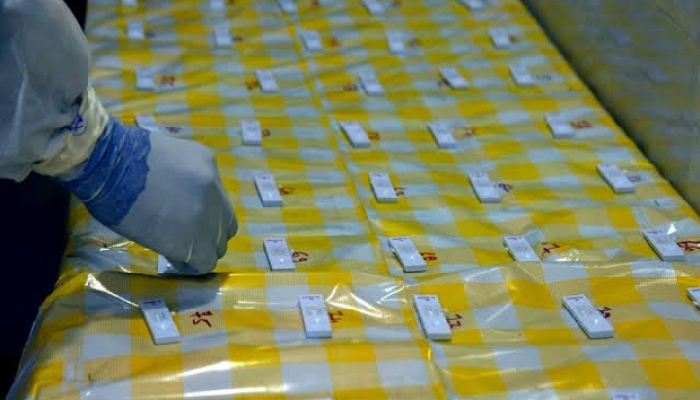
The minister said the Kasaragod district administration will resume issuing of passes for daily commuters between Kasaragod and Mangaluru. But they should undergo rapid antigen test for every week to renew their passes.

"Similarly, one-time interstate passes will be issued for those who want to take part in marriages, funeral and other functions in both states. Even they should undergo antigen test after returning from the functions,” the minister added.

As per the previous order, daily commuters, especially employees, had to stay in Mangaluru for 28 days before returning to Kasargod. Later, Kerala government relaxed rules on July 23 allowing only bank employees from Kasaragod to travel daily in their private vehicles to their workplace in Dakshina Kannada.

Comments

Add new comment

  • Coastaldigest.com reserves the right to delete or block any comments.
  • Coastaldigset.com is not responsible for its readers’ comments.
  • Comments that are abusive, incendiary or irrelevant are strictly prohibited.
  • Please use a genuine email ID and provide your name to avoid reject.