


3 new NH in DK including four-laning of Thokkottu-Melkar Road announced

[email protected] (CD Network )
March 28, 2016

Mangaluru, Mar 28: The much-awaited multi-crore project on four-laning of Thokkottu-Mudipu-Melkar road has moved a step closer to execution with the union government's in-principal approval for the proposal to turn it into a national highway.
gadkerinmpt 2

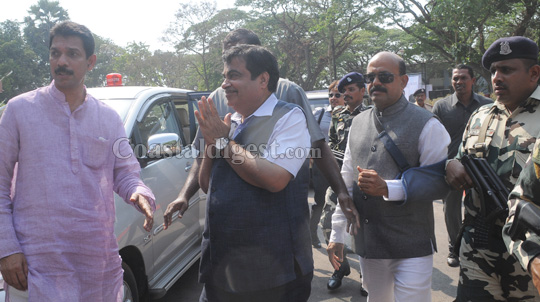
Speaking at a function in the city on Monday, Union Minister for Surface Transport, Highways and Shipping Nitin Gadkari, assured to fulfil the demand of Dakshina Kannada MP Nalin Kumar Kateel to declare three prominent roads in the district as national highways.

Mr Kateel had urged the union minister to take necessary steps to announce (1) Karkala-Moodbidri-BC Road; (2) BC Road-Kaikamba-Kateel-Mulki road and (3) Thokkottu-Mudipu-Melkar road as new National Highways in the district.

Mr Gadkari said that he gave in-principal approval for all three projects. He said that the 44-km long stretch from Karkala to Moodbidri to BC Road will be developed at a cost of Rs 220 crore, 51-km long BC Road-Kaikamba-Kateel-Mulki road will be developed at a cost of Rs 255 crore. The 28-km long four-laning of Thokkottu-Mudipu-Melkar stretch will be taken up at a cost of Rs 280 crore.

The Thokkottu-Melkar road in fact connects the national highways 17 and 48 via Mangalore University. Mangalore University, Yenepoya University, with its medical and dental colleges, Nitte University, with its medical and dental colleges, and Fr. Muller's Homoeopathy Medical College, P.A. College of Engineering and other educational institutions are located on this road.

Clarifying that there was no shortage of funds for the development of roads, Mr Gadkari said that there was a lack of vision and commitment on part of officials.

Comments

Zahoor Ahmed
 - 
Wednesday, 30 Mar 2016

What about Karkal-Moodbidri-Mangalore on Mangalore -Solapur National Highway ? No money to construct ? When will you start ?

Mohammed SS
 - 
Tuesday, 29 Mar 2016

This time vote for BJP, once election over everything will go to garbage box

Add new comment

  • Coastaldigest.com reserves the right to delete or block any comments.
  • Coastaldigset.com is not responsible for its readers’ comments.
  • Comments that are abusive, incendiary or irrelevant are strictly prohibited.
  • Please use a genuine email ID and provide your name to avoid reject.
coastaldigest.com news network
February 23,2020

Mangalore University has been participating in the campus bird count a sub-event of ‘Great backyard bird count’ (GBBC) organized by Bird Count India for the past 5 years. This year, CBC was held from 14th to 17th February of 2020 across various campuses in India.

This year the four days event was successfully ended up with the sightings of 103 species of birds from various locations across the campus spread on 300 acres. In this Black Drongo, Black Kite, Brahminy Kite, Common Iora, Green Wabler, Purple-rumed Sunbird, Red-whiskered Bulbul, White-cheeked Barbet, Jungle Babbler and Plum headed parakeets were the common birds, and also observed House Crow with nest and nestlings, Indian Robin nest with eggs, Bronzed Drongo constructing the nest and Shikra mating and carrying nesting materials.  Whereas Yellow-billed Babbler is rare in the campus, Ashy Drongo, Barn Swallow, Booted Eagle, Grey Wagtail, Indian Pitta etc. were migratory birds, Grey-headed Bulbul (Near Threatened bird), Rufous Babbler and Grey-headed Bulbul were Western Ghats Endemics  and Brown Wood Owl, Barn Owl, Spotted Owlet, Nightjars (Savanna, Indian and Jerdon’s) and Sri Lanka Frogmouth were nocturnal birds. Blue-eared Kingfisher Grey-bellied Cuckoo which was very rare and new additions to avian list of the campus.

In the first year (2016) of Mangalore University’s CBC recorded 77 species, in 2017 recorded 95 species, in 2018 recorded 110 species and in 2019 recorded 107 species of birds. However some of the common species like Rose ringed parakeets, Blue tailed bee-eater, Nilgiri Flowerpecker and Indian roller etc., sighted last year were not seen this year. But with 2 new additions from this CBC, the checklist of Mangalore University Campus has been updated with a total of 141 species.

This event was coordinated by Vivek Hasyagar from the Department of Applied Zoology and Maxim Rodrigues from the Department of Marine Geology. Survey trails were led by more than 60 students and research scholars from various Departments of Mangalore University includes Applied Zoology, Biosciences, Microbiology, Botany, Physics, Chemistry and Material Science.  In addition, some enthusiastic participants from St. Aloysius College had involved in identifying the birds around the campus.

Quote:

Wild/planned fire affects negatively on the existing ecologically sensitive areas in and around the campus especially in lateritic grasslands. Because many insectivorous birds are dependent on these lateritic grassland habitats for their food and breeding grounds for many ground dwelling birds like Yellow wattled lapwing, Red wattled lapwing, Indian Robin and Barred buttonquails. Conserving these habitats will be helpful in protecting these birds.

Quotes from the participants: “The Campus Bird Count 2020 at Mangalore University was an experience of its own kind. Observing birds in their natural habitat gave me new perspective of viewing them not only as another living being, but as equals, or even of higher intelligence. The Campus Bird Count is an important step towards documenting bird life year after year, and creating awareness amongst youngsters, so that proper conservation steps can be taken to protect them from human interference”.

-Jyotsna Dessai ( 1 M.Sc Zoology)

Comments

Add new comment

  • Coastaldigest.com reserves the right to delete or block any comments.
  • Coastaldigset.com is not responsible for its readers’ comments.
  • Comments that are abusive, incendiary or irrelevant are strictly prohibited.
  • Please use a genuine email ID and provide your name to avoid reject.
News Network
January 3,2020

Bengaluru, Jan 3: Prime Minister Narendra Modi on Friday called on young scientists of India to "Innovate, Patent, Produce and Prosper," and said these four steps would lead our country towards faster development. The Prime Minister also stressed on the need to transform the landscape of Indian science, technology and innovation.

"The growth story of India depends on its success in the science and technology sector. There is a need to transform the landscape of Indian science, technology and innovation," Modi said.

Speaking after inaugurating the 107th Session of Indian Science Congress, he said, "My motto for the young scientists in this country is -Innovate, Patent, Produce and Prosper. These four steps will lead our country towards faster development."

"If we innovate we will patent and that in turn will make our production smoother and when we take these products to the people of our country, I'm sure they will prosper," he said, adding that innovation for the people and by the people is the direction of our new India. The Prime Minister also said he was happy to learn that India's ranking has improved in the Global Innovation Index to 52.

"Our programmes have created more technology business incubators in the last five years than in the previous 50 years. I congratulate our scientists for this achievement," he added.

Comments

Add new comment

  • Coastaldigest.com reserves the right to delete or block any comments.
  • Coastaldigset.com is not responsible for its readers’ comments.
  • Comments that are abusive, incendiary or irrelevant are strictly prohibited.
  • Please use a genuine email ID and provide your name to avoid reject.
News Network
February 23,2020

The euphoria over the claim that around 3,000 tonnes of gold reserves, worth Rs 12 trillion, have been discovered in Uttar Pradesh’s Sonbhadra district could not last even 24 hours, with the Geological Survey of India (GSI) clarifying on Saturday there had been no such discovery.

The GSI, headquartered in Kolkata, rebutted the claims of the Uttar Pradesh Directorate of Geology and Mining (UPDGM), and said “miscommunication” must have led to the wrong reporting of facts.

M Sridhar, director general of the GSI, said nobody in the agency gave any such data. He said 52,806 tonnes of gold ore was found in Sonbhadra district during the exploration work in 1998-2000. From this reserve, only 160 kg of gold can be extracted.

“There must have been some miscommunication of facts because of which the gold ore deposits have been overestimated. We have written a letter to Uttar Pradesh (UPDGM), stating the facts. The GSI has not estimated such kind of vast resource of gold deposits in Sonbhadra,” Sridhar said.

ALSO READ: 2,900-tonne gold mine found in Sonbhadra, 4 times that of India's reserves

The UPDGM had said on Friday that gold deposits were found in Son Pahadi and Hardi areas of the district. Sridhar said while gold ore was found in the area during the GSI’s exploration work in 1998-2000, it had told the state government about the discovery in November last year.

Under the new regulation, which came into effect from 2015, the GSI has to inform the state government when ore deposits are discovered. Earlier, no such action was mandatory. In its report, the GSI estimated that only 3.03 gm of gold can be extracted from a tonne of ore. It also clarified that even the extraction amount was tentative and could not be established for certain.

Moreover, Sridhar said the deposits were spread across only 0.5 sq km in forest land, which made the mining of ore economically unviable. “When there are several mines nearby, we can club it into a block and then it makes sense to mine the ore. But in this case, the deposits are too small to make it viable for any company to mine it,” he said. The GSI usually prioritises its exploration work based on the needs of the Centre. While strategic minerals like tin, cobalt, lithium, beryllium, germanium, gallium, indium, tantalum, niobium, selenium, and bismuth are atop the list in GSI exploration, gold is another commodity on its priority list.

According to the World Gold Council, India has reserves of 630 tonnes of gold.

Comments

Add new comment

  • Coastaldigest.com reserves the right to delete or block any comments.
  • Coastaldigset.com is not responsible for its readers’ comments.
  • Comments that are abusive, incendiary or irrelevant are strictly prohibited.
  • Please use a genuine email ID and provide your name to avoid reject.