


3 new NH in DK including four-laning of Thokkottu-Melkar Road announced

[email protected] (CD Network )
March 28, 2016

Mangaluru, Mar 28: The much-awaited multi-crore project on four-laning of Thokkottu-Mudipu-Melkar road has moved a step closer to execution with the union government's in-principal approval for the proposal to turn it into a national highway.
gadkerinmpt 2

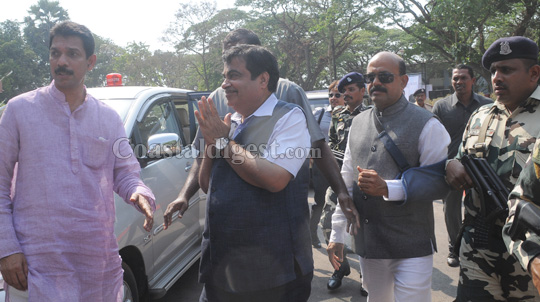
Speaking at a function in the city on Monday, Union Minister for Surface Transport, Highways and Shipping Nitin Gadkari, assured to fulfil the demand of Dakshina Kannada MP Nalin Kumar Kateel to declare three prominent roads in the district as national highways.

Mr Kateel had urged the union minister to take necessary steps to announce (1) Karkala-Moodbidri-BC Road; (2) BC Road-Kaikamba-Kateel-Mulki road and (3) Thokkottu-Mudipu-Melkar road as new National Highways in the district.

Mr Gadkari said that he gave in-principal approval for all three projects. He said that the 44-km long stretch from Karkala to Moodbidri to BC Road will be developed at a cost of Rs 220 crore, 51-km long BC Road-Kaikamba-Kateel-Mulki road will be developed at a cost of Rs 255 crore. The 28-km long four-laning of Thokkottu-Mudipu-Melkar stretch will be taken up at a cost of Rs 280 crore.

The Thokkottu-Melkar road in fact connects the national highways 17 and 48 via Mangalore University. Mangalore University, Yenepoya University, with its medical and dental colleges, Nitte University, with its medical and dental colleges, and Fr. Muller's Homoeopathy Medical College, P.A. College of Engineering and other educational institutions are located on this road.

Clarifying that there was no shortage of funds for the development of roads, Mr Gadkari said that there was a lack of vision and commitment on part of officials.

Comments

Zahoor Ahmed
 - 
Wednesday, 30 Mar 2016

What about Karkal-Moodbidri-Mangalore on Mangalore -Solapur National Highway ? No money to construct ? When will you start ?

Mohammed SS
 - 
Tuesday, 29 Mar 2016

This time vote for BJP, once election over everything will go to garbage box

Add new comment

  • Coastaldigest.com reserves the right to delete or block any comments.
  • Coastaldigset.com is not responsible for its readers’ comments.
  • Comments that are abusive, incendiary or irrelevant are strictly prohibited.
  • Please use a genuine email ID and provide your name to avoid reject.
coastaldigest.com news network
July 16,2020

Bengaluru, Jul 16: Chief Minister B S Yediyurappa led state government’s move to amend the Karnataka Land Reforms Act was “a scam bigger than illegal mining” as farm lands worth Rs 50,000 crore will be lost, according to Leader of the Opposition Siddaramaiah.

The government on July 13 promulgated an ordinance to amend the Karnataka Land Reforms Act, allowing non-agriculturists to buy agricultural lands while also increasing the cap on the extent of such land a person or a family can hold.

Plus, the amendment will have retrospective effect, meaning over 13,000 cases registered over the years for alleged violations in acquiring farm lands will be vacated or dismissed.

“There are 13,814 cases across all 30 districts. Let’s assume that each case involves four acres of land. That’s 52,000 acres. These are lands worth Rs 45,000-50,000 crore,” Siddaramaiah told a news conference. “This is a scam bigger than illegal mining. While the mining scam had specific players, here the entire government has fallen for the corporate bodies and real estate lobby.”

The illegal mining scam unearthed when the BJP was in power was pegged at Rs 35,000 crore, which became a poll plank for the Congress to come to power in 2013.

Calling it a “black” legislation, Siddaramaiah said the amendments to the land reforms law will result in large portions of farm lands becoming real estate. “This will destroy the farming community. They’ll now have to stand at the doors of corporate bodies. Farmers will sell their land and real estate will come. What’ll happen to food production?” he said.

The ordinance amends Section 63 and 80 of the Act, while omitting Sections 79A, B and C. “These sections were inserted in 1974 under the D Devaraj Urs government. It was a revolutionary, progressive step to protect farmers and ensure social justice,” Siddaramaiah said.

The Congress leader claimed that there was a “biggest conspiracy” behind this. “All this is being driven by the Modi government. They want to privatize more and more so that reservations will go. They want to bring back the zamindari system,” he said, citing the examples of some other recent amendments to other laws.

The timing of the ordinance is suspect, he said. “If the Yediyurappa government really wanted to help farmers and had good intentions, they could’ve brought this before the Assembly or placed it for public discussion. Instead, they’ve made use of the lockdown period to promulgate the ordinance,” he said.

The Congress will fight the ordinance till it gets withdrawn, Siddaramaiah said. “We will talk to other parties, farmers organisations and Dalit groups to plan protests against the BJP’s hidden agenda and anti-farmer policies,” he added.

Comments

Add new comment

  • Coastaldigest.com reserves the right to delete or block any comments.
  • Coastaldigset.com is not responsible for its readers’ comments.
  • Comments that are abusive, incendiary or irrelevant are strictly prohibited.
  • Please use a genuine email ID and provide your name to avoid reject.
News Network
March 28,2020

Bengaluru, Mar 28: Sun Tsu, in 'The Art of War' speaks of a skilful general who can subdue his enemy without any fighting. This constitutes the ultimate triumph which is referred to as stratagem. Today, we would need one such when we are faced with the '21-day corona challenge' for India.
Nearly four weeks back, Dr Jyothsna Rao, Dr Gururaj Rao and I sat across the OPD in the afternoon at HCG Bengaluru discussing our ongoing cancer immunology research. While on this topic, we drifted into the discussion on the coronavirus. During this engaging discussion, we wondered the similarity of the enigma between the virus and cancer. I paused to ask Dr Jyothsna and Dr Guru - how we wish we could do something against this virus.
Dr Jyothsna is a PhD from NCBS and had worked under Dr Ralph Steinman, physician and researcher from Rockefeller University, who won the Nobel Prize for his discovery of the dendritic cell and its role in adaptive immunity in 2011. Dr Gururaj is a molecular and cell biologist who did his PhD at the Chapel Hill, University of North Carolina and is the Director of iCrest.
Jyothsna while hearing our perplexing conversation on the covid intervened, "Yes, surely. I think we should take a break from cancer and focus on the innate and adaptive immunity role in COVID-19."
Thus began this sincere attempt to relook the human immune system from the eyes of the COVID-19.
We have 10 types of immune cells at the least which are widely dispersed in millions across the body. When our body is invaded by a foreign organism (bacteria, fungi or virus), these cells work with each other to destroy the invader.
Now, the question is - how do the immune cells talk to each other? They use small-molecule substances called cytokines (cyto means cells; kine means movement). There are many cytokines that are involved in work on the immune system. The most relevant for viruses are interferons.
Interferons (IFN) as the name reflects have an ability to interfere with the viral activity and stop their multiplication. These specialised signal proteins are released by our cells in response to a viral attack to forewarn other cells. They help build the antiviral proteins within the cells to kill the virus as it tries to invade the new cells.
Historically, interferons are a group of cytokines known to be potent antiviral agents against viruses and a hallmark cytokine induced by the host upon viral infections. Interferons possess unique immunoregulatory activities and are signature cytokines released by (TH1) T immune cells, which are crucial in viral infections.
As the outbreak of COVID-19 grapples us, an urgent need for finding strategies to combat the virus is growing. Coronaviruses (CoVs) are a group of RNA viruses. In patients infected with coronavirus, it was indicated that the activation of the IFN does not occur until 48 hours post-infection. Thus the delayed IFN-related antiviral response by the healthy cells leads to coronavirus evade the immune response.
Numerous studies have presented the success in defeating CoVs by the direct administration of IFNs. In a combination as a concoction, it was shown to synergistically inhibit the virus replication in vitro.
Moreover, it is understood that the earlier induction of IFNs in children although they have a less developed immune system could be the reason behind the children being least affected.
The key to success in reducing the disease fatality might be the stimulation of the immune responses to trigger IFN production at the very early stages of the disease, which might be done through the administration of IFN. Despite the evidence for the efficacy of IFNs in treating CoV-induced infections, the proper dosing and ideal timing for such interventions needs to be verified in clinical trials.
For the later stages of the diseases in advance stages where patients are on ventilator and have developed respiratory distress, we propose to utilise the mesenchymal cells derived from donor bone marrow that have been known to treat acute respiratory syndrome. Mesenchymal cells are known to possess anti-inflammatory activity and thus used often in autoimmune diseases.
With this scientific background, we have activated T cells from healthy donors, in a cGMP facility at iCrest - HCG hospital with an enriched cocktail of cytokines rich in Interferons. Injections of this cocktail we believe will result in a surge of cytokines in the body of the infected person and will boost his ability to fight the virus in the early phases. We are in the initial phases of this study and hope to be ready in the coming weeks with meaningful data on its potential utility.
Currently, it awaits government approvals (Union and state) and we have applied to central drugs authority for their initial evaluation and further directions.
As my Guru often expounded the philosophy of 'Seva' - the goal of education is knowledge, the end goal of knowledge is service. In this attempt to serve our fellow humans at this brink of unprecedented crisis, medical fraternity stands with you and promises to do our best for your safety.
We assure to exhaust every bit of our spirit in this fight against coronavirus. We have lost the sight of shores and travelled thus far, but that is the mandatory first step to cross the ocean. Are we going to succeed in this battle, is something only time will answer. 

Comments

Add new comment

  • Coastaldigest.com reserves the right to delete or block any comments.
  • Coastaldigset.com is not responsible for its readers’ comments.
  • Comments that are abusive, incendiary or irrelevant are strictly prohibited.
  • Please use a genuine email ID and provide your name to avoid reject.
News Network
June 8,2020

Bengaluru, Jun 8: Facing a shortage of labour, some top builders in the city have initiated efforts to bring back the migrant workers, who have returned to their native places following the COVID-19 lockdown, and are holding parleys with Railway authorities for operation of special trains to ferry them.

After the lockdown was announced, many construction projects came to a halt and accordingly the labourers were rendered jobless. These migrant workers preferred to go back to their home state as they were not paid when the projects were stopped and were caught in the big financial mess. Many of these migrants even chose to cover thousands of kilometres by foot when even trains, buses or any motor vehicles were not operating.

Keeping their woes in view, the Centre decided to run the Shramik Special trains to ferry them to their native places. But, after they were gone, the builders found themselves in a lurch. An executive of a builder told PTI "Yes, our builder and a few others are in talks with the Railways to run the special train to bring back the labourers." She said nothing has been materialised as of now.

According to her, the builders took the contact numbers of the workers when they left the city to their home states and are now contacting them one by one. The South Western Railway has so far sent 3.11 lakh migrant workers in 216 Shramik Special trains starting from May 3 to June 6.

Comments

Add new comment

  • Coastaldigest.com reserves the right to delete or block any comments.
  • Coastaldigset.com is not responsible for its readers’ comments.
  • Comments that are abusive, incendiary or irrelevant are strictly prohibited.
  • Please use a genuine email ID and provide your name to avoid reject.