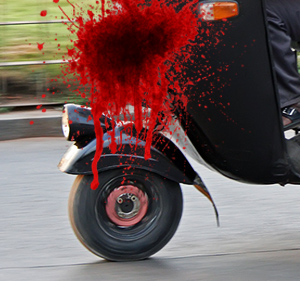
3-year-old boy accidentally drives auto, dies; father booked

[email protected] (CD Network)
January 22, 2017

Mangaluru, Jan 22: In a shocking incident, a 3-year-old boy was killed after he accidentally drove his father's auto-rickshaw which was in ignition mode on Saturday at Charmadi Ghat on the outskirts of the cityAutoRickshaw

According to police, Kalandar, an auto driver had come to pick his son Khaleel from an anganwadi around 1.45pm.

After making his son sit on the driver's seat and keeping the ignition on, he went away to bring other kids. Meanwhile, Khaleel changed the gear lever making the auto move in the backward direction.

As soon as the child changed the gear lever and accelerated, the auto started moving backwards and fell into an under-construction well. Khaleel died on the spot.

Dharmasthala police have booked a negligence case against the child's father. Investigations are on.

Comments

Mohammed SS
 - 
Sunday, 22 Jan 2017

This is a lesson for the Ideates whose brain in their knees not inside the head

Add new comment

  • Coastaldigest.com reserves the right to delete or block any comments.
  • Coastaldigset.com is not responsible for its readers’ comments.
  • Comments that are abusive, incendiary or irrelevant are strictly prohibited.
  • Please use a genuine email ID and provide your name to avoid reject.
News Network
August 6,2020

Chennai, Aug 5: Karnataka on Wednesday crossed the 1.5 lakh mark in respect of COVID-19 cases and Kerala was on the verge of 30,000 while Andhra Pradesh witnessed a five- digit daily caseload after a lull. 

Tamil Nadu saw a small jump in its daily cases as compared to Tuesday while Telangana and union territory Puducherry reported their respective record single-day spikes. 

The five states and the union territory reported a combined 24,415 fresh confirmed coronavirus cases and 316 fatalities on Wednesday. 

A Puducherry Minister tested positive for the deadly virus while an opposition AINRC legislator who contracted the coronavirus earlier was discharged after being cured of it. 

In Karnataka, the coronavirus cases stood at 1,51,449 with the addition of 5,619 fresh cases while 100 deaths were reported, pushing the total fatalities to 2,804, the health department said.

According to a health bulletin, 74,679 persons have been discharged so far, leaving 73,958 active cases. Andhra Pradesh''s COVID-19 surge continued on Wednesday too, with 10,128 cases reported afresh after easing a little in the last four days. 

The overall tally rose to 1,86,461 on Wednesday. The state had last reported its five-figure daily tally on July 31 when it was 10,376. 

The state also saw a record number of 77 coronavirus deaths in a day, pushing the toll to 1,681, the latest bulletin said. 

In the last 24 hours, 8,729 patients had also recovered from the infection and there were 80,426 active cases. 

As many as 1,04,354 patients have been cured and discharged so far. Kerala was on the verge of 30,000 cases, as its tally stood at 29,145 with the addition of 1,195 new COVID-19 cases on Wednesday.

The toll from the virus so far climbed to 94 with seven more deaths. Thiruvananthapuram continued to top the districts in infections with 274 cases on Wednesday, of whom 248 had been infected through contact. 

Malappuram (167), Kasaragod (128), Ernakulam (120) and Alappuzha (108) reported over 100 cases. As many as 112 patients died of COVID-19 in Tamil Nadu, the highest reported in a single day so far, taking the toll to 4,461 on Wednesday while 5,175 more people tested positive, propelling the case count to 2.73 lakh.

Recoveries outnumbered fresh cases with 6,031 people getting discharged from various hospitals, taking the total cured to 2,14,815 as the active cases dropped to 54,184, a government bulletin said. 

In Telangana, 2,012 new cases emerged while 13 related fatalities were reported, taking the total infection tally in the state to 70,958. Out of the new cases, 532 were from the Greater Hyderabad Municipal Corporation (GHMC), followed by Medchal-Malkajgiri 198 and Rangareddy 188, a state government bulletin said on Wednesday, providing data as of 8 PM on August 4. 

The total number of people who recovered from the infectious disease touched 50,814, while 19,568 were under treatment.

The COVID-19 fatality rate in the state was 0.81 per cent, while it was 2.10 per cent at the national level, it said. The recovery rate was 71.6 per cent in the state, while it was 66.31 per cent in the country, it added. 

Puducherry clocked its worst single-day spike of 286 infections, recording seven deaths, even as the overall tally of cases went up to 4,432. 

The deaths during the 24 hours in the Union Territory took the toll to 65 so far since the outbreak of the virus, Health Minister Malladi Krishna Rao told a virtual press conference. 

His cabinet colleague M Kandasamy and his son reported positive for the virus and were admitted to JIPMER.


Comments

Add new comment

  • Coastaldigest.com reserves the right to delete or block any comments.
  • Coastaldigset.com is not responsible for its readers’ comments.
  • Comments that are abusive, incendiary or irrelevant are strictly prohibited.
  • Please use a genuine email ID and provide your name to avoid reject.
News Network
March 28,2020

Bengaluru, Mar 28: Sun Tsu, in 'The Art of War' speaks of a skilful general who can subdue his enemy without any fighting. This constitutes the ultimate triumph which is referred to as stratagem. Today, we would need one such when we are faced with the '21-day corona challenge' for India.
Nearly four weeks back, Dr Jyothsna Rao, Dr Gururaj Rao and I sat across the OPD in the afternoon at HCG Bengaluru discussing our ongoing cancer immunology research. While on this topic, we drifted into the discussion on the coronavirus. During this engaging discussion, we wondered the similarity of the enigma between the virus and cancer. I paused to ask Dr Jyothsna and Dr Guru - how we wish we could do something against this virus.
Dr Jyothsna is a PhD from NCBS and had worked under Dr Ralph Steinman, physician and researcher from Rockefeller University, who won the Nobel Prize for his discovery of the dendritic cell and its role in adaptive immunity in 2011. Dr Gururaj is a molecular and cell biologist who did his PhD at the Chapel Hill, University of North Carolina and is the Director of iCrest.
Jyothsna while hearing our perplexing conversation on the covid intervened, "Yes, surely. I think we should take a break from cancer and focus on the innate and adaptive immunity role in COVID-19."
Thus began this sincere attempt to relook the human immune system from the eyes of the COVID-19.
We have 10 types of immune cells at the least which are widely dispersed in millions across the body. When our body is invaded by a foreign organism (bacteria, fungi or virus), these cells work with each other to destroy the invader.
Now, the question is - how do the immune cells talk to each other? They use small-molecule substances called cytokines (cyto means cells; kine means movement). There are many cytokines that are involved in work on the immune system. The most relevant for viruses are interferons.
Interferons (IFN) as the name reflects have an ability to interfere with the viral activity and stop their multiplication. These specialised signal proteins are released by our cells in response to a viral attack to forewarn other cells. They help build the antiviral proteins within the cells to kill the virus as it tries to invade the new cells.
Historically, interferons are a group of cytokines known to be potent antiviral agents against viruses and a hallmark cytokine induced by the host upon viral infections. Interferons possess unique immunoregulatory activities and are signature cytokines released by (TH1) T immune cells, which are crucial in viral infections.
As the outbreak of COVID-19 grapples us, an urgent need for finding strategies to combat the virus is growing. Coronaviruses (CoVs) are a group of RNA viruses. In patients infected with coronavirus, it was indicated that the activation of the IFN does not occur until 48 hours post-infection. Thus the delayed IFN-related antiviral response by the healthy cells leads to coronavirus evade the immune response.
Numerous studies have presented the success in defeating CoVs by the direct administration of IFNs. In a combination as a concoction, it was shown to synergistically inhibit the virus replication in vitro.
Moreover, it is understood that the earlier induction of IFNs in children although they have a less developed immune system could be the reason behind the children being least affected.
The key to success in reducing the disease fatality might be the stimulation of the immune responses to trigger IFN production at the very early stages of the disease, which might be done through the administration of IFN. Despite the evidence for the efficacy of IFNs in treating CoV-induced infections, the proper dosing and ideal timing for such interventions needs to be verified in clinical trials.
For the later stages of the diseases in advance stages where patients are on ventilator and have developed respiratory distress, we propose to utilise the mesenchymal cells derived from donor bone marrow that have been known to treat acute respiratory syndrome. Mesenchymal cells are known to possess anti-inflammatory activity and thus used often in autoimmune diseases.
With this scientific background, we have activated T cells from healthy donors, in a cGMP facility at iCrest - HCG hospital with an enriched cocktail of cytokines rich in Interferons. Injections of this cocktail we believe will result in a surge of cytokines in the body of the infected person and will boost his ability to fight the virus in the early phases. We are in the initial phases of this study and hope to be ready in the coming weeks with meaningful data on its potential utility.
Currently, it awaits government approvals (Union and state) and we have applied to central drugs authority for their initial evaluation and further directions.
As my Guru often expounded the philosophy of 'Seva' - the goal of education is knowledge, the end goal of knowledge is service. In this attempt to serve our fellow humans at this brink of unprecedented crisis, medical fraternity stands with you and promises to do our best for your safety.
We assure to exhaust every bit of our spirit in this fight against coronavirus. We have lost the sight of shores and travelled thus far, but that is the mandatory first step to cross the ocean. Are we going to succeed in this battle, is something only time will answer. 

Comments

Add new comment

  • Coastaldigest.com reserves the right to delete or block any comments.
  • Coastaldigset.com is not responsible for its readers’ comments.
  • Comments that are abusive, incendiary or irrelevant are strictly prohibited.
  • Please use a genuine email ID and provide your name to avoid reject.
News Network
April 12,2020

Mangaluru, Apr 12: Dakshina Kannada district in-charge minister Kota Srinivas Poojary on Saturday, April 11, welcomed the State government’s decision to permit fishing during the lockdown that’s now extended till April 30.

“We welcome the Centre’s decision to permit fishing during the lockdown. This directive comes as a huge relief for the fishing community,” Poojary told newsmen here.

Poojary informed that 14,000 boats will be deployed for fishing. Keeping the need for social distancing in mind only five crew members will be allowed on a boat. The boats can set sail in the morning and should return by evening.

Comments

Add new comment

  • Coastaldigest.com reserves the right to delete or block any comments.
  • Coastaldigset.com is not responsible for its readers’ comments.
  • Comments that are abusive, incendiary or irrelevant are strictly prohibited.
  • Please use a genuine email ID and provide your name to avoid reject.