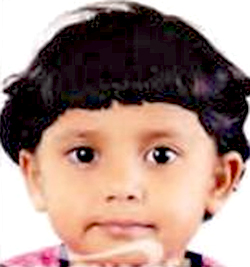
3-year-old girl killed in hit-and-run accident; locals catch driver

[email protected] (CD Network)
April 2, 2015

accidentKasargod, Apr 2: In a heartrending tragedy, a three-year-old girl was killed after she was hit by a mini lorry near Pallikere in Kasaragod on Wednesday evening.

The victim has been identified as Fathimath Shazia (3), daughter of Abdul Khader, who works in Middle East.

The accident occurred while the little girl was crossing the road with her aunt. She was returning from nursery school after participating in a programme.

It is learnt that a speeding mini lorry hit Shazia and sped away without stopping.

However, the local residents, who witnessed the accident chased the mini lorry and caught the driver identified as Abdul Kareem.

The driver was handed over to police. Jurisdictional Bekal police have registered a case.

Comments

Erick
 - 
Wednesday, 13 Jan 2016

Hiya very coopl website!! Guy .. Excellent .. Superb ..I will bookmark your web
sitte and take the feweds also? I am satisfied to seek oout numerous helpful information right here in the publish, we need develop more strategis in thiis regard,
thanks for sharing. . . . . .

Look nto my website - top
eleven cheats android: http://www.zjslsj.com/blog/member.asp?action=view&memName=CristinaEmert…

Add new comment

  • Coastaldigest.com reserves the right to delete or block any comments.
  • Coastaldigset.com is not responsible for its readers’ comments.
  • Comments that are abusive, incendiary or irrelevant are strictly prohibited.
  • Please use a genuine email ID and provide your name to avoid reject.
News Network
June 20,2020

Bengaluru, Jun 20: The Karnataka Health Department has issued guidelines on the admission of COVID-19 patients in private hospitals after clinical assessment, mandating that the district surveillance officer (DSO) should be first informed to initiate further procedures, an official said on Friday.

"A health team sent by the DSO should visit the home or hospital where the patient is staying. The team should conduct a rapid assessment of his or her health condition," said Karnataka's Additional Chief Secretary Jawaid Akhtar.

In the rapid health condition assessment, the team should first check the patient's body temperature, followed by SpO2 (oxygen saturation) level and confirm if there are any comorbidities such as hypertension, diabetes, tuberculosis, HIV, cancer, stroke etc.

Depending on the health condition of patients, Akhtar said, two categories have been made.

"Those who have body temperature greater than 37.5 degrees Celsius, SpO2 level below 94 percent, elderly (above 60 years) and suffering from known comorbid conditions should be taken to a dedicated Covid hospital (DCH)," he said.

"All other patients, even if older but not suffering from co-morbidities, those below 60 and suffering from co-morbidities and asymptomatic cases should be taken to a dedicated Covid health centre (DCHC) or a private hospital as opted by the patient," he added.

Private hospitals have been asked to pitch in due to the rising number of cases in Karnataka. Currently, there are 2943 active cases in the state after 337 cases were reported on Friday.

"The patients are assessed clinically and evaluated at DCHCs or private hospitals with appropriate diagnostic tests. After evaluation, if the patients are asymptomatic, they are shifted to a COVID Care Centre (CCC) for further management," said Akhtar.

CCCs are expected to be equipped with ventilated rooms, pulse oximeters, handheld thermal scanners and blood pressure apparatus.

A nurse has to be present round the clock for every 50 patients and should visit each patient twice a day for assessment whereas the medical officer has to visit the CCC once a day. He should also be available on call in case of an emergency.

Staff serving food and others should wear personal protective equipment and an N-95 mask. Explaining the procedures at DCHCs, Akhtar said general examinations for medical conditions like body temperature, BP, pulse, oxygen saturation and urine output should be in place.

Investigations such as complete blood count, fasting blood sugar, random blood sugar, liver function tests, renal function tests, ECG and chest X-ray facilities should be available.

"DCHCs should ensure that above examinations are over in an orderly timeline of 24 hours and depending on the examination, the patient is continued to be lodged at the DCHC or sent to DCH or CCC," said the senior officer.

Likewise, the discharge policy should be done as per the protocols issued by the Health Department from time to time.

The Karnataka government is yet to fix an upper limit on the cost of treating COVID-19 patients in private hospitals. While reports indicated that this could be capped at Rs 5200 per day, health officials are yet to specify this is the case. Private hospitals in the state have asked the government to take a collaborative approach in deciding the fixed cap on treatment cost.


Comments

Add new comment

  • Coastaldigest.com reserves the right to delete or block any comments.
  • Coastaldigset.com is not responsible for its readers’ comments.
  • Comments that are abusive, incendiary or irrelevant are strictly prohibited.
  • Please use a genuine email ID and provide your name to avoid reject.
News Network
May 23,2020

Bengaluru, May 23: The Karnataka government on Friday said returnees from six states with high COVID-19 cases will be kept in institutional quarantine for seven days.

The states are - Maharashtra, Gujarat, Delhi, Tamil Nadu, Rajasthan and Madhya Pradesh.

As per the standard operating procedure released by the government, all people to arrive via rain, air road are expected to quarantine.

After they test negative for the disease in pool testing, they will be sent for home quarantine for another seven days, the government said.

Returnees from other low prevalence states will be asked to follow 14 days of home quarantine, according to the standard operating procedure (SOP) for entry of persons from other states to Karnataka issued by the state health department late on Friday night.

However home quarantine is allowed for pregnant ladies, people above 80 years, patients with comorbidities and children below 10 years of age, along with one attendant after they test negative.

In special cases like businessmen coming for urgent work, the quarantine period will be waived if they furnish a report from an ICMR-approved laboratory showing they tested negative for COVID-19, it said.

However, if they don't have reports, they will have to stay in institutional quarantine and can leave once their results test negative.

In case their stay exceeds 5 days, they will be sent to the fever clinic and get a five-day extension if found asymptomatic.

The report should not be more than two days old from the date of travel.

All Karnataka returnees who entered from 4 May will be tested from 5-7 days from the time of their arrival.

If found COVID-19 negative, they will be sent to home quarantine and will have to follow due precautions, the SOP stated.

Comments

Add new comment

  • Coastaldigest.com reserves the right to delete or block any comments.
  • Coastaldigset.com is not responsible for its readers’ comments.
  • Comments that are abusive, incendiary or irrelevant are strictly prohibited.
  • Please use a genuine email ID and provide your name to avoid reject.
News Network
March 19,2020

Bengaluru, Mar 19: To better enforce social distancing and prevent further spread of Covid-19, the Karnataka health and family welfare department on Wednesday said it will "stamp the back of the palm" of international passengers advised to be on home quarantine, along with the date they are allowed to get out of home. The stamping process began at 12am Thursday.

Pankaj Kumar Pandey, commissioner, health and family welfare, said: "It is noted that a few passengers under home quarantine are not following the instructions. Therefore, it has been decided to stamp the back of the palm of their left hand with a specially designed stamp which will indicate the last day of quarantine."

He said the special stamp will use an indelible ink and "airports in Karnataka have been instructed to follow this without fail". On average, about 3,000 people are arriving in Bengaluru on international flights every day.

The department said social distancing is the only known method of combating the spread of Covid-19 and added, "International passengers are segregated as symptomatic and asymptomatic."

High-risk flyers kept at mass quarantine unit

The symptomatic passengers (Group-A) are taken to designated hospitals; asymptomatic ones, depending on the port of origin, are taken to the quarantine centre or permitted to go on home quarantine.

At the mass quarantine centre, the asymptomatic passengers are divided into moderate-risk (Group-B) and high-risk (Group-C) categories.

“The high-risk passengers are kept at a mass quarantine centre for medical observation. The moderate-risk passengers are being sent for home quarantine where they need to spend 14 days,” the statement added.

Pandey said: “International passengers changing flights within the country cannot be stopped. Ideally, they should be stamped at the first port of entry when they arrive from a foreign country which is not happening.” He said this issue will be brought to the notice of the Directorate-General of Civil Aviation.

Comments

Add new comment

  • Coastaldigest.com reserves the right to delete or block any comments.
  • Coastaldigset.com is not responsible for its readers’ comments.
  • Comments that are abusive, incendiary or irrelevant are strictly prohibited.
  • Please use a genuine email ID and provide your name to avoid reject.