4 of 15 cattle killed as speeding truck topples during illegal' transportation

[email protected] (CD Network | Chakravarthi)
August 28, 2016

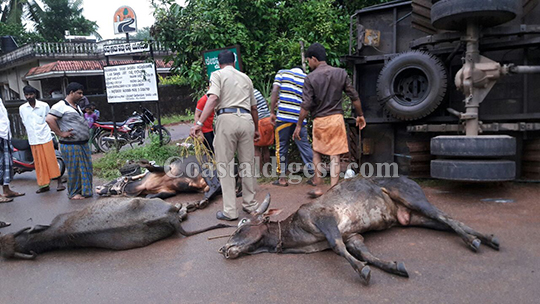
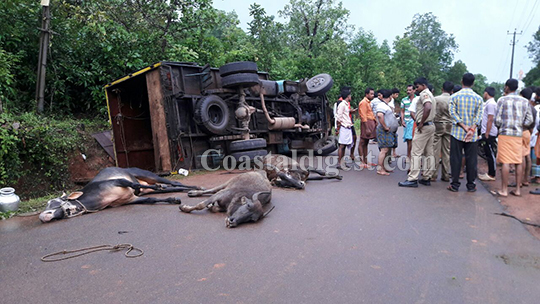
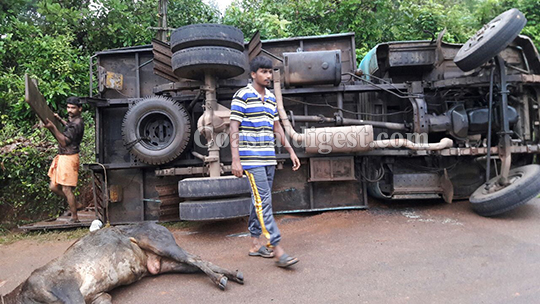
Mangaluru, Aug 28: Four cattle were killed and few more injured when a truck in which they were being transported illegally met with an accident near Kalladka in Bantwal taluk early on Sunday morning.

cattle 2

According to sources, the truck fell on its side while the driver was negotiating a curve at Amtur-Karingana Cross. Over speed is said to be the reason for the mishap.

The driver fled the scene leaving behind the damaged vehicle and cattle soon after the accident. It is not yet known whether the cattle-laden truck was being chased by gau rakshaks when the incident took place.

There were a total of 15 cattle on board the truck. Four among them were killed during the mishap and few more cattle suffered injuries.

Bantwal town police have registered a case and trying to find out who was transporting the cattle. This is a case of illegal transportation, they said.

The incident occurred nearly two weeks after a BJP worker was beaten to death by a group of gau rakshaks belonging to Hindutva groups while he was illegally transporting cattle in Udupi.

cattle 1

cattleD

Comments

Niya
 - 
Monday, 29 Aug 2016

Well done good job jobless chaddis n chaddis if u have guts then stop exporting beef will see

shakur
 - 
Monday, 29 Aug 2016

Mr. Imthiaz.. are you not reading Holy Quran.. in Quran no where mentioned to hurt other religion or beliefs.

mohammad.n
 - 
Sunday, 28 Aug 2016

Mr. Imthiyaz why do you post comment like that? Be sensible enough. Dont hurt anybody's feeling.

babu bajarangi
 - 
Sunday, 28 Aug 2016

THIS IS CHANCE TO SOCIAL SERVICE FOR CHADDI PARIVAR TO FUNAREL THERE MATA KILLD IN THERE FATHER ON PLACE.

Mohammed imthyaz
 - 
Sunday, 28 Aug 2016

Hindu GOD Go Matha Died in Road side like a dog...so baddddd

SK
 - 
Sunday, 28 Aug 2016

Luckily the driver did not meet the fate of Praveen Poojary ..... If the drivers are so afraid, then why are they indulging in such activities....
The vehicle is GONE and the owner will have to run after cases ....Kaad asa Bod na ....

Add new comment

  • Coastaldigest.com reserves the right to delete or block any comments.
  • Coastaldigset.com is not responsible for its readers’ comments.
  • Comments that are abusive, incendiary or irrelevant are strictly prohibited.
  • Please use a genuine email ID and provide your name to avoid reject.
coastaldigest.com web desk
January 3,2020

Mangaluru, Jan 3: S Cube Art Gallery has successfully concluded its prestigious assignment from Airports Authority of India (AAI) to beautify Mangaluru Airport with artistic works. AAI had invited tenders for various jobs to be executed in the airport premises. S Cube Art Gallery had made a competitive bid which was subsequently followed up with presentation before selection panel and award of contract. S Cube Art Gallery bagged the contract for six works in two sectors out of the total four sectors for which the tender had been called.

The themes presented by S Cube Art Gallery showcase the Tulu culture and heritage of the people of Coastal Karnataka. The six themes selected are:

1. ‘Human Hand Flying Paper Plane’ – fibre glass and steel sculpture work installed in the circle in the outer precincts of the airport. This is a larger than life sculpture signifying the dreams and aspirations of the air travelers. Artist: Harish Kodialbail, Mangalore

2. ‘Kambala’ – fibre glass sculpture installed at the exit area of the airport. This sculpture is meant to introduce ‘Kambala’, the iconic folk sport of the region to the visitors and tourists. Artist: Harish Kodialbail, Mangalore

3. ‘Fisherman with Boat’ - fibre glass and steel sculpture installed at the entrance to departures lounge of the airport. It symbolizes the fishing culture of the coastal region depicting the soaring aspirations, life of courage and adventure as well as the daily struggles of the fisher folk. Artist: Harish Kodialbail, Mangalore

4. ‘Tiger Dance’ - fibre glass and steel sculpture installed at the arrivals lounge of the airport. This work depicts the world famous ‘Mangalore Pilivesha’ showing tiger dancers in various typical postures to the visiting tourists. Artist: Harish Kodialbail, Mangalore

5. ‘Folk Art Forms’ – six individual terracotta sculptures with Tulunadu cultural themes installed alongside the domestic and international corridors of the airport. Artist: Venki Palimaru, Udupi

6. ‘Jain Miniature Paintings’ – Jain miniature paintings (18x6 feet) – Two works of acrylic on canvas displayed on the wall on either sides of the exit area. The work was conceived after referring to authentic traditional Jain paintings in Moodbidri Jain Mutt and Shravanabelagola Mutt. Artist: Reshma S. Shetty, Mangalore

The total value of the contract was Rs. 56 lakhs. The work was completed over a period of six months and concluded in the month of July, 2019.  S Cube Art Gallery is grateful to the Airports Authority of India for giving the opportunity to participate in this project and showcase the artistic talents of the region.

Comments

Add new comment

  • Coastaldigest.com reserves the right to delete or block any comments.
  • Coastaldigset.com is not responsible for its readers’ comments.
  • Comments that are abusive, incendiary or irrelevant are strictly prohibited.
  • Please use a genuine email ID and provide your name to avoid reject.
coastaldigest.com news network
February 9,2020

Mangaluru, Feb 9: A youth, native of Dakshina Kannada, was kidnapped and later robbed and then abandoned by a group of criminals, after he landed at the Karipur International Airport in Kerala early on Sunday morning.

In a complaint filed with the Kondotty police, the victim identified as Abdul Nazar Shamsad, said he was kidnapped while he was travelling in a shared auto from the airport to Calicut town. The kidnappers took him to an unknown destination where they tortured him.

Shamshad was reportedly subjected to physical assault and was asked to hand over the gold that he carried with him. It is learnt that the kidnappers had mistaken the youth for a gold smuggler and tortured him in order to get hold of the smuggled gold. They also stole his money and documents before abandoning him.

Comments

Add new comment

  • Coastaldigest.com reserves the right to delete or block any comments.
  • Coastaldigset.com is not responsible for its readers’ comments.
  • Comments that are abusive, incendiary or irrelevant are strictly prohibited.
  • Please use a genuine email ID and provide your name to avoid reject.
Agencies
May 8,2020

Washington D.C., May 8: The prime time for brain development in a child's life is the first year, where the infant spends most of the time asleep. It is the time when neural connections form and sensory memories are encoded.

However, when sleep is disrupted, as occurs more often among children with autism, brain development may be affected, too.

New research led by the University of Washington finds that sleep problems in a baby's first 12 months may not only precede an autism diagnosis but also may be associated with altered growth trajectory in a key part of the brain, the hippocampus.

The study, which was published in the American Journal of Psychiatry, researchers report that in a sample of more than 400 taken of 6- to 12-month-old infants, those who were later diagnosed with autism were more likely to have had difficulty falling asleep.

It also states that this sleep difficulty was associated with altered growth trajectories in the hippocampus.

"The hippocampus is critical for learning and memory, and changes in the size of the hippocampus have been associated with poor sleep in adults and older children.

As many as 80 per cent of the children with autism spectrum disorder have sleep problems," said Annette Estes, director of the UW Autism Center and senior author of the study.

"In our clinical experience, parents have a lot of concerns about their children's sleep, and in our work on early autism intervention, we observed that sleep problems were holding children and families back," added Estes, who is also a UW professor of speech and hearing sciences.

"It could be that altered sleep is part-and-parcel of autism for some children. One clue is that behavioural interventions to improve sleep don't work for all children with autism, even when their parents are doing everything just right. This suggests that there may be a biological component to sleep problems for some children with autism," said Estes.

To consider links among sleep, brain development, and autism, researchers at the IBIS Network looked at MRI scans of 432 infants, surveyed parents about sleep patterns, and measured cognitive functioning using a standardized assessment.

At the outset of the study, infants were classified according to their risk for developing autism: Those who were at higher risk of developing autism -- about two-thirds of the study sample -- had an older sibling who had already been diagnosed.

Infant siblings of children with autism have a 20 per cent chance of developing autism spectrum disorder -- a much higher risk than children in the general population.

In the current study, 127 of the 432 infants were identified as "low risk" at the time the MRI scans were taken because they had no family history of autism.

They later evaluated all the participants at 24 months of age to determine whether they had developed autism. Of the roughly 300 children originally considered "high familial risk," 71 were diagnosed with autism spectrum disorder at that age.

Problems with sleep were more common among the infants later diagnosed with an autism spectrum disorder, as were larger hippocampi. No other subcortical brain structures were affected, including the amygdala, which is responsible for certain emotions and aspects of memory, or the thalamus, a signal transmitter from the spinal cord to the cerebral cortex.

The authors note that while parents reported more sleep difficulties among infants who developed autism compared to those who did not, the differences were very subtle and only observed when looking at group averages across hundreds of infants.

Sleep patterns in the first years of life change rapidly as infants transition from sleeping around the clock to a more adult-like sleep/wake cycle. Until further research is completed, Estes said, it is not possible to interpret challenges with sleep as an early sign of increased risk for autism.


Comments

Add new comment

  • Coastaldigest.com reserves the right to delete or block any comments.
  • Coastaldigset.com is not responsible for its readers’ comments.
  • Comments that are abusive, incendiary or irrelevant are strictly prohibited.
  • Please use a genuine email ID and provide your name to avoid reject.