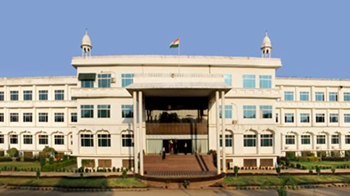
4 Kashmiri students beaten up in Mewar University over beef rumours

March 16, 2016

New Delhi, Mar 16: A mob beat up four Kashmiri students at a private university in Rajasthan over rumours that they were cooking beef inside their hostel rooms in a campus that is vegetarian by policy.

beefruThe incident led to scuffles with Kashmiri students at Mewar University in Chittorgarh. There are around 800 Kashmiri students on campus.

“Some mischief mongers spread rumours that the students were cooking beef. But prima facie it didn't look like beef. We have sent it for forensic testing just to be sure,” Chittorgarh superintendent of police Prasanna Khamesara said.

Some Hindu religious groups protested outside the campus and shouted slogans against the institute's administration but the police arrived soon after.

The incident comes days after reports that Kolkata police wrote to city college authorities, asking for details of Kashmiri students enrolled there.

The Mewar University administration said the issue was “blown out of proportion” by fringe elements.

“We have students from all over the country…from 23 states. It is like a mini India. Sometimes, these small scuffles happen because people are from different socio-cultural backgrounds,” University media liaison officer Harish Gurnani said.

Comments

Clear
 - 
Thursday, 17 Mar 2016

Mr. Bopanna Saudi is a Kingdom so the rules and regulation of king should be followed, India is republic country a democrartic country. our constitution doesnot stop from eating beef. This is the self interest of politicians.

Bopanna
 - 
Wednesday, 16 Mar 2016

will you allow a Hindu to eat pork in Saudi ? Then why try to eat beef in Hindustan ?

Curious
 - 
Wednesday, 16 Mar 2016

what ;;; sending gravy to forensic test? send beja of that goondas to us we will make beja fry. Its Time for muslims to stay united from kashmir to kanyakumari, any one is touched its like they are touching all muslims in india.

SK
 - 
Wednesday, 16 Mar 2016

The hooligans do not have any other work...... Use AK - 47 at the right time, all dogs will wag their tails.....

saleem
 - 
Wednesday, 16 Mar 2016

this is called Intolerance... we have the rights to eat whatever we want to eat in this freedom country.

Mootharapathi
 - 
Wednesday, 16 Mar 2016

As KASHMIR Not in INDIA

we INDIANS are double standards.......we treat KSHMIRI Indians as NON INDIANS....but we claim KASHMIR is is an integral part of INDIA

first clear your stand in Hindu scripture as it is allowed to have Beef....and same time you deny the truth ...what happened to innocent Hindus ....is they blindly follow RSS idealogy

Add new comment

  • Coastaldigest.com reserves the right to delete or block any comments.
  • Coastaldigset.com is not responsible for its readers’ comments.
  • Comments that are abusive, incendiary or irrelevant are strictly prohibited.
  • Please use a genuine email ID and provide your name to avoid reject.
News Network
July 28,2020

Hounde, Jul 28: Coronavirus and its restrictions are pushing already hungry communities over the edge, killing an estimated 10,000 more young children a month as meager farms are cut off from markets and villages are isolated from food and medical aid, the United Nations warned Monday.

In the call to action shared with The Associated Press ahead of publication, four UN agencies warned that growing malnutrition would have long-term consequences, transforming individual tragedies into a generational catastrophe.

Hunger is already stalking Haboue Solange Boue, an infant from Burkina Faso who lost half her former body weight of 5.5 pounds (2.5 kilograms) in just a month. Coronavirus restrictions closed the markets, and her family sold fewer vegetables. Her mother was too malnourished to nurse.

“My child,” Danssanin Lanizou whispered, choking back tears as she unwrapped a blanket to reveal her baby's protruding ribs.

More than 550,000 additional children each month are being struck by what is called wasting, according to the UN — malnutrition that manifests in spindly limbs and distended bellies. Over a year, that's up 6.7 million from last year's total of 47 million. Wasting and stunting can permanently damage children physically and mentally.

“The food security effects of the COVID crisis are going to reflect many years from now,” said Dr. Francesco Branca, the WHO head of nutrition. “There is going to be a societal effect.”

From Latin America to South Asia to sub-Saharan Africa, more poor families than ever are staring down a future without enough food.

In April, World Food Program head David Beasley warned that the coronavirus economy would cause global famines “of biblical proportions” this year. There are different stages of what is known as food insecurity; famine is officially declared when, along with other measures, 30% of the population suffers from wasting.

The World Food Program estimated in February that one Venezuelan in three was already going hungry, as inflation rendered salaries nearly worthless and forced millions to flee abroad. Then the virus arrived.

“Every day we receive a malnourished child,” said Dr. Francisco Nieto, who works in a hospital in the border state of Tachira.

In May, Nieto recalled, after two months of quarantine, 18-month-old twins arrived with bodies bloated from malnutrition. The children's mother was jobless and living with her own mother. She told the doctor she fed them only a simple drink made with boiled bananas.

“Not even a cracker? Some chicken?” he asked.

“Nothing,” the children's grandmother responded. By the time the doctor saw them, it was too late: One boy died eight days later.

The leaders of four international agencies — the World Health Organization, UNICEF, the World Food Program and the Food and Agriculture Organization — have called for at least dollar 2.4 billion immediately to address global hunger.

But even more than lack of money, restrictions on movement have prevented families from seeking treatment, said Victor Aguayo, the head of UNICEF's nutrition program.

“By having schools closed, by having primary health care services disrupted, by having nutritional programs dysfunctional, we are also creating harm,” Aguayo said. He cited as an example the near-global suspension of Vitamin A supplements, which are a crucial way to bolster developing immune systems.

In Afghanistan, movement restrictions prevent families from bringing their malnourished children to hospitals for food and aid just when they need it most. The Indira Gandhi hospital in the capital, Kabul, has seen only three or four malnourished children, said specialist Nematullah Amiri. Last year, there were 10 times as many.

Because the children don't come in, there's no way to know for certain the scale of the problem, but a recent study by Johns Hopkins University indicated an additional 13,000 Afghans younger than 5 could die.

Afghanistan is now in a red zone of hunger, with severe childhood malnutrition spiking from 690,000 in January to 780,000 — a 13% increase, according to UNICEF.

In Yemen, restrictions on movement have blocked aid distribution, along with the stalling of salaries and price hikes. The Arab world's poorest country is suffering further from a fall in remittances and a drop in funding from humanitarian agencies.

Yemen is now on the brink of famine, according to the Famine Early Warning Systems Network, which uses surveys, satellite data and weather mapping to pinpoint places most in need.

Some of the worst hunger still occurs in sub-Saharan Africa. In Sudan, 9.6 million people live from one meal to the next — a 65% increase from the same time last year.

Lockdowns across Sudanese provinces, as around the world, have dried up work and incomes for millions. With inflation hitting 136%, prices for basic goods have more than tripled.

“It has never been easy but now we are starving, eating grass, weeds, just plants from the earth,” said Ibrahim Youssef, director of the Kalma camp for internally displaced people in war-ravaged south Darfur.

Adam Haroun, an official in the Krinding camp in west Darfur, recorded nine deaths linked with malnutrition, otherwise a rare occurrence, over the past two months — five newborns and four older adults, he said.

Before the pandemic and lockdown, the Abdullah family ate three meals a day, sometimes with bread, or they'd add butter to porridge. Now they are down to just one meal of “millet porridge” — water mixed with grain. Zakaria Yehia Abdullah, a farmer now at Krinding, said the hunger is showing “in my children's faces.”

“I don't have the basics I need to survive,” said the 67-year-old, who who hasn't worked the fields since April. “That means the 10 people counting on me can't survive either.”


Comments

Add new comment

  • Coastaldigest.com reserves the right to delete or block any comments.
  • Coastaldigset.com is not responsible for its readers’ comments.
  • Comments that are abusive, incendiary or irrelevant are strictly prohibited.
  • Please use a genuine email ID and provide your name to avoid reject.
News Network
April 24,2020

Riyadh, Apr 24: As many as eleven Indian nationals have died due to COVID-19 in Saudi Arabia.

"As per information available with the Embassy as of April 22, eleven Indian nationals (four in Madinah, three in Makkah, two in Jeddah, one in Riyadh and one in Dammam) have passed away due to COVID-19 in Saudi Arabia," the Embassy of India in Saudi Arabia said in a press release on Wednesday.

It urged the Indian community to remain calm and avoid spreading of rumours amid the COVID-19 crisis.

"The Embassy also reiterates the need for the community to remain calm and avoid spreading of rumours that may create panic. It is important that social media is not used to disseminate false messages and spread hatred along communal lines that can vitiate the atmosphere," the Embassy said.

"As stated by Prime Minister Narendra Modi, COVID-19 does not see race, religion, colour, caste, creed, language or borders before striking, and our response and conduct should attach primacy to unity and brotherhood," it said.

Moreover, several measures on the supply of food, medicines and other emergency assistance to Indians in need are being implemented across the Kingdom.

Earlier, Indian Ambassador to Saudi Arabia, Ausaf Sayeed on April 22 had interacted with Indian community volunteers from the smaller towns all across the Kingdom to discuss the impact of the COVID-19 situation, and evaluate the implementation of various measures to ensure the welfare of Indian nationals.

Comments

Add new comment

  • Coastaldigest.com reserves the right to delete or block any comments.
  • Coastaldigset.com is not responsible for its readers’ comments.
  • Comments that are abusive, incendiary or irrelevant are strictly prohibited.
  • Please use a genuine email ID and provide your name to avoid reject.
Agencies
January 16,2020

Kochi, Jan 16: Kicking up a debate, an influential Catholic Church in Kerala has said "Love Jihad is a reality" and alleged that scores of women from Christian community from the southern state were being lured into the trap of Islamic State and used in terror activities.

The synod of Syro-Malabar Church, an apex body of Catholic Bishops chaired by Cardinal George Alencherry, also accused the state police of not viewing the matter cautiously and taking timely action in 'Love Jihad' cases.

Denying the charges, the Popular Front of India (PFI) questioned the "timing" of the statement and urged the Church to withdraw it immediately "as it would only help create division amid growing unity among various sections of society against Hindutva Fascism."

The Viswa Hindu Parishad (VHP) welcomed the Church statement and called for a united fight against 'Love Jihad' in Kerala Society.

An official of the Kerala State Women's Commission refused to comment, considering the sensitivity involved in the matter.

There was no immediate reaction from the police and government as well.

"There are circumstances in which Christian girls are killed in the name of Love Jihad in Kerala," the Synod has alleged in a statement issued through Syro-Malabar Media Commission here on Tuesday night, referring to the attacks against Christians across the world.

The Synod has termed as "shocking" the killing of Christians in Nigeria on Christmas day.

It is a matter of concern that Love Jihad is gaining grounds in Kerala putting in danger its social peace and communal harmony, the Synod said.

"It is a reality that 'Love Jihad' is happening in Kerala in a planned manner targeting Christian girls," it said.

The Synod, referring to a police record, said out of 21 people who were recruited into Islamic State terror outfit, half of them were converted from Christian faith and it should be an eye opener for the community.

Noting that unofficial accounts say many girls were being used in terror activities through Love Jihad, the Synod said it was a serious matter and such accounts state that Love Jihad is not only "in the imagination".

The Synod, however, said it was not assessing the 'Love Jihad' as an issue affecting the friendship between religions and urged the government to treat it as one related to law and order and not as a religious matter.

The Church demanded speedy action against the culprits involved in the 'Love Jihad.'

It also called for efforts to sensitise parents and children about the dangers of Love Jihad.

The PFI, often being accused of playing key roles in alleged 'Love Jihad' cases in Kerala, claimed that the state police, after conducting a thorough probe, had earlier submitted a report in the Kerala High Court, stating that there was no cases of 'Love Jihad' in the state.

"The Church is raising such a baseless allegation at a time when the minorities including Muslims and Christians and the people of Hindu community are in a joint fight against the Fascist government at the Centre.

Their untimely statement would only help divert the people's attention from the key issues that society is facing at present", PFI State President Naziruddin Elamaram told PTI.

Urging the Bishops to immediately withdraw the statement, he said, "I don't know what is their interest in making such a statement at this juncture."

Not a single Muslim community is holding 'Love Jihad' to increase the number of Muslims here, Elamaram claimed.

He, however, said there were instance of inter-religious marriages in Kerala in which Muslim girls marrying Hindu and Christian boys and Hindu and Christian girls selecting partners from the religions of their choice.

Such marriages cannot be termed as 'Love Jihad', he said.

Asked about the Bishops' allegations that Christian girls are targeted and recruited to Islamic State terror outift, the PFI leader said not a single Muslim organisation in India have recognised the Islamic State and such recruitments should not be seen as part of a 'jihad' as doubts prevail in minds on who created the IS.

Former president of the VHP, SJR Kumar claimed that 'Love Jihad' exists in Kerala society.

He alleged that there were centres in Kerala to "convert Hindu and Christian girls who are being lured into the trap of love by youths with criminal backgrounds".

"We have brought this issue into the attention of the Kerala society much earlier. But nobody listened to us.

Now, we are happy that the Bishops have realised the threat of Love Jihad. It is the time of a joint fight against this menace," Kumar told PTI.

He also alleged that Muslim men trap Hindu and Christian women into marriage and forcing them to convert to Islam.

"The converted Hindu and Christian girls are being used in drug trafficking and terrorism," Kumar said.

Comments

Add new comment

  • Coastaldigest.com reserves the right to delete or block any comments.
  • Coastaldigset.com is not responsible for its readers’ comments.
  • Comments that are abusive, incendiary or irrelevant are strictly prohibited.
  • Please use a genuine email ID and provide your name to avoid reject.