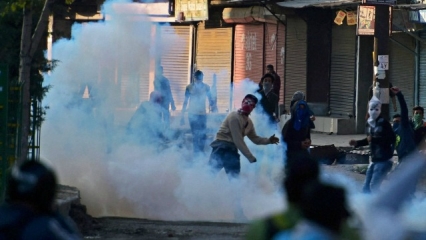
4 killed as stone-pelting protestors clash with security forces

August 16, 2016

Srinagar, Aug 16: Four youth were killed and six others injured today in security forces action against stone-pelting protestors in Magam area of central Kashmir's Budgam district, taking the death toll in the ongoing unrest in the Valley to 64

stone

A group of youth pelted stones at a CRPF vehicle at Aripathan in Magam area this morning, a police official said.

In the retaliatory action by the security forces, one youth was killed while seven others sustained injuries, the official said.

Condition of two of the injured is stated to be critical.

Meanwhile, curfew remained in force in entire Srinagar district and Anantnag town while restrictions were in place in the rest of the Valley as normal life remained paralysed for the 39th consecutive day.

The official said curfew and restrictions were imposed to thwart the plans of separatists to organise sit-in protest against the civilian killings at main market places of the Valley.

"Curfew remained in force in entire Srinagar district and Anantnag town in south Kashmir as a precautionary measure to maintain law and order," the police official said.

Schools, colleges and private offices remained closed while public transport remained off the roads due to the strike called by the separatists.The attendance in government offices was thin.

Internet and mobile services across the Valley remained suspended.

While broadband services were snapped on Saturday evening, the mobile telephony was suspended late in the night on the same day.

Normal life has been affected due to protests against the killing of Hizbul Mujahideen commander Burhan Wani in an encounter with security forces on July 8.

60 persons, including two cops, have been killed and several thousand others have been injured in the clashes that began on July 9.


Comments

Althaf
 - 
Tuesday, 16 Aug 2016

Is this happening in independence India??? Modi Please wake up

Add new comment

  • Coastaldigest.com reserves the right to delete or block any comments.
  • Coastaldigset.com is not responsible for its readers’ comments.
  • Comments that are abusive, incendiary or irrelevant are strictly prohibited.
  • Please use a genuine email ID and provide your name to avoid reject.
Agencies
February 6,2020

New Delhi, Feb 6: Unemployment rate in the country as per a new survey was 6.1 per cent in 2017-18, the government informed Rajya Sabha on Wednesday.

Minister of State for Labour Santosh Gangwar said the government is conducting a new Periodic Labour Force Survey (PLFS) with new parameters and bigger sample size, and its results cannot be compared with previous surveys in this regard.

"As per the new Periodic Labour Force Survey being conducted by the government, the labour force participation is 36.9 per cent and the rate of unemployment for 2017-18 is 6.1 per cent," he said.

Replying to supplementaries during the Question Hour, the minister said the report of this survey is very different than the surveys conducted in previous years.

This survey is not comparable to previous surveys, he said, adding it was an attempt to provide authentic data with the new survey conducted through the Ministry of Statistics.

"We are focusing on infrastructure development and ease of doing business and India's position in the world has improved. India has improved its position to 63rd rank now in 2019 against 196 in previous years," he said.

"Our government is very conscious of creating employment opportunities and is running such programme which generates employment.

"The way our government is functioning, employment opportunities are being created and the youths are getting jobs also," the minister said.

Gangwar said the government has stopped the previous survey as the sample size was low and an attempt is being made to improve the data by adding various parameters and provide more authentic data.

The minister said it will take time for collection of data as households have to be visited on the ground for authentic data collection in rural areas also.

Comments

Add new comment

  • Coastaldigest.com reserves the right to delete or block any comments.
  • Coastaldigset.com is not responsible for its readers’ comments.
  • Comments that are abusive, incendiary or irrelevant are strictly prohibited.
  • Please use a genuine email ID and provide your name to avoid reject.
Agencies
February 27,2020

New Delhi, Feb 27: The US Commission on International Religious Freedom (USCIRF) has said that the Delhi violence in which over 30 people were killed, was specifically targeted against the Muslims.

Expressing "grave concern over the ongoing violence taking place in Delhi", the USCIRF in a statement said that as President Donald Trump's inaugural visit to India winds down, North-East Delhi has been rocked by deadly rioting, with reports of violence and mobs specifically targeting Muslims.

"These incidents are even more concerning in the context of efforts within India to target and potentially disenfranchise Muslims across the country, in clear violation of international human rights standards," USCIRF Commissioner Anurima Bhargava said.

"According to reports, several mosques have also been set alight or vandalized. Many Muslim residents have been forced to flee the area. This unrest comes in the wake of widespread protests against the Citizenship (Amendment) Act following its passage in December 2019.

"The brutal and unchecked violence growing across Delhi cannot continue," Bhargava said adding that the Indian government must take swift action to ensure the safety of all of its citizens.

"Instead, reports are mounting that the Delhi police have not intervened in violent attacks against Muslims, and the government is failing in its duty to protect its citizens."

USCIRF Chair Tony Perkins said the ongoing violence in Delhi and the reported "attacks against Muslims, their homes and shops, and their houses of worship are greatly disturbing".

One of the essential duties of any responsible government, he said, is to provide protection and physical security for its citizens, regardless of faith.

"We urge the Indian government to take serious efforts to protect Muslims and others targeted by mob violence."

In its annual report last year, the USCIRF classified India as a "Tier 2" country for engaging in or tolerating religious freedom violations that meet at least one of the elements of the "systematic, ongoing, egregious standard for designations as a "country of particular concern (CPC)", under the International Religious Freedom Act.

The ongoing violence in North-East Delhi erupted after clashes between pro and anti-CAA protesters on Sunday.

Besides the casualties, over 200 others have been injured in the deadliest violence in the national capital in decades.

Comments

Add new comment

  • Coastaldigest.com reserves the right to delete or block any comments.
  • Coastaldigset.com is not responsible for its readers’ comments.
  • Comments that are abusive, incendiary or irrelevant are strictly prohibited.
  • Please use a genuine email ID and provide your name to avoid reject.
News Network
January 24,2020

New Delhi, Jan 24: Although India's Ujjwala programme encouraged adoption of liquefied petroleum gas (LPG) for cooking among the poor, households availing the scheme have not shifted away from using highly polluting fuels like firewood, a study reveals.

The researchers, including those from the University of British Columbia (UBC) in Canada, found that additional incentives to encourage regular use of cooking gas are necessary for a complete transition to clean cooking fuel among poor rural households.

They noted that about 2.9 billion people across Asia, Africa, and Latin America burn solid fuels like firewood to meet their cooking energy needs.

This has significant negative implications for public health, the environment, and societal development, according to the researchers.

Through the Pradhan Mantri Ujjwala Yojana (PMUY), India has provided capital cost subsidies to poor women to adopt a clean-burning cooking fuel or LPG.

The researchers explained that within the first 40 months of the scheme, more than 80 million households obtained LPG stoves.

However, the full benefits of LPG adoption depend on near complete replacement of polluting fuels with LPG, according to a research-based policy brief published in the journal Nature Energy.

The scientists said this cannot be assumed solely on the basis of LPG presence in the household.

"Our research shows that Ujjwala was able to attract new consumers rapidly, but those consumers did not start using LPG on a regular basis," Abhishek Kar, a postdoc at Columbia University in the US, told PTI.

The study analysed LPG sales data for over 25,000 consumers, including PMUY beneficiaries, as well as general rural LPG consumers in Koppal district of Karnataka.

The scientists employed data covering all LPG purchases of PMUY beneficiaries through their first year in the programme.

They also assessed the general rural population's purchases during their first five years as consumers to assess the effect of experience on use.

The findings estimate that an average rural family needs to purchase five 14.2 kilogramme-cylinders annually to meet half of their cooking needs.

However, the study said just seven per cent of PMUY beneficiaries in Koppal purchased five or more cylinders annually, suggesting that the beneficiaries seldom use LPG.

The general (nonPMUY) consumers in this region use on average two times more LPG cylinders than PMUY beneficiaries, the researchers noted.

Yet, only 45 per cent of nonPMUY consumers use five or more cylinders per year -- even after several years of experience with LPG, they said.

The team assessed price and seasonal factors affecting LPG use among the general population over a three-year period.

It found that LPG consumers are sensitive to price and seasonality -- LPG cylinder refill rates are lower in the summer when agricultural activity is limited, and cash is scarce.

"There was no scheme incentives to promote use, except general LPG subsidies which is available to all, including the urban middle class," said Kar, who was a Ph.D. scholar at UBC when the research was published.

"If there is no additional income, what cost would a poor family on an already tight budget cut to pay for an extra expense on a regular basis.

"Ujjwala has started the scheme of 5 kg-cylinder in response, but the impact of that on LPG sales is still publicly unknown," he said.

These findings, the researchers noted, suggest the need for additional measures to promote regular LPG use for all rural populations.

Although the finding come from a single district in Southern India, it may also apply to other areas with similar socio-economic conditions, they said.

A more expansive evaluation of PMUY would help design targeted incentives to transform infrequent users to regular users, according to the researchers.


Comments

Add new comment

  • Coastaldigest.com reserves the right to delete or block any comments.
  • Coastaldigset.com is not responsible for its readers’ comments.
  • Comments that are abusive, incendiary or irrelevant are strictly prohibited.
  • Please use a genuine email ID and provide your name to avoid reject.