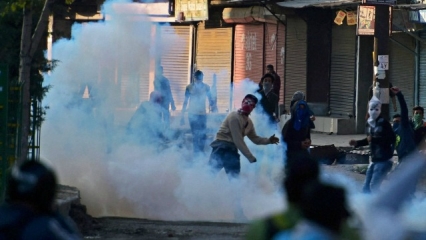
4 killed as stone-pelting protestors clash with security forces

August 16, 2016

Srinagar, Aug 16: Four youth were killed and six others injured today in security forces action against stone-pelting protestors in Magam area of central Kashmir's Budgam district, taking the death toll in the ongoing unrest in the Valley to 64

stone

A group of youth pelted stones at a CRPF vehicle at Aripathan in Magam area this morning, a police official said.

In the retaliatory action by the security forces, one youth was killed while seven others sustained injuries, the official said.

Condition of two of the injured is stated to be critical.

Meanwhile, curfew remained in force in entire Srinagar district and Anantnag town while restrictions were in place in the rest of the Valley as normal life remained paralysed for the 39th consecutive day.

The official said curfew and restrictions were imposed to thwart the plans of separatists to organise sit-in protest against the civilian killings at main market places of the Valley.

"Curfew remained in force in entire Srinagar district and Anantnag town in south Kashmir as a precautionary measure to maintain law and order," the police official said.

Schools, colleges and private offices remained closed while public transport remained off the roads due to the strike called by the separatists.The attendance in government offices was thin.

Internet and mobile services across the Valley remained suspended.

While broadband services were snapped on Saturday evening, the mobile telephony was suspended late in the night on the same day.

Normal life has been affected due to protests against the killing of Hizbul Mujahideen commander Burhan Wani in an encounter with security forces on July 8.

60 persons, including two cops, have been killed and several thousand others have been injured in the clashes that began on July 9.


Comments

Althaf
 - 
Tuesday, 16 Aug 2016

Is this happening in independence India??? Modi Please wake up

Add new comment

  • Coastaldigest.com reserves the right to delete or block any comments.
  • Coastaldigset.com is not responsible for its readers’ comments.
  • Comments that are abusive, incendiary or irrelevant are strictly prohibited.
  • Please use a genuine email ID and provide your name to avoid reject.
News Network
January 21,2020

Amaravati, Jan 21: Telugu Desam Party president N Chandrababu Naidu and at least 17 MLAs of his party were taken in police custody late on Monday as they tried to conduct a foot march from the state assembly to nearby Mandadam village in violation of prohibitory orders.

TDP leaders started off on the march after staging a sit-in near the assembly main entrance following the suspension of 17 MLAs from the House for the day.

They were protesting the AP Decentralisation and Inclusive Development of All Regions Bill, 2020, that was passed by the assembly, enabling the establishment of three capitals for the state.

The TDP leaders were taken to the Mangalagiri police station.

Meanwhile, tensions prevailed at the Jana Sena Party headquarters at Mangalagiri as police prevented its president Pawan Kalyan from proceeding to the Amaravati region to speak to protesters fighting for the retention of only one capital for the state.

DIG Kanti Rana Tata and other senior police officials reached the Sena office and blocked the exit of Kalyan and political affairs committee chairman Nadendla Manohar, resulting in an argument.

Kalyan asked how could police impose restrictions within his own office.

Scores of Sena workers gathered outside the office even as a large posse of police was posted to thwart Kalyan and other leaders' plans.

Comments

Add new comment

  • Coastaldigest.com reserves the right to delete or block any comments.
  • Coastaldigset.com is not responsible for its readers’ comments.
  • Comments that are abusive, incendiary or irrelevant are strictly prohibited.
  • Please use a genuine email ID and provide your name to avoid reject.
Agencies
June 16,2020

Mumbai, Jun 16: Saudi Arabia’s sovereign wealth fund, PIF, is all set to pick up a stake in Jio Platforms, which would complete 25% of Jio’s equity dilution to the investors, said a report by the Gulf News.

Jio Platforms is part of the Reliance Industries empire owned by Mukesh Ambani. The Public Investment Fund (PIF) will acquire 2.33% for an estimated $1.5 billion, the report said.

So far, Jio Platforms has raised investment from 10 different global investors in seven weeks, the latest being TPG Capital buying 0.93% equity for Rs 4,547 crore and private equity firm L Catterton picking up a 0.39% stake for Rs 1894.50 crore.

Jio Platforms has raised a total of Rs 1.04 lakh crore so far from leading global investors including Facebook, Silver Lake, Vista Equity Partners, General Atlantic, KKR, Mubadala, ADIA, TPG and L Catterton since April 22.

With PIF coming on board, Jio Platforms would have diluted 25% of its equity. That's the maximum they intend to dilute to financial investors, which includes Mark Zukerberg's Facebook.

Any new investors coming on board in future will have to be "strategic investors, a tech giant, for instance," said a source who was part of the deal-making process, the report said.

In recent days, Jio Platforms, which will merge telecom, content streaming, gaming and ecommerce features into its app, has seen Abu Dhabi's Mubadala and ADIA pick up significant stakes amounting to $1.2 billion and $750 million, respectively.

Reliance Industries' owner, Ambani, Asia's richest man, has been on an investor acquisition spree, with the likes of Facebook and private equity majors such as KKR and Silver Lake Capital investing in Jio Platforms.

The contours of the deal with Saudi Arabia's PIF was finalised during Ramadan. "It was always Mukesh Ambani's wish to have a special relationship with Saudi Arabia and the UAE," said Anshuman Mishra, a London-based confidante and family friend of the Ambani family of longstanding, Gulf News quoted as saying.

He has also worked extensively with Gulf sovereign wealth funds over the years.

"Saudi Arabia's coming in to close the financial investor round in Jio is indicative of the special nature of the relationship. This is also indicative of the multi-billion-dollar partnership announced last year with Saudi Aramco.

"This is a major success for the present Indian government's foreign policy initiative in the gulf and symbolic of India's significance in the GCC," it said.

Comments

Add new comment

  • Coastaldigest.com reserves the right to delete or block any comments.
  • Coastaldigset.com is not responsible for its readers’ comments.
  • Comments that are abusive, incendiary or irrelevant are strictly prohibited.
  • Please use a genuine email ID and provide your name to avoid reject.
Agencies
June 15,2020

New Delhi, Jun 15: Average temperature of India experienced a rise of 0.7 degree Celsius, along with decline in rainfall, significant increase in frequency of very severe cyclonic storms and droughts in over a decade due to human activities, the Ministry of Earth Sciences in its research report said.

The contentions were made in a report issued by the ministry on the impact of climate change. It will be published by Union Minister Harsh Vardhan on June 19.

According to the report, "Since the middle of the twentieth century, India witnessed rise in temperature; decrease in monsoon; rise in extreme temperature and rainfall, droughts, and sea levels; and increase intensity of severe cyclones.

The report, prepared by researchers of the Centre for Climate Change Research, a cell under The Ministry's Indian Institute of Tropical Meteorology, Pune, further stated that there is compelling scientific evidence that human activities have influenced these changes in regional climate.

India's average temperature has risen by around 0.7 degrees Celsius during 1901-2018, it said, adding that the rise is largely on account of GHG-induced warming and partially offset by forcing due to anthropogenic aerosols.

It states that the average temperature over India is projected to rise by 4.4 degrees Celsius, while the intensity of heat waves is likely to increase by 3-4 times by the end of the century.

In the 30-year period between 1986 and 2015, temperatures of the warmest day and the coldest night of the year have risen by about 0.63 degrees Celsius and 0.4 degree Celsius.

According to the report, by the end of the century, the temperatures of the warmest day and the coldest night are projected to rise by approximately 4.7 degrees Celsius and 5.5 degrees Celsius, respectively.

Alarmingly, sea surface temperature of the tropical Indian Ocean has also risen by one degrees Celsius on average during 1951-2015.

"The frequency of very severe cyclonic storms during the post-monsoon season has increased significantly (+1 event per decade) during the last two decades (2000-2018)," it added.

This came in the backdrop of Cyclone 'Amphan' and 'Nisarga' which made landfalls on May 20 and June 3 and killed several people, flattened villages, and destroyed farms.

"This is the first-ever climate change assessment report for India. This report will be very useful for policy makers, researchers, social scientists, economists, and students," said M. Rajeevan, secretary, the Ministry of Earth Sciences.

Besides this, the report also highlighted various other unnerving data on climate change in the country. Both the frequency and extent of droughts have increased significantly during 1951-2016.

The overall decrease of seasonal "summer monsoon rainfall" during the last 6-7 decades has led to an increased propensity for droughts over India.

"In particular, areas over central India, southwest coast, southern peninsula and north-eastern India have experienced more than 2 droughts per decade, on average, during this period. The area affected by drought has also increased by 1.3 per cent per decade over the same period."

The Hindu Kush Himalayas (HKH) also experienced a temperature rise of about 1.3 degree Celsius during 1951-2014.

Several areas of the Himalayas have experienced a declining trend in snowfall and also retreat of glaciers in recent decades. By the end of the twenty-first century, its annual mean surface temperature is projected to increase by about 5.2 degree Celsius.

The summer monsoon precipitation from June to September over India has also declined by around 6 per cent from 1951 to 2015, with notable decreases over the Indo-Gangetic Plains and the Western Ghats, the report further states.


Comments

Add new comment

  • Coastaldigest.com reserves the right to delete or block any comments.
  • Coastaldigset.com is not responsible for its readers’ comments.
  • Comments that are abusive, incendiary or irrelevant are strictly prohibited.
  • Please use a genuine email ID and provide your name to avoid reject.