4 killed as stone-pelting protestors clash with security forces

August 16, 2016

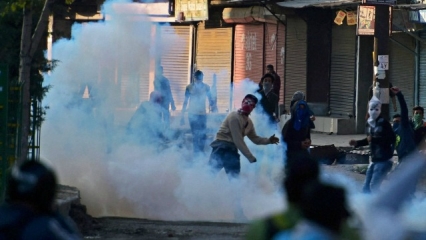
Srinagar, Aug 16: Four youth were killed and six others injured today in security forces action against stone-pelting protestors in Magam area of central Kashmir's Budgam district, taking the death toll in the ongoing unrest in the Valley to 64

stone

A group of youth pelted stones at a CRPF vehicle at Aripathan in Magam area this morning, a police official said.

In the retaliatory action by the security forces, one youth was killed while seven others sustained injuries, the official said.

Condition of two of the injured is stated to be critical.

Meanwhile, curfew remained in force in entire Srinagar district and Anantnag town while restrictions were in place in the rest of the Valley as normal life remained paralysed for the 39th consecutive day.

The official said curfew and restrictions were imposed to thwart the plans of separatists to organise sit-in protest against the civilian killings at main market places of the Valley.

"Curfew remained in force in entire Srinagar district and Anantnag town in south Kashmir as a precautionary measure to maintain law and order," the police official said.

Schools, colleges and private offices remained closed while public transport remained off the roads due to the strike called by the separatists.The attendance in government offices was thin.

Internet and mobile services across the Valley remained suspended.

While broadband services were snapped on Saturday evening, the mobile telephony was suspended late in the night on the same day.

Normal life has been affected due to protests against the killing of Hizbul Mujahideen commander Burhan Wani in an encounter with security forces on July 8.

60 persons, including two cops, have been killed and several thousand others have been injured in the clashes that began on July 9.


Comments

Althaf
 - 
Tuesday, 16 Aug 2016

Is this happening in independence India??? Modi Please wake up

Add new comment

  • Coastaldigest.com reserves the right to delete or block any comments.
  • Coastaldigset.com is not responsible for its readers’ comments.
  • Comments that are abusive, incendiary or irrelevant are strictly prohibited.
  • Please use a genuine email ID and provide your name to avoid reject.
News Network
May 25,2020

New Delhi, May 25: Realtors' apex body CREDAI has written a letter to Prime Minister Narendra Modi, seeking immediate relief measures to tide over the crisis caused by the COVID-19 pandemic.

The association, which has around 15,000 developer members, has sought one-time debt restructuring, lower interest rate on home loans and tax sops to boost liquidity and demand in the sector.

In an open letter to the prime minister, the Confederation of Real Estate Developers' Associations of India (CREDAI) said, "In this distressful situation arising out of the COVID-19 calamity, we in the real estate sector seek immediate relief for our survival."

Stating that the sector contributes substantially to the country's GDP and has backward and forward linkages with almost 250 industries, CREDAI said, "Our survival, therefore, is not just desirable, it is rather crucial for the economy."

Liquidity crunch, stagnant demand and cartelization of raw materials are major impediments for the industry to kickstart, it added.

CREDAI made seven recommendations to revive the sector and sought immediate intervention from the prime minister.

Pointing out that the situation is "much worse" than global financial crisis in 2008, CREDAI said "a one-time restructuring scheme as was permitted by RBI in 2008 may be quickly instituted by all lending institutions."

Since real estate was already reeling under a cyclical downturn before COVID-19, debt restructuring needs to be allowed for all accounts which were standard as on December 31, 2019, it added.

CREDAI demanded that all banks, non-banking financial companies (NBFCs) and housing finance companies (HFCs) should be directed to provide additional credit equal to 20 per cent of the existing real estate project related advances with no additional security and without the classification of project as NPA.

The penal interest charged by banks and financial institutions should be suspended for a period of one year or until such time as it takes for the pandemic to abate.

To revive housing demand, CREDAI suggested that "government should reduce the maximum rate of interest on new home loans to 5 per cent by subsidizing the interest component of EMIs for next five years."

The limit of principal deduction on housing loan under Section 80C should be increased to 2.5 lakh.

Interest deduction under Section 24 on housing loan for homebuyers may be increased to Rs 10 lakh, it said.

There should be no capital gains for residential properties held for a period longer than one year.

CREDAI also demanded that the subvention scheme be allowed again by National Housing Bank (NHB) and the Reserve Bank.

Under the scheme, builders used to pay EMIs on behalf of homebuyers during construction of projects.

"The economic uncertainty and job insecurity at the moment would not allow purchase of residential property at this time. A scheme whereby a homebuyer would need to pay only margin money with no EMI for 24 months will address this insecurity," the letter said.

The association pointed out that prices of cement and steel have been increased during the lockdown period, and asked for crackdown on cartelisation by manufacturers.

On the GST front, CREDAI said that the current regime of GST provides a rate of 1 per cent  for affordable housing.

"The limit of Rs 45 lakh serves as a criterion of affordability for the purpose of GST. On all other housing, GST is applied at the rate of 5 per cent without input tax credit. It has been felt that the criterion of Rs 45 lakh is too low an index of affordability anywhere across the country, and especially so in the metros," the letter said.

It will serve as an inducement to buyers in the metros if the benefit of GST at the rate of 1 per cent is extended to units costing up to Rs 75 lakh, the association said.

CREDAI pointed out that the flat rate of 5 per cent GST for under construction residential housing is causing cost build up and is acting as a deterrent for sale of under construction projects since there is no GST on completed units.

It suggested that GST rate of 1 per cent and 5 per cent, without input tax credit, should continue.

"However, an option of GST @12 per cent for normal housing/ 8 per cent for affordable housing (with 1/3rd deduction for land i.e. effective GST rate of 8 per cent for normal housing and effective GST rate of 5 per cent for affordable housing) with input tax credit (ITC) benefits in line with the scheme applicable for the works contracts for government may be revived and made applicable to the real estate," the letter said.

Lastly, CREDAI demanded that a Rs 25,000 crore stress fund for completing stalled housing projects should be deployed at the earliest.

"We shall be grateful for your much-needed intervention for the above mentioned measures required to revive the real estate sector," CREDAI said in the letter to the PM.

Comments

Add new comment

  • Coastaldigest.com reserves the right to delete or block any comments.
  • Coastaldigset.com is not responsible for its readers’ comments.
  • Comments that are abusive, incendiary or irrelevant are strictly prohibited.
  • Please use a genuine email ID and provide your name to avoid reject.
Agencies
July 29,2020

Ambala, Jul 29: The five French Rafale fighter jets touched down at Haryana's Ambala after covering a distance of nearly 7,000 km to join the Indian Air Force.

The jets were given a customary water salute upon their arrival at the airbase, some 220-km from the India-Pakistan border.

The formal induction ceremony of the aircraft would be held later. The aircraft would move out soon to another operational base for operational sorties.

After taking off from France on Monday, the aircraft made their first stopover at a French base in the United Arab Emirates on their way to India and were refuelled by the French Air Force tanker aircraft somewhere around Greece or Israel over the sea before landing there.

The five were flown by pilots of the 17 Golden Arrows led by Commanding Officer Group Captain Harkirat Singh along with other pilots, Wing Commanders MK Singh, R Kataria, Sidhu and Arun.

The five Rafale fighter aircraft took off on Monday for India from an airbase in France. The weather in Ambala was cloudy with one or two spells of rain or thundershowers being forecasted.

India had signed a Rs 59,000-crore deal on September 23, 2016 for 36 Rafale jets from French aerospace major Dassault Aviation.

In view of Rafale fighter jets landing in the city on Wednesday, Section 144 is being imposed in four villages close to Ambala airbase. Munish Sehgal, DSP Traffic, Ambala, said the administration is on a high alert and the gathering of people on roofs and photography during landing has been strictly prohibited.

The five Rafale fighter jets had entered the Indian Airspace earlier in the day. "The Birds have entered the Indian airspace..Happy Landing in Ambala!" tweeted the Defence Minister's Office earlier on Wednesday.

The Defence Minister's Office further informed that the five Rafales were escorted by 02 SU30 MKIs as they enter the Indian airspace.

Here are the key Highlights of Rafale:

It's an Omni role aircraft.
4th Generation Fighter Jet.
It's a two-engine aircraft.
It's top speed is 2,222 Km/Hr.
It can go up to 50,000 Ft.
It's Rate of Climb is 60,000 Ft/Min.
It's Operational Range is 3,700 Km.
Ground Support.
In-depth Strike.
Anti-Ship Strike.

Reach and combat radius is 1600-1700 Kms.
Capable for Long Range standoff Mission.
Equipped with Air-to-Ground Missile System.

Specifically designed to take off from an extremely cold high altitude region.

It will also be fitted with the air-to-air beyond visual range interception combat and self-defence missile.

It can also carry the best long range air-to-land missile.

It has multi-directional radar system which can detect 40 targets at the same time in a range of over 100 Kms.

It has advance radar warning receiver to identify hostile tracking system a towed decoy system to thwart incoming missile attacks.

Rafale will ensure that our pilots will not have to cross the border to strike the target, that is about 600 Km in enemy territory.

It will get French industrial support for 50 years. 

Comments

Add new comment

  • Coastaldigest.com reserves the right to delete or block any comments.
  • Coastaldigset.com is not responsible for its readers’ comments.
  • Comments that are abusive, incendiary or irrelevant are strictly prohibited.
  • Please use a genuine email ID and provide your name to avoid reject.
News Network
January 23,2020

Mumbai, Jan 23: Rashmi Sahijwala never expected to start working at the age of 59, let alone join India’s gig economy—now she is part of an army of housewives turning their homes into “cloud kitchens” to feed time-starved millennials.

Asia’s third-largest economy is battling a slowdown so sharp it is creating a drag on global growth, the International Monetary Fund said Monday, but there are some bright spots.

The gig economy, aided by cheap mobile data and abundant labour, has flourished in India, opening up new markets across the vast nation.

Although Indian women have long battled for access to education and employment opportunities, the biggest hurdle for many is convincing conservative families to let them leave home.

But new apps like Curryful, Homefoodi, and Nanighar are tapping the skills of housewives to slice, dice and prepare meals for hungry urbanites from the comfort of their homes.

The so-called cloud kitchens—restaurants that have no physical presence and a delivery-only model—are rising in popularity as there is a boom in food delivery apps such as Swiggy and Zomato.

“We want to be the Uber of home-cooked food,” said Ben Mathew, who launched Curryful in 2018, convinced that housewives were a huge untapped resource.

His company—which employs five people for the app’s daily operations—works with 52 women and three men, and the 31-year-old web entrepreneur hopes to get one million female chefs on-board by 2022.

“We usually train them in processes of sanitisation, cooking, prep time and packaging... and then launch them on the platform,” Mathew told news agency.

One of the first housewives to join Curryful in November 2018 shortly after its launch, Sahijwala was initially apprehensive, despite having four decades of experience in the kitchen.

But backed by her children, including her son who gave her regular feedback about her proposed dishes, she took the plunge.

Since then, she’s undergone a crash course in how to run a business, from creating weekly menus to buying supplies from wholesale markets to cut costs.

The learning curve was steep and Sahijwala switched from cooking everything from scratch to preparing curries and batters for breads in advance to save time and limit leftovers.

She even bought a massive freezer to store fruits and vegetables despite her husband’s reservations about the cost.

“I told him that I am a professional now,” she told news agency.

‘Internet restaurants’

Kallol Banerjee, co-founder of Rebel Foods which runs 301 cloud kitchens backing up 2,200 “internet restaurants”, was among the first entrepreneurs to embrace the concept in 2012.

“We could do more brands from one kitchen and cater to different customer requirements at multiple price points,” Banerjee told AFP.

The chefs buy the ingredients, supply the cookware and pay the utility bills.

The apps—which make their money through charging commission, such as more than 18 percent per order for Curryful—offer training and supply the chefs with containers and bags to pack the food in.

Curryful chef Chand Vyas, 55, spent years trying to set up a lunch delivery business but finally gave up after failing to compete with dabbawalas, Mumbai’s famously efficient food porters.

Today Vyas works seven hours a day, five days a week in her kitchen, serving up a bevy of Indian vegetarian staples, from street food favourites to lentils and rice according to the app’s weekly set menus.

“I don’t understand marketing or how to run a business but I know how to cook. So, the current partnership helps me focus on just that while Curryful takes care of the rest,” Vyas told AFP.

She pockets up to $150 (Rs 10,000 approx) a month after accounting for the commissions and costs, but hopes to earn more as the orders increase.

In contrast, a chef at a bricks-and-mortar restaurant takes home a monthly wage of between $300 (Rs 20,000 approx) and $1,000 (Rs 70,000) approx for working six days a week.

With India’s cloud kitchen sector expected to reach $1.05 billion by 2023, according to data platform Inc42, other companies are also keen to get a slice of the action.

Swiggy, for example, has invested 2.5 billion rupees ($35.3 million) in opening 1,000 cloud kitchens across the nation.

Back in her Mumbai kitchen, Sahijwala is elated to have embarked on a career at an age when her contemporaries are eyeing retirement.

Over the past year, she has seen her profit grow to $200 (Rs 15,000 approx) a month, but more importantly, she said, “My passion has finally found an outlet.

“I am just glad life has given me this chance.”

Comments

Add new comment

  • Coastaldigest.com reserves the right to delete or block any comments.
  • Coastaldigset.com is not responsible for its readers’ comments.
  • Comments that are abusive, incendiary or irrelevant are strictly prohibited.
  • Please use a genuine email ID and provide your name to avoid reject.