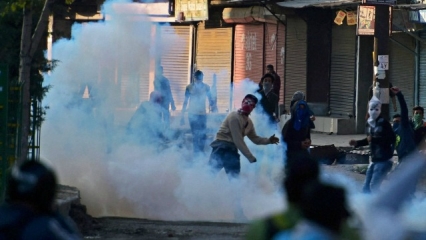
4 killed as stone-pelting protestors clash with security forces

August 16, 2016

Srinagar, Aug 16: Four youth were killed and six others injured today in security forces action against stone-pelting protestors in Magam area of central Kashmir's Budgam district, taking the death toll in the ongoing unrest in the Valley to 64

stone

A group of youth pelted stones at a CRPF vehicle at Aripathan in Magam area this morning, a police official said.

In the retaliatory action by the security forces, one youth was killed while seven others sustained injuries, the official said.

Condition of two of the injured is stated to be critical.

Meanwhile, curfew remained in force in entire Srinagar district and Anantnag town while restrictions were in place in the rest of the Valley as normal life remained paralysed for the 39th consecutive day.

The official said curfew and restrictions were imposed to thwart the plans of separatists to organise sit-in protest against the civilian killings at main market places of the Valley.

"Curfew remained in force in entire Srinagar district and Anantnag town in south Kashmir as a precautionary measure to maintain law and order," the police official said.

Schools, colleges and private offices remained closed while public transport remained off the roads due to the strike called by the separatists.The attendance in government offices was thin.

Internet and mobile services across the Valley remained suspended.

While broadband services were snapped on Saturday evening, the mobile telephony was suspended late in the night on the same day.

Normal life has been affected due to protests against the killing of Hizbul Mujahideen commander Burhan Wani in an encounter with security forces on July 8.

60 persons, including two cops, have been killed and several thousand others have been injured in the clashes that began on July 9.


Comments

Althaf
 - 
Tuesday, 16 Aug 2016

Is this happening in independence India??? Modi Please wake up

Add new comment

  • Coastaldigest.com reserves the right to delete or block any comments.
  • Coastaldigset.com is not responsible for its readers’ comments.
  • Comments that are abusive, incendiary or irrelevant are strictly prohibited.
  • Please use a genuine email ID and provide your name to avoid reject.
News Network
June 25,2020

India has jumped past 4.5 lakh coronavirus cases and 14,476 people have succumbed to the viral infection so far. In this backdrop, speaking to IANS in an exclusive interview, AIIMS Director Randeep Guleria said India is also vulnerable to second wave of coronavirus and people should continue to follow social distancing, wearing mask and other precautions, after cases begin to decline.

He added that in order to contain the outbreak of Covid-19, a limited lockdown in hotspots, where volume of cases is very high, may be considered along with a micro-plan to prevent leakage of cases from these areas to other non-containment areas. Excerpts of the interview are below:

Q: Reports say China and South Korea are witnessing a second wave of coronavirus infection, what is this second wave, is India also vulnerable to this?

A: When cases come down significantly, people tend to drop their guard against the viral infection, and this leads to the second wave (which means a sudden increase in the number of cases). After cases begin to decline, people should continue to follow the precautions -- continue to maintain social distancing and wear masks regularly. See what happened in Singapore, it was struck by a second wave of coronavirus. Look, what happened in the 1918 pandemic, people dropped their guard and the second wave of viral infection struck back. If people do not follow social distancing then the spike in cases is apparent. We need to take these precautions at least for one year. India is also vulnerable to this second wave.

Q: If Covid-19 cases continue to rise rapidly, do you think we need another lockdown in areas where volume of cases are very high?

A: A large volume of cases is concentrated in specific areas like hotspots, and in order to maintain things in order, we may need a limited lockdown in these areas. This should be followed by a micro-plan which entails extensive testing of people and also extensive contact tracing of people who have got in touch with positive people. Need to ensure there is no leakage of cases from these areas. People from these areas should not mix with others in non-containment areas. This will aid in containing the outbreak of the virus. People who have developed symptoms should get themselves tested, especially in the containment areas.

Q: With more than 4.5 lakh cases and close to 14,500 deaths, do you think India has reached its peak and a decline in cases is prominent?

A: The cases will continue to increase for some time. The doubling time of cases has also increased. But, the cases will also begin to flatten. Though, it is difficult to give an exact time period in this viral infection, it seems, the growth in cases will flatten in the end of July or beginning of August. A decline will come to this viral infection, but it does not mean that people should drop their guard. As a measure, we need to decrease community participation and citizens should continue to follow social distancing. People should get themselves tested. All these efforts will help in preventing people from contracting this virus. These precautions will also prevent us from the second wave, and we must continue to take precautions. The virus has not gone away, it is still lurking.

Q: India has crossed the 4.5 lakh coronavirus cases so far, although our recovery rate is good, but still 10,000 to 15,000 cases are reported daily. Why do cases continue to spiral, what is the reason?

A: We have to remember a few things -- the bulk of cases are in 10 cities, nearly 70 per cent, and if we take into account cases per million population, the number is not very high, as compared with countries including countries in Europe. Many European countries put together still do not add up to the Indian population. Do not compare India to countries like Italy, Spain etc. We need to focus on hotspots, which contribute to between 70 -80 per cent of cases, and we have to identify cases in these areas at an early stage. The population density is very high in these cities. People in lower socio-economic status are highly vulnerable to the viral infection, as many live together in small spaces and there is a lot of mixing of people happening there. Look at the market places, people are not following social distancing and not wearing masks. In fact, many are in close vicinity of each other.


Comments

Add new comment

  • Coastaldigest.com reserves the right to delete or block any comments.
  • Coastaldigset.com is not responsible for its readers’ comments.
  • Comments that are abusive, incendiary or irrelevant are strictly prohibited.
  • Please use a genuine email ID and provide your name to avoid reject.
News Network
July 4,2020

New Delhi, July 4: India on Friday reported its highest single-day spike of COVID-19 cases with 22,771 cases reported in the last 24 hours, said the Union Ministry of Health and Family Welfare.

With these new cases, India's coronavirus cases tally has gone up to 6,48,315, out of which there are 2,35,433 active cases in the country and 3,94,227 cases have been cured/discharged or migrated.

As many as 442 deaths due to COVID-19 have been reported in the last 24 hours taking the number of patients succumbing to the deadly virus across the country to 18,655.

As per the Union Health Ministry, Maharashtra -- the worst affected state due to COVID-19 -- has a total of 1,92,990 cases which is inclusive of 8,376 deaths. Meanwhile, Tamil Nadu, the second worst-affected state, has a total of 1,02,721 cases and 1,385 fatalities. Delhi's tally of coronavirus cases stands at 94,695 which is inclusive of 2923 deaths due to the virus.

The Centre said that the recovery rate has further improved to 60.80 per cent. The recoveries/deaths ratio is 95.48 per cent : 4.52 per cent.

The Indian Council of Medical Research, earlier on Saturday, said that the total number of samples tested up to July 3 is 95,40,132, out of which 2,42,383 samples were tested yesterday.

Comments

Add new comment

  • Coastaldigest.com reserves the right to delete or block any comments.
  • Coastaldigset.com is not responsible for its readers’ comments.
  • Comments that are abusive, incendiary or irrelevant are strictly prohibited.
  • Please use a genuine email ID and provide your name to avoid reject.
News Network
June 13,2020

New Delhi, Jun 13: Veteran Urdu poet Anand Mohan Zutshi 'Gulzar' Dehlvi passed away on Friday afternoon, five days after he recovered from COVID-19.

He died at his Noida home, and was a month shy of turning 94.

"His corona test came negative on June 7 and we brought him home. Today he had lunch and at around 2.30pm he passed away," his son Anoop Zutshi told PTI.

"He was quite old, and the infection had left him very weak. So doctors are thinking it was possible a cardiac arrest," he added.

A freedom fighter and a premier 'inquilabi' poet, Dehlvi was admitted to a private hospital on June 1 after testing positive for coronavirus.

Born in old Delhi's Gali Kashmeerian in 1926, he was also the editor of 'Science ki Duniya', the first Urdu science magazine published by the Government of India in 1975.

Remembering her fond memories of Dehlvi, historian-writer Rana Safvi recalled seeing the poet at most 'mushairas' in Delhi.

"I cannot express how big a loss it is. We used to see him at every 'mushaira' in Delhi. It's a big loss to Delhi and the world of poetry," Safvi said.

She also took to Twitter to express her condolences.

"Sad to hear about Gulzar Dehlvi saheb's demise. He was the quintessential Dilli waala. May he rest in peace," she tweeted.

According to Delhi-based poet and lawyer Saif Mahmood, Dehlvi was "the presiding bard of Delhi", following in the footsteps of iconic poets like Mirza Ghalib, and Mir Taqi Mir.

His death is the "end of an era", he said.

"No one knew the nooks and crannies of Mir and Ghalib's Delhi like him. Gulzar saheb claimed that his father, Allama Pandit Tribhuvan Nath Zutshi 'Zaar Dehlvi', was a disciple of the renowned poet Daagh Dehlvi," he said, while reminiscing his meeting with Dehlvi three years back.

The poet had recited a still unpublished 'sher' (couplet) then, Mahmood said, which seems more relevant now in the aftermath of his demise.

"Mere baad aane waalon, meri baat yaad rakhna/ mere naqsh-e-pa se behtar, koi raasta nahin hai". (Those who come after, remember what I say/ there’s no better way than to follow my footprints).

"He was a true exemplar of not just the Urdu language but also of the Urdu culture. In fact he was a living and breathing form of Urdu tehzeeb," Mahmood said.

Comments

Add new comment

  • Coastaldigest.com reserves the right to delete or block any comments.
  • Coastaldigset.com is not responsible for its readers’ comments.
  • Comments that are abusive, incendiary or irrelevant are strictly prohibited.
  • Please use a genuine email ID and provide your name to avoid reject.