


4 killed as stone-pelting protestors clash with security forces

August 16, 2016

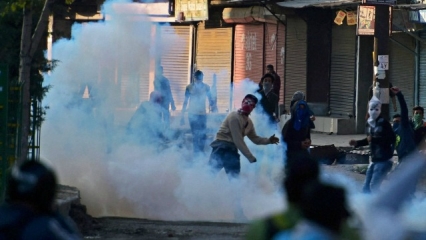
Srinagar, Aug 16: Four youth were killed and six others injured today in security forces action against stone-pelting protestors in Magam area of central Kashmir's Budgam district, taking the death toll in the ongoing unrest in the Valley to 64
stone

A group of youth pelted stones at a CRPF vehicle at Aripathan in Magam area this morning, a police official said.

In the retaliatory action by the security forces, one youth was killed while seven others sustained injuries, the official said.

Condition of two of the injured is stated to be critical.

Meanwhile, curfew remained in force in entire Srinagar district and Anantnag town while restrictions were in place in the rest of the Valley as normal life remained paralysed for the 39th consecutive day.

The official said curfew and restrictions were imposed to thwart the plans of separatists to organise sit-in protest against the civilian killings at main market places of the Valley.

"Curfew remained in force in entire Srinagar district and Anantnag town in south Kashmir as a precautionary measure to maintain law and order," the police official said.

Schools, colleges and private offices remained closed while public transport remained off the roads due to the strike called by the separatists.The attendance in government offices was thin.

Internet and mobile services across the Valley remained suspended.

While broadband services were snapped on Saturday evening, the mobile telephony was suspended late in the night on the same day.

Normal life has been affected due to protests against the killing of Hizbul Mujahideen commander Burhan Wani in an encounter with security forces on July 8.

60 persons, including two cops, have been killed and several thousand others have been injured in the clashes that began on July 9.

 

Comments

Althaf
 - 
Tuesday, 16 Aug 2016

Is this happening in independence India??? Modi Please wake up

Add new comment

  • Coastaldigest.com reserves the right to delete or block any comments.
  • Coastaldigset.com is not responsible for its readers’ comments.
  • Comments that are abusive, incendiary or irrelevant are strictly prohibited.
  • Please use a genuine email ID and provide your name to avoid reject.
Agencies
January 15,2020

Mumbai, Jan 15: The Reserve Bank of India (RBI) on Wednesday redistributed portfolios of Deputy Governors following the appointment of Michael Debabrata Patra to the post.

An official release said that NS Vishwanathan will handle co-ordination, Department of Regulation (DOR), Department of Communication (DoC), Enforcement Department, Inspection Department (ID), Risk Monitoring Department (RMD), and Secretary's Department.

BP Kanungo will look after Department of Currency Management (DCM), Department of External Investments and Operations (DEIO), Department of Government and Bank Accounts (DGBA), Department of Information Technology (DIT), Department of Payment and Settlement Systems (DPSS), Deposit Insurance and Credit Guarantee Corporation (DICGC), Foreign Exchange Department (FED), Internal Debt Management Department (IDMD), Legal Department (LD) and Right to Information (RIA) Division.

The release said that MK Jain will handle the Department of Supervision (DOS), Consumer Education and Protection Department (CEPD), Financial Inclusion and Development Department (FIDD), Human Resource Management Department (HRMD), HR Operations Unit (HR-OU), Premises Department (PD), Central Security Cell (CSC), and Rajbhasha Department.

Patra will look after the Monetary Policy Department including Forecasting and Modelling Unit (MPD/MU), Financial Markets Operations Department (FMOD), Financial Markets Regulation Department including Market Intelligence (FMRD/MI), International Department (Intl. D), Department of Economic and Policy Research (DEPR), Department of Statistics & Information Management (including Data and Information Management Unit) (DSIM/DIMU), Corporate Strategy and Budget Department (CSBD) and Financial Stability Unit.

Comments

Add new comment

  • Coastaldigest.com reserves the right to delete or block any comments.
  • Coastaldigset.com is not responsible for its readers’ comments.
  • Comments that are abusive, incendiary or irrelevant are strictly prohibited.
  • Please use a genuine email ID and provide your name to avoid reject.
News Network
May 13,2020

New Delhi, May 13: With an increase of 3,525 COVID-19 cases reported in the last 24 hours, India's tally of positive coronavirus cases rises to 74,281 cases, as of Wednesday, said the Ministry of Health and Family Welfare.

The tally is inclusive of 47,480 patients who are active coronavirus cases and 24,385 patients who have been cured/discharged and one patient migrated.

With an increase of 122 deaths due to COVID-19 reported in the last 24 hours, the number of deaths in the country now stands at 2,415.

According to the ministry, Maharashtra has the most number of positive COVID-19 cases with 24,427 positive cases that include 5,125 patients recovered and 921 fatalities.

Gujarat has reported 8,903 COVID-19 cases inclusive of 3,246 recovered patients and 537 deaths due to the coronavirus.

Tamil Nadu reported 8,718 positive coronavirus cases with 2,134 patients recovering from the disease and 61 succumbing to the infection.

Delhi's tally of COVID-19 cases stands at 7,639 cases with 2,512 patients recovering and 86 patients died due to coronavirus.

Meanwhile Arunachal Pradesh (one case reported--now recovered), Goa (seven cases reported--all seven recovered), Manipur (two cases reported--both recovered) and Mizoram (one case reported--now recovered) have reported no new cases of COVID-19.

Comments

Add new comment

  • Coastaldigest.com reserves the right to delete or block any comments.
  • Coastaldigset.com is not responsible for its readers’ comments.
  • Comments that are abusive, incendiary or irrelevant are strictly prohibited.
  • Please use a genuine email ID and provide your name to avoid reject.
News Network
February 19,2020

New Delhi, Feb 19: India will switch to the world's cleanest petrol and diesel from April 1 as it leapfrogs straight to Euro-VI emission compliant fuels from Euro-IV grades now - a feat achieved in just three years and not seen in any of the large economies around the globe.

India will join the select league of nations using petrol and diesel containing just 10 parts per million of sulphur as it looks to cut vehicular emissions that are said to be one of the reasons for the choking pollution in major cities.

Sanjiv Singh, Chairman of Indian Oil Corp (IOC) - the firm that controls roughly half of the country's fuel market, said almost all refineries began producing ultra-low sulphur BS-VI (equivalent to Euro-VI grade) petrol and diesel by the end of 2019 and oil companies have now undertaken the tedious task of replacing every drop of fuel in the country with the new one.

"We are absolutely on track for supplying BS-VI fuel from April 1. Almost all refineries have begun supplying BS-VI fuel and the same has reached storage depots across the country," he said.

From storage depots, the fuel has started travelling to petrol pumps and in the next few weeks all of them will only have BS-VI grade petrol and diesel, he said. "We are 100 per cent confident that fuel that will flow from nozzles at all the petrol pumps in the country on April 1 will be BS-VI emission compliant fuel."

India adopted Euro-III equivalent (or Bharat Stage-III) fuel with a sulphur content of 350 ppm in 2010 and then took seven years to move to BS-IV that had a sulphur content of 50 ppm. From BS-IV to BS-VI it took just three years.

"It was a conscious decision to leapfrog to BS-VI as first upgrading to BS-V and then shifting to BS-VI would have prolonged the journey to 4 to 6 years. Besides, oil refineries, as well as automobile manufacturers, would have had to make investments twice - first to producing BS-V grade fuel and engines and then BS-VI ones," he said.

State-owned oil refineries spent about Rs 35,000 crore to upgrade plants that could produce ultra-low sulphur fuel. This investment is on top of Rs 60,000 crore they spent on refinery upgrades in the previous switchovers.

BS-VI has a sulphur content of just 10 ppm and emission standards are as good as CNG.

Originally, Delhi and its adjoining towns were to have BS-VI fuel supplies by April 2019 and the rest of the country was to get same supplies from April 2020.

But oil marketing companies switched over to supply of BS-VI grade fuels in the national capital territory of Delhi on April 1, 2018.

The supply of BS-VI fuels was further extended to four contiguous districts of Rajasthan and eight of Uttar Pradesh in the National Capital Region (NCR) on April 1, 2019, together with the city of Agra.

BS-VI grade fuels were made available in 7 districts of Haryana from October 1, 2019.

Singh said the new fuel will result in a reduction in NOx in BS-VI compliant vehicles by 25 per cent in petrol cars and by 70 per cent in diesel cars.

The switchover, he said, is a tedious task as every drop of old, higher-sulphur content fuel has to be flushed out in depots, pipelines and tanks before being replaced by BS-VI.

"We are confident of disruption-free switchover to BS-VI supplies across the country," he said. "What we will be supplying is the best quality available anywhere in the world. You don't have any better fuel that is supplied in any part of the world. Perhaps our BS-VI fuel will be better than equivalent fuel in some parts of the US and Europe."

India adopted a fuel upgradation programme in the early 1990s. Low lead gasoline (petrol) was introduced in 1994 in Delhi, Mumbai, Kolkata and Chennai. On February 1, 2000, unleaded gasoline was mandated nationwide.

Similarly, BS-2000 (Euro-I equivalent, BS-1) vehicle emission norms were introduced for new vehicles from April 2000. BS-II (Euro-II equivalent) emission norms for new cars were introduced in Delhi from 2000 and extended to the other metro cities in 2001.

Benzene limits have been reduced progressively from 5 per cent in 2000 to 1 per cent nationwide. Lead content in gasoline was removed in phases and only unleaded gasoline is being produced and sold from February 1, 2000.

The octane number of gasoline signifies the improved performance of the engine. Loss in octane number due to phasing out of lead was made up by installing new facilities in the refinery and changes in refinery operation. RON (Research Octane Number) of gasoline for BS-2000 spec was increased to 88. This has over time been increased to 91.

Singh said sulphur reduction will reduce Particulate Matter (PM) emissions even in the in-use older generation diesel vehicles.

Comments

Add new comment

  • Coastaldigest.com reserves the right to delete or block any comments.
  • Coastaldigset.com is not responsible for its readers’ comments.
  • Comments that are abusive, incendiary or irrelevant are strictly prohibited.
  • Please use a genuine email ID and provide your name to avoid reject.