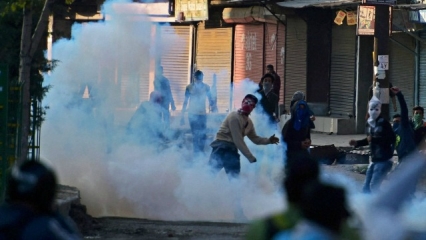
4 killed as stone-pelting protestors clash with security forces

August 16, 2016

Srinagar, Aug 16: Four youth were killed and six others injured today in security forces action against stone-pelting protestors in Magam area of central Kashmir's Budgam district, taking the death toll in the ongoing unrest in the Valley to 64

stone

A group of youth pelted stones at a CRPF vehicle at Aripathan in Magam area this morning, a police official said.

In the retaliatory action by the security forces, one youth was killed while seven others sustained injuries, the official said.

Condition of two of the injured is stated to be critical.

Meanwhile, curfew remained in force in entire Srinagar district and Anantnag town while restrictions were in place in the rest of the Valley as normal life remained paralysed for the 39th consecutive day.

The official said curfew and restrictions were imposed to thwart the plans of separatists to organise sit-in protest against the civilian killings at main market places of the Valley.

"Curfew remained in force in entire Srinagar district and Anantnag town in south Kashmir as a precautionary measure to maintain law and order," the police official said.

Schools, colleges and private offices remained closed while public transport remained off the roads due to the strike called by the separatists.The attendance in government offices was thin.

Internet and mobile services across the Valley remained suspended.

While broadband services were snapped on Saturday evening, the mobile telephony was suspended late in the night on the same day.

Normal life has been affected due to protests against the killing of Hizbul Mujahideen commander Burhan Wani in an encounter with security forces on July 8.

60 persons, including two cops, have been killed and several thousand others have been injured in the clashes that began on July 9.


Comments

Althaf
 - 
Tuesday, 16 Aug 2016

Is this happening in independence India??? Modi Please wake up

Add new comment

  • Coastaldigest.com reserves the right to delete or block any comments.
  • Coastaldigset.com is not responsible for its readers’ comments.
  • Comments that are abusive, incendiary or irrelevant are strictly prohibited.
  • Please use a genuine email ID and provide your name to avoid reject.
Agencies
May 10,2020

New Delhi, May 10: Congress leader Rahul Gandhi on Saturday demanded that Prime Minister Narendra Modi ensured audit of donations made to the PM-CARES Fund, and to share the details and the money spent with the people.

"The PM-CARES Fund has received huge contributions from PSUs and major public utilities like the Railways. It's important that the Prime Minister ensure the fund is audited and that the record of money received and spent is available to the public," he tweeted.

The #PmCares fund has received huge contributions from PSUs & major public utilities like the Railways.

It’s important that PM ensures the fund is audited & that the record of money received and spent is available to the public.

— Rahul Gandhi (@RahulGandhi) May 9, 2020
His remarks came amid reports that the central government is accumulating a huge sum of money in the Prime Minister's Citizen Assistance and Relief in Emergency Situations Fund set up as a corpus to fight novel coronavirus and that the amount spent will not be audited by the Comptroller and Auditor General.

The CAG office had clarified that since the fund is based on donations, it has no right to audit a charitable organisation.

On Friday, Rahul Gandhi told the media that the PM-CARES Fund should be audited and people of the country should know about the donors and the donations made.

Comments

Add new comment

  • Coastaldigest.com reserves the right to delete or block any comments.
  • Coastaldigset.com is not responsible for its readers’ comments.
  • Comments that are abusive, incendiary or irrelevant are strictly prohibited.
  • Please use a genuine email ID and provide your name to avoid reject.
Agencies
March 26,2020

New Delhi, Mar 26: The government on Thursday announced a Rs 1.7 lakh crore stimulus that included free foodgrain and cooking gas to poor for three months, and cash doles to women and poor senior citizens as it looked to ease the economic impact of the nationwide lockdown.

While over 80 crore poor ration card holders will each get 5 kg of wheat or rice and one kg of preferred pulses free of cost every month for the next three months, 20.4 crore women having Jan Dhan bank accounts would get one-time cash help of Rs 1,500 spread over three months.

Over 8.3 crore poor women, who were handed out free cooking gas connections since 2016, will get free LPG refills for the next three months, while poor senior citizens, widows and disabled will get an ex-gratia cash of Rs 1,000.

"Since the lockdown has been in force (since Wednesday) and therefore we have come out with a package which will immediately take care of the concerns and welfare of poor and suffering workers and those who need immediate help," Finance Minister Nirmala Sitharaman said at a news conference here.

The package, she said, is being announced within 36 hours of the 21-day nationwide lockdown announced by the Prime Minister to protect the nation's 130 crore people from the fast-spreading coronavirus. "We do not want anyone to remain hungry."

She hinted at more announcements if a need arises.

"So, today's measures are very clearly aimed at reaching out with food and money that they need to have it in their hands. We will obviously think about other things. I will gradually address if there is more to attend," she said.

The package included advancing the payment of one-third of the Rs 6,000 a year pre-2019 general election cash dole scheme for farmers, government contributions to retirement funds for the next three months of small companies with 90 per cent of staff earning less than Rs 15,000, and a Rs 50 lakh insurance cover to healthcare workers.

For rural workers, the daily wage under the MNREGA employment guarantee programme has been increased to Rs 202 from Rs 182, benefiting 5 crore workers of about Rs 2,000 in all.

India joins countries -- from the US to Singapore -- that have pledged spending to contain the economic fallout of the pandemic that has infected almost 5 lakh people globally and left over 21,000 dead.

The pandemic has infected 649 persons in India and has killed 13 so far.

While the free food grains and pulses would cost Rs 45,000 crore, Rs 2,000 payment to 8.7 crore farmers under Pradhan Mantri Garib Kalyan Yojana will cost Rs 16,000 crore.

The cash to women Jan Dhan account holders will cost Rs 31,000 crore and another Rs 13,000 crore is estimated to be the expenditure for providing free cooking gas.

Sitharaman, however, evaded a reply to questions on how the government will finance the package given that the impact of the closure of businesses across the country will be felt over the next few months and would have a direct bearing on already strained tax collections.

She also did not say if the government will relax budget deficit targets or resort to additional borrowings to fund the programme.

The revised fiscal deficit - the gap between revenue and expenditure - has been put at 3.8 per cent of the GDP in the current fiscal. For the fiscal starting April, the government is targeting a 3.5 per cent fiscal deficit.

"Today's measures are very clearly aimed at reaching out to the poor," she said. "At this stage, I am more concerned about reaching out to those who need help."

With businesses closed during the lockdown, the government will contribute employees as well as employer's contribution to the provident fund for the next three months of companies with up to 100 employees with 90 per cent earning not more than Rs 15,000. The contribution will be a total of 24 per cent of eligible wages.

Also, workers will be allowed to draw a non-refundable advance of 75 per cent from credit in provident fund account or three months salary, whichever is lower, she said.

Sitharaman said the limit of collateral-free loans to 63 lakh women self-help groups is being doubled to Rs 20 lakh, impacting 7 crore households.

The free foodgrain and pulses are over-and-above the existing entitlement through the public distribution system (PDS). The ration card holders can take the foodgrain and pulses from the PDS in two installments, she added.

The government had previously relaxed timelines for meeting tax and other statutory filing requirements as well as allowed companies to divert their philanthropy or CSR funds to support the fight against coronavirus.

These measures and the ones announced on Thursday will be topped up by the expected announcement of interest rate cuts by the Reserve Bank of India (RBI) at its bi-monthly monetary policy review meet slated next week.

Commenting on the package, Anil Talreja, Partner, Deloitte India said the announcements are is expected to give reprieve to the mass sections of the population. "This is a good way to ensure that the poor and needy get what they deserve. It has ensured that the farmers, poor senior citizens, widows and specified sections of the society as well as people who are attached to the healthcare sectors get rewarded for their hard work and sacrifices".

Comments

Add new comment

  • Coastaldigest.com reserves the right to delete or block any comments.
  • Coastaldigset.com is not responsible for its readers’ comments.
  • Comments that are abusive, incendiary or irrelevant are strictly prohibited.
  • Please use a genuine email ID and provide your name to avoid reject.
News Network
January 1,2020

Jan 1: The ban on the practice of instant triple talaq, making it a penal offence and the increase in the strength of Supreme Court judges were two of the major achievements of the law ministry in 2019.

In July, Parliament gave its nod to The Muslim Women (Protection of Rights on Marriage) Bill, 2019. The new law makes talaq-e-biddat or any other similar form of talaq having the effect of instantaneous and irrevocable divorce pronounced by a Muslim husband void and illegal.

It makes it illegal to pronounce talaq three times in spoken, written or through SMS or WhatsApp or any other electronic chat in one sitting.

According to the new law, any Muslim who pronounces the illegal form of talaq upon his wife shall be punished with imprisonment for a term which may extend to three years, and shall also be liable to fine.

During the year, four new judges were appointed to the Supreme Court in September, taking its strength to 34, the highest-ever.

However, vacancies in high courts and lower courts are on the rise and convincing state governments and the 25 high courts to come on board to create an all-India judicial service to recruit judges for the subordinate courts tops the agenda of the Law Ministry in 2020.

Besides creating a consensus on setting up the All-India Judicial Services, the ministry will also have to focus on filling up vacancies in the high court. On an average, the vacancies stood at 400 throughout this year.

With more than 5,000 positions of judicial officers in district and subordinate courts lying vacant, the Law Ministry has pitched for setting up all-India judicial services.

The sanctioned strength of the judicial officers in district and subordinate courts was 22,644. The number of judicial officers in position and vacant posts is 17,509 and 5,135, respectively.

The government has proposed that while states and high courts can recruit judicial officers, the Union Public Service Commission (UPSC) can hold pan-India entrance tests.

The ministry has made it clear that such services would not encroach on the powers of the states.

As of now, the selection and appointment of judges in subordinate courts is the responsibility of the high courts and state governments concerned.

The Narendra Modi government has given a fresh push to the long-pending proposal to set up the new service to have a separate cadre for the lower judiciary in the country.

But there is a divergence of opinion among state governments and respective high courts on the constitution of the All India Judicial Service (AIJS).

One of the problems cited is that since several states have used powers under Code of Criminal Procedure (CrPC) and Code of Civil Procedure (CPC) to declare that the local language would be used in lower courts even for writing orders, a person say selected from Tamil Nadu may find it difficult to hold proceedings in states like Uttar Pradesh and Bihar.

The other point of opposition is that an all India service may hamper the career progression of state judicial services officers.

Another key issue the ministry has to handle in 2020 is vacancies in the 25 high courts.

Throughout 2019, on an average, the high courts faced a shortage of 400 judges.

According to Law Ministry data, as on September 1, the high courts had 414 vacant positions as compared to the sanctioned strength of 1,079 judges. The figure was 409 in August and 403 in July, as per the data.

A three-member Supreme Court collegium recommends the names of candidates for appointment as high court judges. In case of appointments to the Supreme Court, the collegium consists of five top judges of the top court.

High court collegiums shortlist candidates for their respective high courts and send the names to the law ministry.

The ministry, along with background check reports by the Intelligence Bureau, forwards it to the Supreme Court collegium for a final call.

The government has maintained that appointment of judges in the high courts is a "continuous collaborative process" between the Executive and the Judiciary, as it requires consultation and approval from various Constitutional authorities.

Vacancies keep arising on account of retirement, resignation or elevation of judges and increase in judges' strength. In June last year, the vacancy position stood at 399, while it was 396 in May.

In April, 399 posts of judges were vacant, while the figure was 394 in March. The vacancy position in February stood at 400 and in January, it was 392, according to the data collated by the Department of Justice.

Over 43 lakh cases are pending in the 25 high courts.

Another priority would be the finalisation of the memorandum of the procedure to guide the appointment and transfer of the Supreme Court and high court judges. The issue had now been pending for over two years now with the SC collegium and the government failing to reach a consensus.

Successive governments have also been working on making India a hub of international arbitration. It has taken several steps to change laws dealing with commercial disputes.


Comments

Add new comment

  • Coastaldigest.com reserves the right to delete or block any comments.
  • Coastaldigset.com is not responsible for its readers’ comments.
  • Comments that are abusive, incendiary or irrelevant are strictly prohibited.
  • Please use a genuine email ID and provide your name to avoid reject.