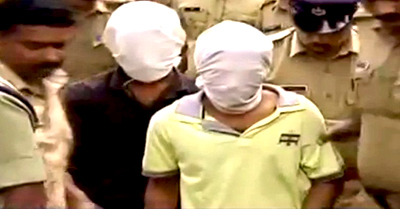
4 young RSS workers arrested for murder of CPM activist

[email protected] (CD Network)
July 18, 2016

rss

Kasaragod, Jul 18: Four activists of Rashtriya Swayamsevak Sangh have been arrested in Kannur yesterday in connection with the July 11 murder of a 38-year old CPM worker over political rivalry in the politically volatile Payyannur district, police said.

A team led by Payyannur Circle Inspector V Ramesh arrested Vysakh, 21, Sukesh, 29, Prejithlal, 21, and Anoop, 21, all hailing from the district, they said.

The arrested men were among the eight persons identified as accused in the case. The four allegedly had direct involvement in the crime and the others will also be nabbed soon, police said.

CV Dhanaraj was hacked to death by a group of people, allegedly RSS activists, when he was entering his house at Payyannur. He had died while being rushed to the hospital.

In a suspected retaliatory attack hours later, 52-year-old BJP activist Ramachandran, an autorickshaw driver, was murdered by another group at his house in Vellur village in the district, police said.

No arrests had been made so far in this connection.

Kannur and some parts of the state had witnessed clashes between CPM and BJP workers after the May 16 Assembly election results.

Comments

Naren kotian
 - 
Tuesday, 19 Jul 2016

Don't worry they will be out soon .. ...so I don't find they have done wrong ...meanwhile jihadis must answer biryani boys aka cattle lifters avre ree Pakistan from of India ..chennai nalli Pakistan zindabad antha idvanthe howda .. Haha ...police navru rubtavrante sariyagi maklige howda....haha

Sahil
 - 
Monday, 18 Jul 2016

Someone is hiding here... I cant see narayana and groups today... Why guys why?? where are you?? Need your comments on this topic as nationalists are arrested without any reason!!

Mohammed SS
 - 
Monday, 18 Jul 2016

RSS group noted for terrorism, 99% of them are making easy money by doing terror activities now the time has come to ban this organization.

ali
 - 
Monday, 18 Jul 2016

Leader of RSS is still hiding. Catch the big fish and rest of them will surrender easily.

Well Wisher
 - 
Monday, 18 Jul 2016

Let police investigate n expose their full team member name photo all over India n call their backing famous media persons to discuss on rss agenda. Let them decide whether rss is a patriotic or terror group.

Yasar
 - 
Monday, 18 Jul 2016

Cover the face with Saffron shawl which has their flag. Hand over to NIA.
How the Police gets Arabic shawl when Muslim get arrested? Our Police dept. is more dangerous than these terrorists.

A. Mangalore
 - 
Monday, 18 Jul 2016

RSS IS TERRRORIST ORGANIZATION. BOMBING , KILLING IS INCREASING IN THEIR ORGANZATION. MUST BAN THIS ORGANIZATION LIKE NEHRU GOVERNMENT BANNED AFTER THEY KILLED MAHATMA GHANDHI.

Satyameva jayate
 - 
Monday, 18 Jul 2016

RSS terrorists

PK
 - 
Monday, 18 Jul 2016

Y cover the face of the REAL TERRORIST.. and KILLERS.
Times up with cheddis deceptions....everything will be exposed

Add new comment

  • Coastaldigest.com reserves the right to delete or block any comments.
  • Coastaldigset.com is not responsible for its readers’ comments.
  • Comments that are abusive, incendiary or irrelevant are strictly prohibited.
  • Please use a genuine email ID and provide your name to avoid reject.
Agencies
February 6,2020

Even more than three years after demonetisation and all-out efforts to make most transactions through electronic, cash is still king, as it thrives in a digital India, said fintech start-up Paytm founder Vijay Sekhar Sharma.

"While cashless economy is not possible in India, less cash economy will be in the future. Less cash is the only solution, not the elimination of cash," Sharma told IANS in an interview after unveiling an all-in-one payment gateway on Tuesday.

Asserting that it would take 5-10 years for India to make the transition to digital payments from the traditional mode of cash, Sharma, 41, said the e-payment industry benefitted more from the November 8, 2016 note ban and withdrawal of old Rs 1,000 and Rs 500 denominations.

"I think it (demonetisation) helped the industry despite lack of specific help. But the world has changed since then. It is about the scale of distribution of merchants that is what is propelling digital payments," said Sharma.

Most of the cash not only came back into circulation, but also remains as the mode of payment for the majority due to its convenience for the people used to such transactions.

Expounding Paytm's zero service charge, Sharma said the strategy is sustainable as it leads to acquiring more customers and merchants, enabling newer business opportunities.

Paytm also does not levy a service charge to small merchants for its payments services, unlike organised players like Uber.

"Though there is a monetisation model, the merchants who are small shopkeepers, become our financial services customers as they open a bank account, which is profitable."

Paytm secured a Payments Bank license from the Reserve Bank of India to offer a savings bank account, Rupay debit card and money transfer services.

"We are banking on payment services acquiring customers and merchants who avail banking, lending, insurance, wealth and software services like billing software and business ledger software services eventually," Sharma noted.

The mobile first bank services include zero balance and zero digital transaction charge accounts.

"Basically, payments, cloud, commerce and financial services are a cohort we follow. So, payments is our customer as well as merchant acquisition. If it breaks even, we are happy because other line items make more money, he affirmed.

Noting that in a market like India, one cannot price services at a premium unlike in a developed country like the US, the billionaire businessman said a consumer in a developing country would not be able to afford such a hefty charge.

Forbes ranked Sharma as India's youngest billionaire in 2017, with a net worth of $2.1 billion.

While several countries operate on the model of higher service charges, Sharma said newer business models have to be discovered in India, as customer lifecycle value is accounted for more stages than in other nations.

Asked about an upscale retailer like Zara not giving a wallet payment option during its recent end of season sale in Bengaluru, Sharma said Paytm was addressing such hiccups with its all-in-one payment solutions.

"It's an opportunity, because if the retailer has our all-in-one point of sale machine, where in they enter the amount, it shows both the Quick Response code (QR) and card payment options," he observed.

Sharma compared older swiping payment machine to feature phones and modern ones to feature-rich smartphones.

"If you notice, they look like feature phones and the modern day card machine is more a smartphone like. You can add the smatphone components, which can add the features," reiterated Sharma.

Though Paytm's all-in-one QR point of sale machine integrates the billing system, its chief executive said it was not ideal to have an independent QR feature.

Paytm has 16 million strong merchant user base, which Sharma aims to raise to 26 million base in the next one year.

Sharma has launched in this tech city an all-in-one payment gateway and Paytm Business Payments solution, which enable digital payments through multiple methods for small and medium enterprises (SMEs) and an Android point of sale machine.

With the new gateway solution, collecting digital payments through multiple methods can be achieved seamlessly while Paytm Business Payments solution enables automated vendor payments, including employee salaries and customer refunds among others.

The One97 Communications-owned Paytm aims to help SMEs streamline and digitise their business activities using its new solutions, which enhance the overall efficiency of both accepting and making payments.

Paytm has a data bank of over 200 million saved cards and bank accounts, a feature which enables partner apps to shorten transaction times and propel faster conversions while using the all-in-one payment gateway.

Complementing the two solutions, Sharma also launched an all-in-one Android point of sale machine, which can accept payments through all forms such as cards, wallets, UPI apps and even cash.

The device has a QR code that supports all contact and contactless payments, coming with integrated billing software customized solutions for different sectors such as catering, ticketing, parking and others.

The handheld Android device is equipped with an in-built printer, scanner and can also generate bills.

Valued at $16 billion, Paytm is not alone in the fiercely competitive Indian fintech space where a dozen players like PhonePe, MobiKwik, Kotak 811 and deep pocketed international giants Google Pay and Amazon Pay are in the fray.


Comments

Add new comment

  • Coastaldigest.com reserves the right to delete or block any comments.
  • Coastaldigset.com is not responsible for its readers’ comments.
  • Comments that are abusive, incendiary or irrelevant are strictly prohibited.
  • Please use a genuine email ID and provide your name to avoid reject.
News Network
February 25,2020

Mangaluru, Feb 25: Notorious gangster Ravi Poojary,

who has been extradited to India from Senegal, has 34 cases registered against him within the city police commissionerate.

Now in Bengaluru police custody for interrogation in connection with several cases there, Poojary faces cases relating to murder, murder attempt, extortion and threat calls in the city, police sources said.

Sources said the city police are trying to get Pujari for interrogation though it would take a while as the court has allowed Bengaluru police to keep him in custody for questioning and evidence taking for 15 days.

Most of the cases in the city against him, 28 of them, are in connection with threat calls.

He had allegedly made threat calls in 2015 to the then state ministers B Ramanath Rai and Abhayachandra Jain, demanding immediate arrest of the accused in the murder of Bajrang Dal worker Prashanth Poojary.

All the cases against Poojary in the city were registered between 2007 and 2018.

Cases involving murder, death threats and shootouts are among the cases to be investigated, the sources said.

A total of 28 cases of death threat calls, one of murder, three of shootouts, one of abduction and a case of funding his associates lodged in prison are the crimes being probed by the city police.

The cases are now pending in courts at different stages of trial.

Cases of making threat calls to businessmen using his associates demanding protection money have been registered at Moodbidri, Kavoor, Kadri, Konaje, Barke and Urwa police stations.

Some of his associates were imprisoned in 2012 in connection with threat calls to a businessman from Kinnigoli.

The case relating to providing them money while in prison was also registered in the same year.

Pujari, wanted in many cases including extortion and murder in different parts of the country, including Karnataka and who had been on the run for over 15 years, was deported to Senegal following his arrest and later extradited

He had jumped bail in Senegal last year after being arrested there.

Comments

Add new comment

  • Coastaldigest.com reserves the right to delete or block any comments.
  • Coastaldigset.com is not responsible for its readers’ comments.
  • Comments that are abusive, incendiary or irrelevant are strictly prohibited.
  • Please use a genuine email ID and provide your name to avoid reject.
Agencies
May 8,2020

Washington D.C., May 8: The prime time for brain development in a child's life is the first year, where the infant spends most of the time asleep. It is the time when neural connections form and sensory memories are encoded.

However, when sleep is disrupted, as occurs more often among children with autism, brain development may be affected, too.

New research led by the University of Washington finds that sleep problems in a baby's first 12 months may not only precede an autism diagnosis but also may be associated with altered growth trajectory in a key part of the brain, the hippocampus.

The study, which was published in the American Journal of Psychiatry, researchers report that in a sample of more than 400 taken of 6- to 12-month-old infants, those who were later diagnosed with autism were more likely to have had difficulty falling asleep.

It also states that this sleep difficulty was associated with altered growth trajectories in the hippocampus.

"The hippocampus is critical for learning and memory, and changes in the size of the hippocampus have been associated with poor sleep in adults and older children.

As many as 80 per cent of the children with autism spectrum disorder have sleep problems," said Annette Estes, director of the UW Autism Center and senior author of the study.

"In our clinical experience, parents have a lot of concerns about their children's sleep, and in our work on early autism intervention, we observed that sleep problems were holding children and families back," added Estes, who is also a UW professor of speech and hearing sciences.

"It could be that altered sleep is part-and-parcel of autism for some children. One clue is that behavioural interventions to improve sleep don't work for all children with autism, even when their parents are doing everything just right. This suggests that there may be a biological component to sleep problems for some children with autism," said Estes.

To consider links among sleep, brain development, and autism, researchers at the IBIS Network looked at MRI scans of 432 infants, surveyed parents about sleep patterns, and measured cognitive functioning using a standardized assessment.

At the outset of the study, infants were classified according to their risk for developing autism: Those who were at higher risk of developing autism -- about two-thirds of the study sample -- had an older sibling who had already been diagnosed.

Infant siblings of children with autism have a 20 per cent chance of developing autism spectrum disorder -- a much higher risk than children in the general population.

In the current study, 127 of the 432 infants were identified as "low risk" at the time the MRI scans were taken because they had no family history of autism.

They later evaluated all the participants at 24 months of age to determine whether they had developed autism. Of the roughly 300 children originally considered "high familial risk," 71 were diagnosed with autism spectrum disorder at that age.

Problems with sleep were more common among the infants later diagnosed with an autism spectrum disorder, as were larger hippocampi. No other subcortical brain structures were affected, including the amygdala, which is responsible for certain emotions and aspects of memory, or the thalamus, a signal transmitter from the spinal cord to the cerebral cortex.

The authors note that while parents reported more sleep difficulties among infants who developed autism compared to those who did not, the differences were very subtle and only observed when looking at group averages across hundreds of infants.

Sleep patterns in the first years of life change rapidly as infants transition from sleeping around the clock to a more adult-like sleep/wake cycle. Until further research is completed, Estes said, it is not possible to interpret challenges with sleep as an early sign of increased risk for autism.

Comments

Add new comment

  • Coastaldigest.com reserves the right to delete or block any comments.
  • Coastaldigset.com is not responsible for its readers’ comments.
  • Comments that are abusive, incendiary or irrelevant are strictly prohibited.
  • Please use a genuine email ID and provide your name to avoid reject.