


5 of 15 Muslims missing from Kerala had converted to Islam recently

July 10, 2016

Kasaragod, Jul 10: Five of the 15 missing Muslims from Kerala who are feared to have joined the Islamic State (IS) were Hindus and Christians who had converted to Islam about a year ago.
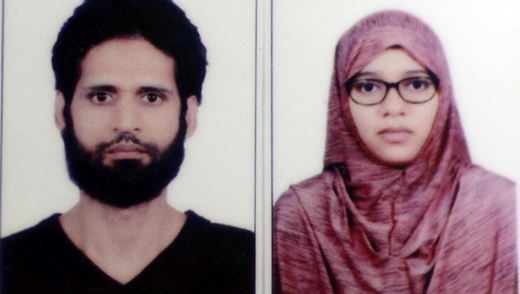
1couple

Fathima Nimisha who went missing with her husband Eesa who were feared to have joined in IS terror group

Meanwhile, intelligence sources said one of those missing was in Afghanistan, while another was hiding in India.

Among the five married couples who are missing, two were earlier Hindus or Christians.

— Nimisha, alias Fathima, from a Hindu family in Thiruvananthapuram, converted to Islam while studying at a dental college in Kasaragod district in November last year.

— Merlin, alias Mariyam, from Kochi was a Christian who converted to Islam while working with IBM in Mumbai last year.

— Nimisha and Merlin were married to two brothers, Issa and Yahiya, from Palakkad who had both converted from Christianity to Islam. Their father, Vincent, filed a missing person's complaint on Saturday.

— Sonia, alias Ayisha, an engineering graduate — who is missing with her husband Abdul Rasheed, an engineer, and their two-year-old daughter Sara — was a Christian who converted to Islam about a year ago.

Nimisha's mother, Bindu, said her daughter first went missing from her college last November. After she filed a police complaint, Nimisha and Issa appeared before a local court. “I was shocked to see her covering her face. I was told that she had been converted to Islam by some Mujahideen group,'' she said.

Nimisha's family moved a habeas corpus petition in the high court in November. But the court allowed her to live with Issa. “I asked my daughter how she met Issa as he was not her classmate or friend. I was told that her seniors in college arranged the match, that they wanted a converted youth to marry a converted girl. They had become friends just four days before they started living together,'' she said.

At first, Nimisha did not contact her family. But she later got in touch, and even visited her mother in the second week of May. “After spending a few hours with the family, she left for Palakkad. Later, I was told that they were going to Sri Lanka to explore some business opportunities. I pleaded with Issa not to go there with my pregnant daughter, but he refused to listen. After reaching Sri Lanka, she sent me WhatsApp messages,'' said Bindu.

Jacob, the father of another missing woman, Merlin, said his daughter and Yahiya had studied together in a school in Kochi. “After graduation, my daughter got a job with IBM in Mumbai. During college, she was not in touch with Yahiya, who was then a Christian. Last year, after converting to Islam, he managed to track down her in Mumbai and converted her also,'' he said.

He said Merlin told him that they were going to Sri Lanka to address religious gatherings. “We discouraged them from going to Lanka. She was a brilliant girl. We thought she would not fall into any trap. We had warned her about this relationship. She was brainwashed. For the last three weeks, we have received no information about her,'' he said.

Sonia, whose family is from Vyttila in Kochi, was born in Bahrain, where her parents were employed. She came to Kerala for her engineering studies, during which she met Abdul Rashid, a resident of Kasaragod.

According to sources, Sonia was not in touch with her family after she converted to Islam. Intelligence sources said Sonia had become a preacher, while Rashid is suspected to be the local organiser of the missing group from Kasaragod.

Meanwhile, at Padanna in Kasaragod, two brothers, Dr Ijas and Shihab, an engineer, and their wives are among those missing. Their father, Abdul Rahim, told the media that if they had joined the Islamic State he would “consider them as dead”.

Two other families in Kasaragod also filed missing complaints after their sons, who were working in Qatar and Abu Dhabi, failed to reach home. Police said the youths had called up their families on June 9, informing them that would reach home in a week. “The families expected that they would come for Eid last week. The reports about missing men made them worried. Hence, they filed complaints today,'' said police sources.

Comments

Rajesh Sequira
 - 
Wednesday, 13 Jul 2016

The plot thickens.....

Maruthi
 - 
Monday, 11 Jul 2016

ALL is now understood.........................................................................BJP= high rise in scams and problems . violence and trouble in cabinet reshuffling.......Dr.Zakir Naik issue (which was unnecessary link)

in KERALA people are more attracted to ISLAM.......So ISIS issue ...that too New Muslims

Ha Ha ....

THINKERS
 - 
Monday, 11 Jul 2016

Dear Yogesh,
Study ISLAM, you will understand the media twist... Dont live as per media instruction ... sometimes verify and use your intellect.

Also Ponder on NA TASYA PRATIMA ASTI>..

abdullah
 - 
Monday, 11 Jul 2016

It clearly understood that RSS people with the help of Israel making all these controversies to avoid people from converting to Islam.

True commentator
 - 
Monday, 11 Jul 2016

Dear Yogesh,
There are thousand of people from both the sex are converting to Islam, after they fully study it.
Then these highly educated people really work as propagators than the initially borned Muslims.

You should compare how many of them have joined IS or became terrorists. In contrary those people worked as the peace propagators than anybody.

So your addressing of these 15 Keralite have not studied Islam well.
Unfortunately the young brain have been mislead to join IS which is not at all portraying ISLAMIC values. In contrary IS is the enemy of Islam and enemy of all peace loving community.

Add new comment

  • Coastaldigest.com reserves the right to delete or block any comments.
  • Coastaldigset.com is not responsible for its readers’ comments.
  • Comments that are abusive, incendiary or irrelevant are strictly prohibited.
  • Please use a genuine email ID and provide your name to avoid reject.
Agencies
June 26,2020

Mumbai, Jun 26: In a humanitarian gesture, a mosque in Bhiwandi town of adjoining Thane district has been converted by its administrators into a temporary COVID-19 facility, where oxygen is provided free of cost to patients.

The facility at Makkah Masjid in the Shanti Nagar area of the powerloom town has been set up by the local chapter of Jamaat-e-Islami Hind (JIH), Movement for Peace and Justice and the Shanti Nagar Trust, which runs the mosque.

Apart from putting up five beds equipped with oxygen cylinders, the JIH also delivers them for free to patients homes if required, an office-bearer of the JIH said, adding the makeshift facility is open to all communities.

So far, the Bhiwandi-Nizampur municipality has recorded over 1,332 COVID-19 cases and 88 casualties. It has a mortality rate of 5.26 per cent, a release stated.

"Bhiwandi-Nizampur has been hit hard by the pandemic as it is a congested city. It doesn't even have proper health infrastructure.

"The situation has only worsened during the pandemic as general medical practitioners have shut their clinics fearing the virus spread," said Ausaf Ahmed Falahi, president of the JIH's Bhiwandi chapter.

As a majority of people here lack awareness about the viral disease and are unable to afford treatment, a facility like this one was the need of the hour, he said.

Over 70 persons have benefited from this facility, which has two doctors, while 15 oxygen cylinders have been delivered to the homes of eight COVID-19 patients, Falahi said.

People irrespective of their religion have been availing treatment at the mosque, he added.

"Makkah Masjid has been shut for prayers since the lockdown. So, we decided to use a part of the premises to help those who can't avail treatment elsewhere," said Qaiser Mirza of the Shanti Nagar Trust. 

Comments

Add new comment

  • Coastaldigest.com reserves the right to delete or block any comments.
  • Coastaldigset.com is not responsible for its readers’ comments.
  • Comments that are abusive, incendiary or irrelevant are strictly prohibited.
  • Please use a genuine email ID and provide your name to avoid reject.
News Network
May 3,2020

Bengaluru, May 3: Undergraduate and postgraduate students skipping online classes held by their universities run the risk of being debarred from writing their exams. 

State universities, which are monitoring the attendance of online classes, are asking their affiliate colleges to send the monthly online attendance details and this would reflect in their regular attendance. This would apply to those studying professional courses like medicine and engineering. 

State medical education minister Dr K Sudhakar has asked all medical colleges to regularly send attendance details to the Rajiv Gandhi University of Health Sciences (RGUHS).

RGUHS vice-chancellor Dr Sachidanand confirmed to DH that the varsity is indeed monitoring the attendance of students. “Online classes are equal to classroom teaching. (Such method of conducting classes) are necessary during the Covid-19 pandemic and the nationwide lockdown,” he said.

According to the Supreme Court directions, students should have 75% attendance to be eligible to appear for the final exams. There could be relaxations if they have health issues. If students are bunking online classes, it would reflect on their minimum attendance necessary to appear for the exams, the vice-chancellors of state-run varsities said.

Bangalore University vice-chancellor Prof K R Venugopal said most of the students are attending online classes and teachers are messaging the parents of those who are irregular. “(Of course) if they fall short of the minimum attendance, they won’t be allowed to appear for the exams,” he said.

Bengaluru North University vice-chancellor Prof T D Kemparaju said the administration has asked its teachers to record details of students attending online classes and update the university.

Mixed signals 

Meanwhile, the University Grants Commission (UGC) on Wednesday issued guidelines directing all universities to treat the lockdown period as “deemed as attended” for students and research scholars. Experts pointed out that the order would prompt students not to take the online classes seriously.

“Arrangements have been made at the state varsities to make students attend online classes compulsorily and students are also serious about it. Now, because of the UGC guidelines, they may bunk classes,” said the vice-chancellor of a state-run university.

Comments

Add new comment

  • Coastaldigest.com reserves the right to delete or block any comments.
  • Coastaldigset.com is not responsible for its readers’ comments.
  • Comments that are abusive, incendiary or irrelevant are strictly prohibited.
  • Please use a genuine email ID and provide your name to avoid reject.
Agencies
May 8,2020

Washington D.C., May 8: The prime time for brain development in a child's life is the first year, where the infant spends most of the time asleep. It is the time when neural connections form and sensory memories are encoded.

However, when sleep is disrupted, as occurs more often among children with autism, brain development may be affected, too.

New research led by the University of Washington finds that sleep problems in a baby's first 12 months may not only precede an autism diagnosis but also may be associated with altered growth trajectory in a key part of the brain, the hippocampus.

The study, which was published in the American Journal of Psychiatry, researchers report that in a sample of more than 400 taken of 6- to 12-month-old infants, those who were later diagnosed with autism were more likely to have had difficulty falling asleep.

It also states that this sleep difficulty was associated with altered growth trajectories in the hippocampus.

"The hippocampus is critical for learning and memory, and changes in the size of the hippocampus have been associated with poor sleep in adults and older children.

As many as 80 per cent of the children with autism spectrum disorder have sleep problems," said Annette Estes, director of the UW Autism Center and senior author of the study.

"In our clinical experience, parents have a lot of concerns about their children's sleep, and in our work on early autism intervention, we observed that sleep problems were holding children and families back," added Estes, who is also a UW professor of speech and hearing sciences.

"It could be that altered sleep is part-and-parcel of autism for some children. One clue is that behavioural interventions to improve sleep don't work for all children with autism, even when their parents are doing everything just right. This suggests that there may be a biological component to sleep problems for some children with autism," said Estes.

To consider links among sleep, brain development, and autism, researchers at the IBIS Network looked at MRI scans of 432 infants, surveyed parents about sleep patterns, and measured cognitive functioning using a standardized assessment.

At the outset of the study, infants were classified according to their risk for developing autism: Those who were at higher risk of developing autism -- about two-thirds of the study sample -- had an older sibling who had already been diagnosed.

Infant siblings of children with autism have a 20 per cent chance of developing autism spectrum disorder -- a much higher risk than children in the general population.

In the current study, 127 of the 432 infants were identified as "low risk" at the time the MRI scans were taken because they had no family history of autism.

They later evaluated all the participants at 24 months of age to determine whether they had developed autism. Of the roughly 300 children originally considered "high familial risk," 71 were diagnosed with autism spectrum disorder at that age.

Problems with sleep were more common among the infants later diagnosed with an autism spectrum disorder, as were larger hippocampi. No other subcortical brain structures were affected, including the amygdala, which is responsible for certain emotions and aspects of memory, or the thalamus, a signal transmitter from the spinal cord to the cerebral cortex.

The authors note that while parents reported more sleep difficulties among infants who developed autism compared to those who did not, the differences were very subtle and only observed when looking at group averages across hundreds of infants.

Sleep patterns in the first years of life change rapidly as infants transition from sleeping around the clock to a more adult-like sleep/wake cycle. Until further research is completed, Estes said, it is not possible to interpret challenges with sleep as an early sign of increased risk for autism.

Comments

Add new comment

  • Coastaldigest.com reserves the right to delete or block any comments.
  • Coastaldigset.com is not responsible for its readers’ comments.
  • Comments that are abusive, incendiary or irrelevant are strictly prohibited.
  • Please use a genuine email ID and provide your name to avoid reject.