50,000 animals butchered near Hindu temple to appease goddess

[email protected] (CD Network)
October 12, 2016

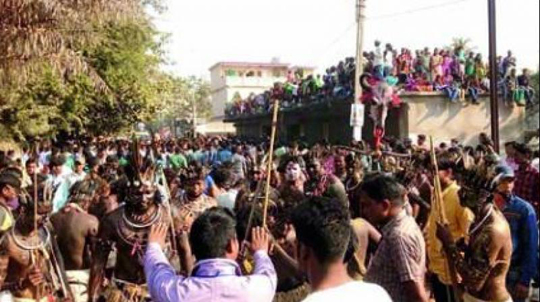
Bhawanipatna, Oct 12: In spite of public awareness campaigns and ban imposed by the Odisha government, people belonging to Hindu community have mercilessly butchered over 50,000 animals and birds to “appease” goddess Manikeswari during the annual “Chhattar Yatra” near the Manikeswari temple, here like previous years.

goddess

The district administration had also made fervent appeals to the people to refrain from killing animals and birds. However, the slaughtering continued tillSunday afternoon despite 15 CCTV and drone cameras being installed.

The huge deployment of police personnel also failed to check the slaughter, as most of the locals extended their patronage to the act, arguing that animal sacrifice was a long-practiced religious tradition during Chhattar Yatra, and the government's ban is an infringement of their right to religion.

Since no political parties want to earn the displeasure of the locals, they also don't raise their voice against the practice, nor do they cooperate with the administration's effort to enforce the law.

According to reports, over 1.5 lakh people took part in the annual festival, and had a glimpse of the presiding deity while it was taken out in a procession.

As many as 11 platoons of police personnel were deployed to maintain law and order. Besides, 41 sub-inspectors, 15 inspectors, five deputy superintendents of police and one additional SP, were deployed at the festival.

“We had initiated awareness campaigns to prevent animal sacrifice. I believe it will be on the wane due to massive awareness programmest,” Kalahandi SP Brijesh Kumar Rai was quoted as saying.

During the Chhattar Yatra, the goddess is taken in a procession from Jenakhal after Sandhi Puja to Bhawanipatna town, the permanent abode of the deity.

On Sunday, the Chhattar procession took off at around 5.20 am with people making beeline to have a glimpse of the presiding deity. The town reverberated amid the rhythmic beats of Jenabadya, Nisan and Ghanta (traditional musical instruments) and dancers performing Ghumura' and martial art forms.

“We eagerly wait for the festival to participate in it. The people of Kalahandi have immense faith in Maa Manikeswari. We offer sacrifices on fulfillment of our wishes in which people across caste and religion participate in it,” Sudharam Sarap, a devotee.

Before the start of the sacrifice ritual on Asthami tithi of the Hindu month of Ashwina every year, two swords belonging to the goddess are washed in the pond located behind the palace. The swords are then worshipped and brought back to the temple in a procession. Then a buffalo is sacrificed at the Budharaja or Vairab temple, a satellite shrine of the Manikeswari temple.

Following this ritual, the Chhattar or umbrella of the goddess, along with two swords of the deity, are taken out for the procession.

Comments

Satyameva jayate
 - 
Thursday, 13 Oct 2016

Where our beloved maa lovers and nationalists......
Muslims sacrifice animals In the name of the world's creator and consume it as food with respect.....these people sacrifice in the names of story book characters and dump them as waste....so which is cruel......

Raj
 - 
Wednesday, 12 Oct 2016

This is not hinduism. If this is hinduism then i think. Islam is better religion. They don't sacrifice to please god. As per true indian. What he said is true. I gone through quran app just now. And god says he only feed and he is not fed.

Many hindus including my self eat kfc. It DOESN'T please God.

If they continue like this. Then many hindus will convert to Muslim.

Every year hindu population is decreasing and muslim population is increasing. May be this is the reason.

suresh
 - 
Wednesday, 12 Oct 2016

VERY BAD.
god does not need anything from us.
Love, live and let live.

In Nepal, infamous Gadhimai temple sacrifice has banned completely by people. Now we have to be caring for all the living beings on earth.

H A Dsouza
 - 
Wednesday, 12 Oct 2016

Where is gavrakshakas their aim is to target minorities

TRUE INDIAN
 - 
Wednesday, 12 Oct 2016

WHY GOD NEEDS BLOOD. THEY EVEN KILL YOUNG KIDS TO PLEASE GOD. DISGUSTING.

Quran 6:14 He who feeds and is not fed?

Best way of life Islam.

SHABEER AHAMME…
 - 
Wednesday, 12 Oct 2016

OH my god..Bajarangdal / RSS / VHP / RAMASENE / & 100 many more Hindu wrong wings sleeping or RIP. Oh yeah political game. maneka gandhi / and many more on vacation it seems.
OH What about Arnab Cow Swamy. Still at large

Rikaz
 - 
Wednesday, 12 Oct 2016

Where is Maneka Gandhi, is she sleeping.....

Add new comment

  • Coastaldigest.com reserves the right to delete or block any comments.
  • Coastaldigset.com is not responsible for its readers’ comments.
  • Comments that are abusive, incendiary or irrelevant are strictly prohibited.
  • Please use a genuine email ID and provide your name to avoid reject.
News Network
April 2,2020

Bengaluru, Apr 2: A health worker, who was part of a team fighting against the Coronavirus disease in the city, was allegedly attacked by a mob and duped of her belongings at the Sadiq Layout in the Shivajinagar area on Thursday.

According to police sources, the health worker came under attack by a mob of youths when she was collecting data from those who were sick in the locality.

Comments

Add new comment

  • Coastaldigest.com reserves the right to delete or block any comments.
  • Coastaldigset.com is not responsible for its readers’ comments.
  • Comments that are abusive, incendiary or irrelevant are strictly prohibited.
  • Please use a genuine email ID and provide your name to avoid reject.
News Network
May 31,2020

Bengaluru, May 31: Karnataka government on Sunday issued guidelines, which will come into force from June 1 and continue till June 30.

According to the new guidelines, religious places and places of worship for the public, hotels, restaurants and other hospitality services, and shopping malls will be permitted to open from June 8.

Union Ministry of Home Affairs (MHA) on Saturday announced new guidelines for phased re-opening of "all activities outside containment zones for the next one month beginning June 1.

In an order, Karnataka government said that phased re-opening of areas outside the containment zones, all activities will be permitted, except the following, which will be allowed, with the stipulation of following Standard Operating Procedures (SOPs) to be prescribed by the Ministry of Health and Family Welfare (MoHFW).

PHASE I

The activities will be allowed with effect from June 8 at religious places/places of worship for public, hotels, restaurants, and other hospitality services, shopping malls.

PHASE II

For the opening of schools, colleges, educational/training/ coaching institutions, the State government will hold consultations at the institution level with parents and other stakeholders. Based on the feedback, a decision on the re-opening of these institutions will be taken in the month of July.

PHASE III

Based on the assessment of the situation, dates for re-starting activities will be decided -- international air travel of passengers, except as permitted by MHA, Metro Rail, cinema halls, gymnasiums, swimming pools, entertainment parks, theatres, bars and auditoriums, assembly halls and similar places, social/political/spoils/ entertainment/academic/cultural/religious functions and other large congregations.

The State government said that it will follow the MHA's national directives for the coronavirus management, including compulsory use of face masks and social distancing norms.

"Face coverings are compulsory in public places, workplaces and during transport. Individuals must maintain a minimum distance of 6 feet in public places. Shops will ensure physical distancing among customers and will not allow more than 5 persons at a time," read the directives issued by the MHA.

In the order, State government has said that night curfew will continue to remain in force on the movement of individuals for all non-essential activities outside containment zones till June 30.

Lockdown limited to Containment Zones

* Lockdown shall continue to remain in force in the Containment Zones till June 30.

* Containment Zones will be demarcated by the district authorities after taking into consideration the guidelines of Department of Health and Family Welfare, Government of Karnataka.

* In the Containment Zones, only essential activities shall be allowed. There shall be strict perimeter control to ensure that there is no movement of people in or out of these zones, except for medical emergencies and for maintaining a supply of essential goods and services.

* In the Containment Zones, there shall be intensive contact tracing, house-to-house surveillance, and other clinical interventions, as required. Guidelines of the Department of Health and Family Welfare, Government of Karnataka shall be taken into consideration for the above purpose.

* District authorities/BBMP authorities may also identify buffer zones outside the Containment Zones, where new cases are more likely to occur. Within the buffer zones, restrictions, as considered necessary, may be put in place by the District authorities.

Movement of persons, goods

* There shall be no restriction on inter-State and intra-State movement of persons and goods. No separate permission/approval/e-permit will be required for such movements.

* Based on reasons of public health and assessment of the prevalence of Covid-19 in various States separate orders will be issued by the Health and Family Welfare Department regarding the inter-state movement of persons to Karnataka.

* Movement by passenger trains and Shramik special trains; domestic passenger air travel; movement of Indian Nationals stranded outside the country and of specified persons to travel abroad; evacuation of foreign nationals; and sign-on and sign-off of Indian seafarers will continue to be regulated as per SOPs issued.

The State Government in its guidelines advised persons above 65 years of age, persons with co-morbidities, pregnant women, and children below the age of 10 years, to stay at home, except for essential and health purposes.

Guidelines for Aarogya Setu App

* Aarogya Setu enables early identification of potential risk of infection, and thus acts as a shield for individuals and the community.

* With a view to ensuring safety in offices and workplaces, employers on best effort basis should ensure that Aarogya Sew is installed by all employees having compatible mobile phones.

* District authorities and BBMP Authorities may advise individuals to install the Aarogya Setu application on compatible mobile phones and regularly update their health status on the app. This will facilitate timely provision of medical attention to those individuals who are at risk.

Union Ministry of Home Affairs (MHA) on Saturday said that lockdown will continue in containment zones till June 30 and only essential activities will be allowed in those areas.

"Lockdown shall continue to remain in force in the containment zones till 30 June. In the containment zones, only essential activities shall be allowed. There shall be strict perimeter control to ensure that there is no movement of people in or out of these zones, except for medical emergencies and for maintaining the supply of essential goods and services. In the containment zones, there shall be intensive contact tracing, house-to-house surveillance, and other clinical interventions, as required," MHA said in its guidelines for #Unlock1.

It also issued new guidelines for phased re-opening of "all activities outside containment zones for the next one month beginning June 1."


Comments

Add new comment

  • Coastaldigest.com reserves the right to delete or block any comments.
  • Coastaldigset.com is not responsible for its readers’ comments.
  • Comments that are abusive, incendiary or irrelevant are strictly prohibited.
  • Please use a genuine email ID and provide your name to avoid reject.
News Network
February 12,2020

Mumbai, Feb 12: The Income Tax department's Criminal Investigation wing has identified 2,000 Indian citizens who hold properties in Dubai but had failed to declare it in their IT returns.

In its ongoing crackdown on black money, the agency has identified Indian citizens who purchased properties in Dubai but failed to declare and explain the source of funds used to purchase these properties.

In the past few years, people have used shell companies to route illegal money and buy overseas properties to evade income tax.

However, the tax department has now increased its efforts to track down those involved in major tax evasion cases.

The 2,000 persons and companies identified mainly include businessmen, top professionals, and government officials.

The IT department will initiate action against the accused under the Black Money Act.

Citizens who own properties outside the country but fail to declare the source of funds or income used for the purchase could be prosecuted under the Black Money Act.

Under Section FA (Foreign Assets) of the Income Tax Act, an individual has to declare purchase and ownership of properties, assets, companies owned outside the country while filing the income tax returns annually.

In the recent drive against black money, the IT department identified 2,000 Indian nationals who failed to provide information on the same while filing IT returns.

Of the 2,000 citizens owning properties in Dubai, around 600 could not furnish details regarding purchase details.

Those who haven't been able to explain the source of funds used for the purchase of properties could be prosecuted and their properties can be attached by the agency.

Other than the attachment of the property, they can face a monetary penalty up to 300 per cent of the property value and also face imprisonment under the Black Money Act.

The properties owned by Indians in Dubai raised red flags as this pattern of parking money is used by money launderers, smugglers, underworld gangsters and drug traffickers for making payments.

It is worth mentioning that of the 2,000 citizens identified, most are residing in Mumbai, followed by Kerala and Gujarat.

The clause under section FA (foreign Assets) came into effect in the year 2011-12 and it is mandatory for people owning properties outside India to declare it in their IT returns.

Those identified by IT department could also face action under FEMA (Foreign Exchange Management Act) by the Enforcement Directorate under Section 4.

Recently the Enforcement Directorate (ED) launched a crackdown on black money parked overseas by tracking and identifying immovable assets bought overseas by Indian nationals illegally.

The move is being carried out under rules laid down under Section 4 of FEMA (Foregn Exchange Manipulation Act), 1999. Section 4 of FEMA states that no person resident in India shall acquire, hold, own, possess or transfer any foreign exchange, foreign security or any immovable property situated outside India.

On January 17, the Enforcement Directorate (ED) conducted searches at the residence of a former chief engineer of Brihanmumbai Municipal Corporation (BMC) in connection with an inquiry related to FEMA.

In the raids, the ED officials recovered documents related to the purchase of a property in Dubai in an allegedly illegal manner.

The ex-BMC chief engineer was posted with some of the most crucial wings of the municipal corporation -- the building proposal department and development plan department.

The agency did not disclose the name of the ex-BMC chief engineer but it has been learnt that he had superannuated around seven years ago from the municipal corporation.

ED, in a statement, said incriminating documents with regard to illegal acquisition of a property held in Dubai was recovered during the search operation.

The former BMC chief engineer has stated that he had purchased the property in Dubai at 'Park Island, Bonaire Marsa, Dubai' for Rs 70 lakh in 2012. The property is held jointly in his name, his spouse and son.

The retired BMC officials could not furnish any documents which would help ascertain the value of the property and also could not provide details on how the payments were made to buy the property in Dubai.

The citizens identified by the IT department recently also adopted a similar route to buy property in Delhi. It remains to be seen how the income tax department plans to penalise them.

Comments

Add new comment

  • Coastaldigest.com reserves the right to delete or block any comments.
  • Coastaldigset.com is not responsible for its readers’ comments.
  • Comments that are abusive, incendiary or irrelevant are strictly prohibited.
  • Please use a genuine email ID and provide your name to avoid reject.