


50,000 animals butchered near Hindu temple to appease goddess

[email protected] (CD Network)
October 12, 2016

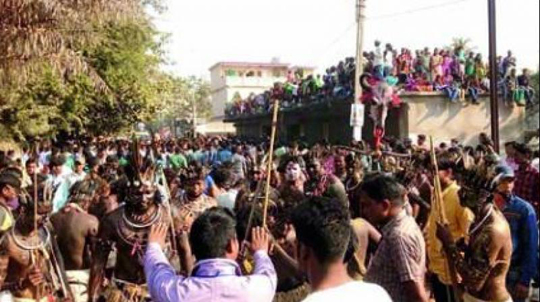
Bhawanipatna, Oct 12: In spite of public awareness campaigns and ban imposed by the Odisha government, people belonging to Hindu community have mercilessly butchered over 50,000 animals and birds to “appease” goddess Manikeswari during the annual “Chhattar Yatra” near the Manikeswari temple, here like previous years.
goddess

The district administration had also made fervent appeals to the people to refrain from killing animals and birds. However, the slaughtering continued tillSunday afternoon despite 15 CCTV and drone cameras being installed.

The huge deployment of police personnel also failed to check the slaughter, as most of the locals extended their patronage to the act, arguing that animal sacrifice was a long-practiced religious tradition during Chhattar Yatra, and the government's ban is an infringement of their right to religion.

Since no political parties want to earn the displeasure of the locals, they also don't raise their voice against the practice, nor do they cooperate with the administration's effort to enforce the law.

According to reports, over 1.5 lakh people took part in the annual festival, and had a glimpse of the presiding deity while it was taken out in a procession.

As many as 11 platoons of police personnel were deployed to maintain law and order. Besides, 41 sub-inspectors, 15 inspectors, five deputy superintendents of police and one additional SP, were deployed at the festival.

“We had initiated awareness campaigns to prevent animal sacrifice. I believe it will be on the wane due to massive awareness programmest,” Kalahandi SP Brijesh Kumar Rai was quoted as saying.

During the Chhattar Yatra, the goddess is taken in a procession from Jenakhal after Sandhi Puja to Bhawanipatna town, the permanent abode of the deity.

On Sunday, the Chhattar procession took off at around 5.20 am with people making beeline to have a glimpse of the presiding deity. The town reverberated amid the rhythmic beats of Jenabadya, Nisan and Ghanta (traditional musical instruments) and dancers performing Ghumura' and martial art forms.

“We eagerly wait for the festival to participate in it. The people of Kalahandi have immense faith in Maa Manikeswari. We offer sacrifices on fulfillment of our wishes in which people across caste and religion participate in it,” Sudharam Sarap, a devotee.

Before the start of the sacrifice ritual on Asthami tithi of the Hindu month of Ashwina every year, two swords belonging to the goddess are washed in the pond located behind the palace. The swords are then worshipped and brought back to the temple in a procession. Then a buffalo is sacrificed at the Budharaja or Vairab temple, a satellite shrine of the Manikeswari temple.

Following this ritual, the Chhattar or umbrella of the goddess, along with two swords of the deity, are taken out for the procession.

Comments

Satyameva jayate
 - 
Thursday, 13 Oct 2016

Where our beloved maa lovers and nationalists......
Muslims sacrifice animals In the name of the world's creator and consume it as food with respect.....these people sacrifice in the names of story book characters and dump them as waste....so which is cruel......

Raj
 - 
Wednesday, 12 Oct 2016

This is not hinduism. If this is hinduism then i think. Islam is better religion. They don't sacrifice to please god. As per true indian. What he said is true. I gone through quran app just now. And god says he only feed and he is not fed.

Many hindus including my self eat kfc. It DOESN'T please God.

If they continue like this. Then many hindus will convert to Muslim.

Every year hindu population is decreasing and muslim population is increasing. May be this is the reason.

suresh
 - 
Wednesday, 12 Oct 2016

VERY BAD.
god does not need anything from us.
Love, live and let live.

In Nepal, infamous Gadhimai temple sacrifice has banned completely by people. Now we have to be caring for all the living beings on earth.

H A Dsouza
 - 
Wednesday, 12 Oct 2016

Where is gavrakshakas their aim is to target minorities

TRUE INDIAN
 - 
Wednesday, 12 Oct 2016

WHY GOD NEEDS BLOOD. THEY EVEN KILL YOUNG KIDS TO PLEASE GOD. DISGUSTING.

Quran 6:14 He who feeds and is not fed?

Best way of life Islam.

SHABEER AHAMME…
 - 
Wednesday, 12 Oct 2016

OH my god..Bajarangdal / RSS / VHP / RAMASENE / & 100 many more Hindu wrong wings sleeping or RIP. Oh yeah political game. maneka gandhi / and many more on vacation it seems.
OH What about Arnab Cow Swamy. Still at large

Rikaz
 - 
Wednesday, 12 Oct 2016

Where is Maneka Gandhi, is she sleeping.....

Add new comment

  • Coastaldigest.com reserves the right to delete or block any comments.
  • Coastaldigset.com is not responsible for its readers’ comments.
  • Comments that are abusive, incendiary or irrelevant are strictly prohibited.
  • Please use a genuine email ID and provide your name to avoid reject.
News Network
April 29,2020

Newsroom, Apr 29: Abdul Rahman Al Sudais, the imam of the Grand Mosque in Makkah has hinted that Muslims will be allowed to perform prayers again at the holiest mosque after a few days. 

Al Sudais, who is also the president of the General Presidency for the Affairs of the Two Holy Mosques, predicted this while answering a question from a reporter about the possibility of having worshippers gather again at the mosque.

He said that soon people will be allowed to return to the mosque for prayers and for circumambulation around the holy Kaaba.

The authorities care about people more than anything else, he said. "All Muslims should pray to Allah to help us through this pandemic. People must be careful and take necessary precautions to protect themselves and others," he added.

Comments

Add new comment

  • Coastaldigest.com reserves the right to delete or block any comments.
  • Coastaldigset.com is not responsible for its readers’ comments.
  • Comments that are abusive, incendiary or irrelevant are strictly prohibited.
  • Please use a genuine email ID and provide your name to avoid reject.
Agencies
June 17,2020

Riyadh, Jun 17: Saudi Arabia is expected to scale back or call off this year's hajj pilgrimage for the first time in its modern history, observers say, a perilous decision as coronavirus cases spike.

Muslim nations are pressing Riyadh to give its much-delayed decision on whether the annual ritual will go ahead as scheduled in late July.

But as the kingdom negotiates a call fraught with political and economic risks in a tinderbox region, time is running out to organise logistics for one of the world's largest mass gatherings.

A full-scale hajj, which last year drew about 2.5 million pilgrims, appears increasingly unlikely after authorities advised Muslims in late March to defer preparations due to the fast-spreading disease.

"It's a toss-up between holding a nominal hajj and scrapping it entirely," a South Asian official in contact with Saudi hajj authorities said.

A Saudi official said: "The decision will soon be made and announced."

Indonesia, the world's most populous Muslim nation, withdrew from the pilgrimage this month after pressing Riyadh for clarity, with a minister calling it a "very bitter and difficult decision".

Malaysia, Senegal and Singapore followed suit with similar announcements.

Many other countries with Muslim populations -- from Egypt and Morocco to Turkey, Lebanon and Bulgaria -- have said they are still awaiting Riyadh's decision.

In countries like France, faith leaders have urged Muslims to "postpone" their pilgrimage plans until next year due to the prevailing risks.

The hajj, a must for able-bodied Muslims at least once in their lifetime, represents a major potential source of contagion as it packs millions of pilgrims into congested religious sites.

But any decision to limit or cancel the event risks annoying Muslim hardliners for whom religion trumps health concerns.

It could also trigger renewed scrutiny of the Saudi custodianship of Islam's holiest sites -- the kingdom's most powerful source of political legitimacy.

A series of deadly disasters over the years, including a 2015 stampede that killed up to 2,300 worshippers, has prompted criticism of the kingdom's management of the hajj.

"Saudi Arabia is caught between the devil and the deep blue sea," Umar Karim, a visiting fellow at the Royal United Services Institute in London, told AFP.

"The delay in announcing its decision shows it understands the political consequences of cancelling the hajj or reducing its scale."

"Buying time"

The kingdom is "buying time" as it treads cautiously, the South Asian official said.

"At the last minute if Saudi says 'we are ready to do a full hajj', (logistically) many countries will not be in a position" to participate, he said.

Amid an ongoing suspension of international flights, a reduced hajj with only local residents is a likely scenario, the official added.

A decision to cancel the hajj would be a first since the kingdom was founded in 1932.

Saudi Arabia managed to hold the pilgrimage during previous outbreaks of Ebola and MERS.

But it is struggling to contain the virus amid a serious spike in daily cases and deaths since authorities began easing a nationwide lockdown in late May.

In Saudi hospitals, sources say intensive care beds are fast filling up and a growing number of health workers are contracting the virus as the total number of cases has topped 130,000. Deaths surpassed 1,000 on Monday.

To counter the spike, authorities this month tightened lockdown restrictions in the city of Jeddah, gateway to the pilgrimage city of Mecca.

"Heartbroken"

"The hajj is the most important spiritual journey in the life of any Muslim, but if Saudi Arabia proceeds in this scenario it will not only exert pressure on its own health system," said Yasmine Farouk from the Carnegie Endowment for International Peace.

"It could also be widely held responsible for fanning the pandemic."

A cancelled or watered-down hajj would represent a major loss of revenue for the kingdom, which is already reeling from the twin shocks of the virus-induced slowdown and a plunge in oil prices.

The smaller year-round umrah pilgrimage was already suspended in March.

Together, they add $12 billion to the Saudi economy every year, according to government figures.

A negative decision would likely disappoint millions of Muslim pilgrims around the world who often invest their life savings and endure long waiting lists to make the trip.

"I can't help but be heartbroken -- I've been waiting for years," Indonesian civil servant Ria Taurisnawati, 37, told AFP as she sobbed.

"All my preparations were done, the clothes were ready and I got the necessary vaccination. But God has another plan."

Comments

Add new comment

  • Coastaldigest.com reserves the right to delete or block any comments.
  • Coastaldigset.com is not responsible for its readers’ comments.
  • Comments that are abusive, incendiary or irrelevant are strictly prohibited.
  • Please use a genuine email ID and provide your name to avoid reject.