61st Karnataka Rajyotsava: CM pushes for primacy of regional languages

November 1, 2016

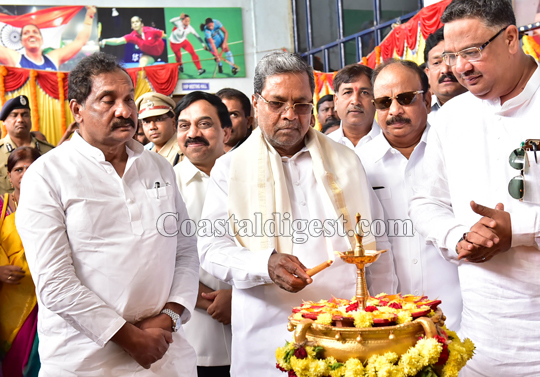
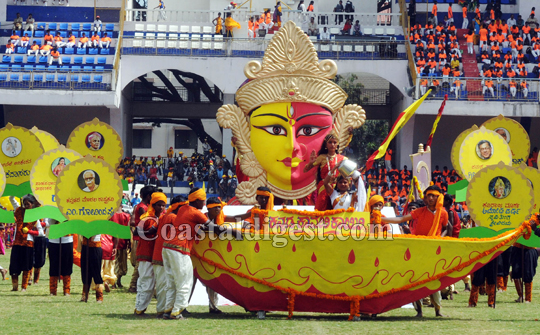
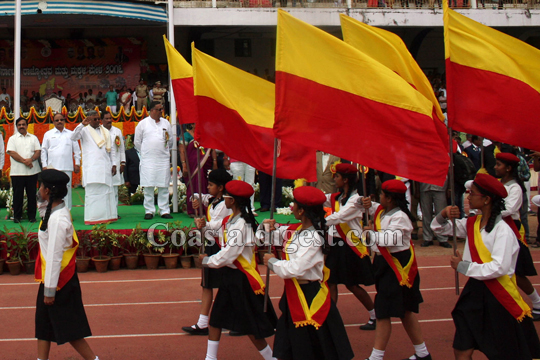
Bengaluru, Nov 1: Pitching for supremacy of regional languages, Karnataka Chief Minister Siddaramaiah today pushed for the state's demand to make it the medium of instruction for primary education.

Rajytsav 1

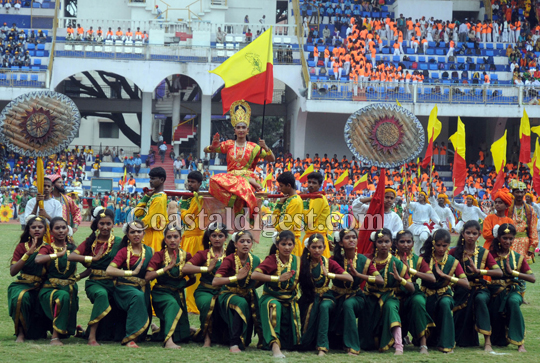
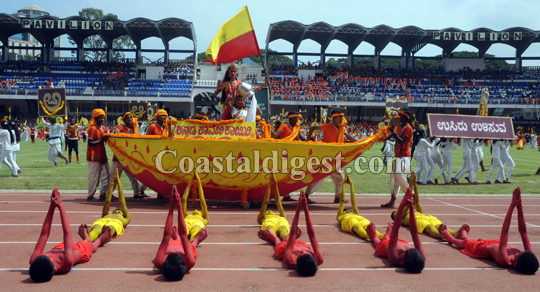
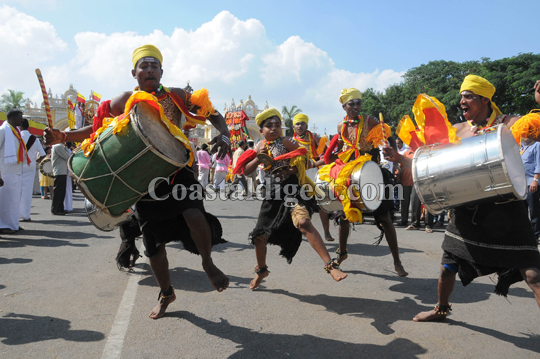
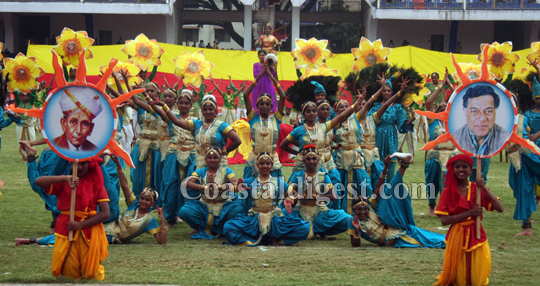
Speaking at the 61st Karnataka Rajyotsava (state formation day) celebration event here, he urged the Prime Minister to call a meeting of Chief Ministers of all states and bring an amendment to the Constitution to this effect.

"I have written two letters to the Prime Minister.I have also written to all Chief Ministers because the Supreme Court's order is causing a threat to all regional languages," Siddaramaiah said.

The Chief Minister said he had also met the Prime Minister in this regard.

"We have to bring an amendment to the Constitution.It has to get declared in Parliament that regional languages are supreme in states.. amendments should be brought to make changes to the Supreme Court order. So Prime Minister has to call a meeting of Chief Ministers of all states and decide," he said.

"I will continue to make this demand," he said, adding most language and education experts had opined that the mother tongue should be the medium of instruction in primary schools.

Siddaramaiah said it would help in development of regional languages and also mental development of children.

In May 2014, the Supreme Court while hearing the issue before it challenging two Karnataka Government Orders of 1994, making the mother tongue or regional language compulsory to impart education from Class I to IV, had held that the government cannot impose mother tongue on linguistic minority for imparting primary education.

The CM said the state government had announced a language policy in 1994, "which was questioned by unaided educational institutions in courts, where we had to face a setback."

"Despite appealing against it, we did not get justice. We made all possible efforts, but this was an order passed by the Constitution bench. As the Supreme Court is final, we cannot appeal in any other courts," he added.

Pointing out that the state government was taking all steps to protect and encourage Kannada, Siddaramaiah said, "It is our mother tongue; it is language of this land, this soil.

"Showing our Kannadiga pride just on November 1 or in this month is not enough, it should be a continuous process."

Recalling Karnataka's united fight on the Cauvery water issue, Siddaramaiah said, "Power may come or go. It is not permanent, but the land, water, culture and language of this state are paramount."

"It is our responsibility to protect even at the cost of power and the state government is committed to it".

Rajytsav 2

Rajytsav 3

Rajytsav 4

Rajytsav 5

Rajytsav 6

Rajytsav 7

Rajytsav 8

Rajytsav 9

Rajytsav 10

Comments

Rahul
 - 
Tuesday, 1 Nov 2016

Mr. Siddaramaiah, you are very right. The local languages should be the medium of instruction in primary schools. Karnataka has Kannada, Konkani, and Tulu that are recognized languages of Karnataka state.
With the present trend, children are forced to learn English and Hindi and completely lose interest over their mother tongue. It is high time this matter is addressed. Our neighbouring states of Taml Nadu and Kerala are better placed.
Karnataka is with you sir.

Suresh
 - 
Tuesday, 1 Nov 2016

Ban Hindi in Karnataka; it is just anther regional language they are imposing on us leading to Hindi imperialism on Non Hindi speaking states. And those Hindi people do not care to learn any other Indian languages, instead they want others to learn their language for their convenience and comfort. Just ban Hindi in Karnataka permanently before it becomes a predator language.

Add new comment

  • Coastaldigest.com reserves the right to delete or block any comments.
  • Coastaldigset.com is not responsible for its readers’ comments.
  • Comments that are abusive, incendiary or irrelevant are strictly prohibited.
  • Please use a genuine email ID and provide your name to avoid reject.
coastaldigest.com news network
June 16,2020

New Delhi, Jun 16: The class 10 and 12 students of the CICSE board can choose not to appear for pending board exams and be marked as per their performance in pre-board exams or internal assessment, according to top officials.

The board had also submitted the proposal before the Bombay High Court on Monday in response to a petition filed by a parent seeking directions to the authorities to cancel exams in view of the spike in COVID-19 cases.

According to Gerry Arathoon, Chief Executive and Secretary, Council for the Indian School Certificate Examinations (CISCE), the students will have to communicate their option to their respective schools by June 22.

For latest updates on coronavirus outbreak, click here

The exams which were postponed due to the lockdown to contain the spread of coronavirus, are now scheduled to be conducted from July 1 to 14. However, several parents have been demanding the exams be scrapped.

"The students will be given two options---they either appear for the rescheduled exams or choose to have their results based on their performance in the pre-board exams or internal assessment. The option will be available only for the pending exams, the result of the subjects for which exams were already conducted, will be calculated as per performance in the exam only," Arathoon said.

The board also clarified that the students will not be entitled to make a subject-wise choice between the two options for pending exams.

Unlike the Central Board of Secondary Education (CBSE), which will only be conducting exams in 29 subjects crucial for promotion and admission to higher educational institutions, the CISCE will be conducting all pending exams.

The pending CBSE exams are scheduled from July 1 to 15. The schedule for the board exams has been decided in order to ensure that they are completed before competitive examinations. While the engineering entrance exam JEE-Mains is scheduled to be held from July 18 to 23, the medical entrance exam NEET is scheduled for July 26.

While the CBSE has given the option to not appear for pending board exams for differently-abled students, it has canceled the examinations for its around 250 schools situated abroad and has adopted the criteria of awarding marks on the basis of either practical exams conducted or the internal assessment marks.

Coronavirus India update: State-wise total number of confirmed cases, deaths on June 16

A group of parents has filed a petition in the Supreme Court seeking a direction to the CBSE to declare results on the basis of tests already conducted, and calculate the total on an average basis with internal assessment marks of the remaining subjects.

Universities and schools across the country have been shut since March 16, when the Centre announced a countrywide classroom shut down as part of measures to contain the COVID-19 outbreak. A nationwide lockdown was announced on March 24, which came into effect the next day.

While the government has eased several restrictions, schools and colleges continue to remain closed.

According to Home Ministry guidelines, there will be no exam centres in containment zones.

"Wearing of face masks by teachers, staff and students will be mandatory. There shall be provisions of thermal screening and sanitiser at the centres and social distancing rules will have to be followed at exam centres. Special buses may be arranged by states and UTs for transportation of students to exam centres," the Home Ministry has said.

Comments

Add new comment

  • Coastaldigest.com reserves the right to delete or block any comments.
  • Coastaldigset.com is not responsible for its readers’ comments.
  • Comments that are abusive, incendiary or irrelevant are strictly prohibited.
  • Please use a genuine email ID and provide your name to avoid reject.
News Network
April 28,2020

Bengaluru, Apr 28: With fresh guidelines on the COVID-19 lockdown expected soon, Karnataka Chief Minister B S Yediyurappa on Monday chaired a meeting with key ministers, officials and Deputy Commissioners of districts and discussed about re-starting economic activities in the state, as he took stock about of the pandemic.

"At the video conference with DCs, CM took stock of COVID-19 situation and measures taken to control its spread. Discussions also happened regarding starting of certain economic activities in parts of the state," official sources said. The state government would take any decision in this regard after the Centre issues fresh guidelines or directives, they said, without elaborating.

The meeting came hours after Prime Minister Narendra Modi held a video conferencing with Chief Ministers to discuss the situation arising due to COVID-19 in the country, which is under lockdown since March 25 to contain the pandemic. Only nine chief ministers spoke in the virtual meeting with the Prime Minister and Yediyurappa did not get an opportunity.

A senior Minister, who attended the meeting told PTI, necessary directions regarding the lockdown after May 3, they were likely to come in a couple of days.

"Most of the Chief Ministers wanted the lockdown to continue to contain the spread.... nothing concrete emerged, but we expect the necessary directions will follow in couple of days. This is what we expect after seeing what has happened as a followup to three to four such video conferences in the past," he said.

The Minister said the larger opinion was that the current measures should continue and interstate or inter-district movement should not be allowed. Regarding movement within the districts that are green zone, some decision may be taken soon, he said, adding the Prime Minister also asked states to concentrate on reforms, aimed at attracting investments in the days to come.

Comments

Add new comment

  • Coastaldigest.com reserves the right to delete or block any comments.
  • Coastaldigset.com is not responsible for its readers’ comments.
  • Comments that are abusive, incendiary or irrelevant are strictly prohibited.
  • Please use a genuine email ID and provide your name to avoid reject.
Ram Puniyani
February 10,2020

Noam Chomsky is one of the leading peace workers in the world. In the wake of America’s attack on Vietnam, he brought out his classic formulation, ‘manufacturing consent’. The phrase explains the state manipulating public opinion to have the public approve of it policies—in this case, the attack of the American state on Vietnam, which was then struggling to free itself from French colonial rule.

In India, we are witness to manufactured hate against religious minorities. This hatred serves to enhance polarisation in society, which undermines India’s democracy and Constitution and promotes support for a Hindu nation. Hate is being manufactured through multiple mechanisms. For example, it manifests in violence against religious minorities. Some recent ghastly expressions of this manufactured hate was the massive communal violence witnessed in Mumbai (1992-93), Gujarat (2002), Kandhamal (2008) and Muzaffarnagar (2013). Its other manifestation was in the form of lynching of those accused of having killed a cow or consumed beef. A parallel phenomenon is the brutal flogging, often to death, of Dalits who deal with animal carcasses or leather.

Yet another form of this was seen when Shambhulal Regar, indoctrinated by the propaganda of Hindu nationalists, burned alive Afrazul Khan and shot the video of the heinous act. For his brutality, he was praised by many. Regar was incited into the act by the propaganda around love jihad. Lately, we have the same phenomenon of manufactured hate taking on even more dastardly proportions as youth related to Hindu nationalist organisations have been caught using pistols, while police authorities look on.

Anurag Thakur, a BJP minster in the central government recently incited a crowd in Delhi to complete his chant of what should happen to ‘traitors of the country...” with a “they should be shot”. Just two days later, a youth brought a pistol to the site of a protest at Jamia Millia Islamia university and shouted “take Azaadi!” and fired it. One bullet hit a student of Jamia. This happened on 30 January, the day Nathuram Godse had shot Mahatma Gandhi in 1948. A few days later, another youth fired near the site of protests against the CAA and NRC at Shaheen Bagh. Soon after, he said that in India, “only Hindus will rule”.

What is very obvious is that the shootings by those associated with Hindu nationalist organisations are the culmination of a long campaign of spreading hate against religious minorities in India in general and against Muslims in particular. The present phase is the outcome of a long and sustained hate campaign, the beginning of which lies in nationalism in the name of religion; Muslim nationalism and Hindu nationalism. This sectarian nationalism picked up the communal view of history and the communal historiography which the British introduced in order to pursue their ‘divide and rule’ policy.

In India what became part of “social common sense” was that Muslim kings had destroyed Hindu temples, that Islam was spread by force, and that it is a foreign religion, and so on. Campaigns, such as the one for a temple dedicated to the Hindu god Rama to be built at the site where the Babri masjid once stood, further deepened the idea of a Muslim as a “temple-destroyer”. Aurangzeb, Tipu Sultan and other Muslim kings were tarnished as the ones who spread Islam by force in the subcontinent. The tragic Partition, which was primarily due to British policies, and was well-supported by communal streams also, was entirely attributed to Muslims. The Kashmir conflict, which is the outcome of regional, ethnic and other historical issues, coupled with the American policy of supporting Pakistan’s ambitions of regional hegemony, (which also fostered the birth of Al-Qaeda), was also attributed to the Muslims.

With recurring incidents of communal violence, these falsehoods went on going deeper into the social thinking. Violence itself led to ghettoisation of Muslims and further broke inter-community social bonds. On the one hand, a ghettoised community is cut off from others and on the other hand the victims come to be presented as culprits. The percolation of this hate through word-of-mouth propaganda, media and re-writing of school curricula, had a strong impact on social attitudes towards the minorities.

In the last couple of decades, the process of manufacturing hate has been intensified by the social media platforms which are being cleverly used by the communal forces. Swati Chaturvedi’s book, I Am a Troll: Inside the Secret World of the BJP’s Digital Army, tells us how the BJP used social media to spread hate. Whatapp University became the source of understanding for large sections of society and hate for the ‘Other’, went up by leaps and bounds. To add on to this process, the phenomenon of fake news was shrewdly deployed to intensify divisiveness.

Currently, the Shaheen Bagh movement is a big uniting force for the country; but it is being demonised as a gathering of ‘anti-nationals’. Another BJP leader has said that these protesters will indulge in crimes like rape. This has intensified the prevalent hate.

While there is a general dominance of hate, the likes of Shambhulal Regar and the Jamia shooter do get taken in by the incitement and act out the violence that is constantly hinted at. The deeper issue involved is the prevalence of hate, misconceptions and biases, which have become the part of social thinking.

These misconceptions are undoing the amity between different religious communities which was built during the freedom movement. They are undoing the fraternity which emerged with the process of India as a nation in the making. The processes which brought these communities together broadly drew from Gandhi, Bhagat Singh and Ambedkar. It is these values which need to be rooted again in the society. The communal forces have resorted to false propaganda against the minorities, and that needs to be undone with sincerity.

Combating those foundational misconceptions which create hatred is a massive task which needs to be taken up by the social organisations and political parties which have faith in the Indian Constitution and values of freedom movement. It needs to be done right away as a priority issue in with a focus on cultivating Indian fraternity yet again.


Comments

Add new comment

  • Coastaldigest.com reserves the right to delete or block any comments.
  • Coastaldigset.com is not responsible for its readers’ comments.
  • Comments that are abusive, incendiary or irrelevant are strictly prohibited.
  • Please use a genuine email ID and provide your name to avoid reject.