


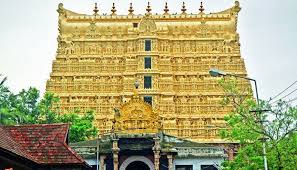
769 gold pots worth Rs 186 crore missing from Kerala temple

August 16, 2016

url

Thiruvananthapuram, Aug 16: A report submitted to the Supreme Court shows that 769 gold pots, valued approximately at Rs 186 crore, are missing from Sree Padmanabhaswamy temple in Thiruvananthapuram, Kerala.

A report submitted by former Comptroller and Auditor General of India Vinod Rai said the disappearance of the gold pots weighing 776 kg from the vast treasures found in the vaults of the Kerala temple needed a “detailed probe”, reported The Hindu.

The apex court had asked Rai in October 2015 to submit the audit report.

A bench led by Chief Justice of India TS Thakur will shortly hear Rai.

 As per the report, gold worth Rs 186 crore in the form of 769 gold pots is not traceable. It added that 30 percent of the gold sent for melting and purification was lost.

“Gold worth Rs 2.50 crore was lost because of change in ratio adopted for purification. Moreover, the residual quantity of gold was not recovered from the contractor which lead to a loss of Rs 59 lakhs,” The New Indian Express quoted sources as saying.

“There was a lack of transparency in Kanikka counting. Gold and silver worth Rs 14.18 lakh had not been entered in the Nadavarav register, which is illegal,” as per the report.

“Silver bar with the value of Rs 14 lakh was found to be missing,” the report added.

Rai has suggested changes in the temple's security arrangements. “Priceless items in the temple should be housed in a modern museum and security installments need to be altered a bit.”

He has also suggested the appointment of a new committee led by a retired All India Service Officer.

Comments

Satyameva jayate
 - 
Tuesday, 16 Aug 2016

That is why they don't allow anyone to interfere into this temple's assets....even when govt tried...all looters.....take it out and distribute to the poor.....

Ahmed K. C.
 - 
Tuesday, 16 Aug 2016

When god allowed them to take it away, it is for them to enjoy that gold, god is not in need of gold anyway.

PK
 - 
Tuesday, 16 Aug 2016

What is the purpose of keeping large amount of Gold inside the temple... Y cant it be used in the society and to the poor people of that area?
God doesnt want Gold but he like acts of charity. So give the Gold to the poor rather than keeping in the locker. use it for the welfare of the society... It would helpful in the society ...

Karthik
 - 
Tuesday, 16 Aug 2016

god give them peace of mind,

Mohan
 - 
Tuesday, 16 Aug 2016

ohh god no crime here. robber looted prasada.

pran
 - 
Tuesday, 16 Aug 2016

not only this all about 90% of the wealth already looted this is looting of remaining 10% simply this temple authority fooling people to make money,. but people will never understand.

Add new comment

  • Coastaldigest.com reserves the right to delete or block any comments.
  • Coastaldigset.com is not responsible for its readers’ comments.
  • Comments that are abusive, incendiary or irrelevant are strictly prohibited.
  • Please use a genuine email ID and provide your name to avoid reject.
coastaldigest.com news network
June 24,2020

Udupi, Jun 24: Nearly four years after he was arrested in the murder case of NRI entrepreneur Bhaskar Shetty, the District Sessions court has granted conditional interim bail to Niranjan Bhat, one of the three prime accused in the case.

The development comes two days after the death of Niranjan’s father Srinivas Bhat(65). Though Srinivas and his driver Raghavendra were also arrested in the case on the accusation of destruction of evidence, they were released within a month.

Through his lawyer Niranjan had appealed to the court seeking bail to perform his father’s post-death rituals. 

After hearing the arguments, the court granted conditional interim bail till July 7 on furnishing a bond of Rs 5 lakh. The judge directed the accused to report to the court on or before July 7 to be taken into judicial custody.

Bhaskar Shetty, who owned a chain of supermarkets in Saudi Arabia, went missing from his house in Udupi on 28 July 2016. His mother Gulabi Shetty lodged a missing person complaint on July 29. The police arrested his wife Rajeshwari, her son Navaneeth and astrologer Niranjan Bhat on the charge of murdering Bhaskar Shetty and destroying the evidence, in Udupi on August 7, 2016. Rajeshwari is already out on bail. Navneet is still in prison.

Shetty was murdered at his house in Indrali and later his body was taken to Belman. It is alleged Niranjan Bhat had put the body of deceased Bhaskar Shetty in the pit used for Homa rituals and burnt it.

Comments

Add new comment

  • Coastaldigest.com reserves the right to delete or block any comments.
  • Coastaldigset.com is not responsible for its readers’ comments.
  • Comments that are abusive, incendiary or irrelevant are strictly prohibited.
  • Please use a genuine email ID and provide your name to avoid reject.
coastaldigest.com news network
August 3,2020

Koppal, Aug 3: The activists of Popular Front of India (PFI) have won the heart of the people by performing the last rites of a local leader of Bharatiya Janata Party in Koppla district of Karnataka. 

Somashekhara Gowda, a senior BJP leader in Koppal’s Gangavathi died of covid-19. His family members were reportedly quarantined. His own party activists also were not ready to participate in the last rite due to the fear of coronavirus infection.

Following requests, a team of PFI comprised of district secretary Fayaz, and members Yaseen, Abdul Aalam, Shamid Razi and Husain Azarauddin performed the last rites as per Veerashaiva Lingayat traditions. 

Speaking to media persons PFI district president Zaheer Abbas lamented that people still have plenty of misconceptions about covid-19. “Due to the misconceptions, performing the last rites of those who die of covid-19 has become a challenge,” he said.

He said that PFI activists followed all the health guidelines and took necessary precautions while performing the last rites. “Under the guidance of district health officials and with the consent of the family members of the deceased, the last rites were performed as per Veerashaiva Lingayat traditions,” he said.

Comments

Add new comment

  • Coastaldigest.com reserves the right to delete or block any comments.
  • Coastaldigset.com is not responsible for its readers’ comments.
  • Comments that are abusive, incendiary or irrelevant are strictly prohibited.
  • Please use a genuine email ID and provide your name to avoid reject.
Agencies
July 8,2020

The Central Board of Secondary Education (CBSE) has rationalised by up to 30 per cent the syllabus for classes 9 to 12 for the academic year 2020-21 to reduce course load on students amid the COVID-19 crisis, Union HRD Minister Ramesh Pokhriyal 'Nishank' announced on Tuesday.

The curriculum has been rationalised while retaining the core elements, the Human Resource Development said.

Among the chapters dropped after the rationalisation exercise are lessons on democracy and diversity, demonetisation, nationalism, secularism, India's relations with its neighbours and growth of local governments in India, among others.

"Looking at the extraordinary situation prevailing in the country and the world, CBSE was advised to revise the curriculum and reduce course load for the students of classes 9 to 12.

"To aid the decision, a few weeks back I also invited suggestions from all educationists on the reduction of syllabus for students and I am glad to share that we received more than 1.5K suggestions. Thank you, everyone, for the overwhelming response," Nishank tweeted.

"Considering the importance of learning achievement, it has been decided to rationalise syllabus up to 30 per cent by retaining the core concepts," he added.

The Union minister said the changes made in the syllabi have been finalised by the respective course committees with the approval of the curriculum committee and the Governing Body of the Board.

"The heads of schools and teachers have been advised by the board to ensure that the topics that have been reduced are also explained to the students to the extent required to connect different topics. However, the reduced syllabus will not be part of the topics for internal assessment and year-end board examination.

"Alternative academic calendar and inputs from the NCERT on transacting the curriculum using different strategies shall also be part of the teaching pedagogy in the affiliated schools," a senior official of the HRD ministry said.

For classes 1 to 8, the National Council of Education Research and Training (NCERT) has already notified an alternative calendar and learning outcomes.

According to the updated curriculum, among the chapters deleted from class 10 syllabus are-- democracy and diversity, gender, religion and caste, popular struggles and movement, challenges to democracy

For class 11, the deleted portions included chapters on federalism, citizenship, nationalism, secularism, growth of local governments in India.

Similarly, class 12 students will not be required to study chapters on India's relations with its neighbours, changing nature of India's economic development, social movements in India and demonetisation, among others.

Universities and schools across the country have been closed since March 16 when the central government announced a nationwide classroom shutdown as one of the measures to contain the COVID-19 outbreak.

A nationwide lockdown was announced on March 24, which came into effect the next day. While the government has eased several restrictions, schools and colleges continue to remain closed.

Comments

Add new comment

  • Coastaldigest.com reserves the right to delete or block any comments.
  • Coastaldigset.com is not responsible for its readers’ comments.
  • Comments that are abusive, incendiary or irrelevant are strictly prohibited.
  • Please use a genuine email ID and provide your name to avoid reject.