


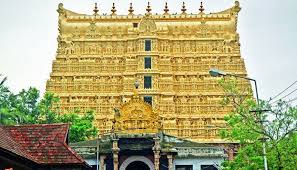
769 gold pots worth Rs 186 crore missing from Kerala temple

August 16, 2016

url

Thiruvananthapuram, Aug 16: A report submitted to the Supreme Court shows that 769 gold pots, valued approximately at Rs 186 crore, are missing from Sree Padmanabhaswamy temple in Thiruvananthapuram, Kerala.

A report submitted by former Comptroller and Auditor General of India Vinod Rai said the disappearance of the gold pots weighing 776 kg from the vast treasures found in the vaults of the Kerala temple needed a “detailed probe”, reported The Hindu.

The apex court had asked Rai in October 2015 to submit the audit report.

A bench led by Chief Justice of India TS Thakur will shortly hear Rai.

 As per the report, gold worth Rs 186 crore in the form of 769 gold pots is not traceable. It added that 30 percent of the gold sent for melting and purification was lost.

“Gold worth Rs 2.50 crore was lost because of change in ratio adopted for purification. Moreover, the residual quantity of gold was not recovered from the contractor which lead to a loss of Rs 59 lakhs,” The New Indian Express quoted sources as saying.

“There was a lack of transparency in Kanikka counting. Gold and silver worth Rs 14.18 lakh had not been entered in the Nadavarav register, which is illegal,” as per the report.

“Silver bar with the value of Rs 14 lakh was found to be missing,” the report added.

Rai has suggested changes in the temple's security arrangements. “Priceless items in the temple should be housed in a modern museum and security installments need to be altered a bit.”

He has also suggested the appointment of a new committee led by a retired All India Service Officer.

Comments

Satyameva jayate
 - 
Tuesday, 16 Aug 2016

That is why they don't allow anyone to interfere into this temple's assets....even when govt tried...all looters.....take it out and distribute to the poor.....

Ahmed K. C.
 - 
Tuesday, 16 Aug 2016

When god allowed them to take it away, it is for them to enjoy that gold, god is not in need of gold anyway.

PK
 - 
Tuesday, 16 Aug 2016

What is the purpose of keeping large amount of Gold inside the temple... Y cant it be used in the society and to the poor people of that area?
God doesnt want Gold but he like acts of charity. So give the Gold to the poor rather than keeping in the locker. use it for the welfare of the society... It would helpful in the society ...

Karthik
 - 
Tuesday, 16 Aug 2016

god give them peace of mind,

Mohan
 - 
Tuesday, 16 Aug 2016

ohh god no crime here. robber looted prasada.

pran
 - 
Tuesday, 16 Aug 2016

not only this all about 90% of the wealth already looted this is looting of remaining 10% simply this temple authority fooling people to make money,. but people will never understand.

Add new comment

  • Coastaldigest.com reserves the right to delete or block any comments.
  • Coastaldigset.com is not responsible for its readers’ comments.
  • Comments that are abusive, incendiary or irrelevant are strictly prohibited.
  • Please use a genuine email ID and provide your name to avoid reject.
News Network
January 24,2020

Bengaluru, Jan 24: The JD(S) is looking to leverage anti-Citizen (Amendment) Act (CAA), National Register of Citizens (NRC) and National Population Register (NPR) sentiment sweeping the country to revive itself and will hold protests in Bengaluru and New Delhi.

The Bengaluru protest is scheduled for Friday. At a meeting of party workers in Bengaluru on Thursday, party patriarch HD Deve Gowda and former chief minister HD Kumaraswamy urged the rank and file to participate in the rally to send out a loud and clear message to the BJP.

"The BJP has set out to make Muslims second-grade citizens. India has 40 crore Muslims, can these communal forces eliminate them all?" Gowda said in his address. "We should have the guts to launch a massive protest at Jantar Mantar. We should be prepared to go to jail in the fight against [Prime Minister] Narendra Modi and [Union home minister] Amit Shah."

Gowda said he will lead the rally in Delhi and urged secular parties to unite to take on the BJP. "It is important that regional parties, which share a secular ideology, unite on a common agenda and fight the BJP. Bihar, Kerala and Odisha have said they will not implement CAA. The sentiment is likely to spread to other states," Gowda said.

Kumaraswamy said not only Muslims but many other communities will also bear the brunt of BJP’s "divisive politics". "This pair of Hakka-Bukka [Modi and Shah] is not targeting Muslims alone," he said. "For them, all communities other than upper caste Hindus are inferior Shudras. They will treat even Lingayats, Vokkaligas and Dalits with the same contempt."

The former CM made a special appeal to Lingayats, who generally back the BJP, to stop supporting the saffron party’s caste-oriented politics. "You had appreciated my farm loan waiver scheme and promised support in the elections. But, the results were contrary to that," he said.

The JD(S) passed three resolutions including one to condemn the Centre for enacting CAA. The others were to protest against the Centre’s indifference to the floods in the state and the failed economic policy of the Centre.

Comments

Add new comment

  • Coastaldigest.com reserves the right to delete or block any comments.
  • Coastaldigset.com is not responsible for its readers’ comments.
  • Comments that are abusive, incendiary or irrelevant are strictly prohibited.
  • Please use a genuine email ID and provide your name to avoid reject.
Agencies
January 19,2020

New Delhi, Jan 19: Senior Congress leader Kapil Sibal on Sunday asserted that every state assembly has the constitutional right to pass a resolution and seek the amended Citizenship Act's withdrawal, but if the law is declared constitutional by the Supreme Court then it will be problematic to oppose it.

His remarks came a day after he had said there is no way a state can deny the implementation of the Citizenship Amendment Act (CAA) when it is already passed by the Parliament.

"I believe the CAA is unconstitutional. Every State Assembly has the constitutional right to pass a resolution and seek its withdrawal. When and if the law is declared to be constitutional by the Supreme Court then it will be problematic to oppose it. The fight must go on!" Sibal said in a tweet.

His remarks on the CAA at the Kerala Literature Festival (KLF) on Saturday had caused a flutter as several non-BJP governments, including Kerala, Rajasthan, Madhya Pradesh, West Bengal and Maharashtra, have voiced their disagreement with the CAA as well as National Register of Citizens (NRC) and National Population Register (NPR).

"If the CAA is passed no state can say 'I will not implement it'. It is not possible and is unconstitutional. You can oppose it, you can pass a resolution in the Assembly and ask the central government to withdraw it.

"But constitutionally saying that I won't implement, it is going to be problematic and going to create more difficulties," said the former minister of law and justice.

Comments

Add new comment

  • Coastaldigest.com reserves the right to delete or block any comments.
  • Coastaldigset.com is not responsible for its readers’ comments.
  • Comments that are abusive, incendiary or irrelevant are strictly prohibited.
  • Please use a genuine email ID and provide your name to avoid reject.
News Network
February 28,2020

Bengaluru, Feb 28: Historian S. Shettar, 85, breathed his last early on February 28 in Bengaluru. He was suffering from respiratory problems and was hospitalised for over a week.

Shettar was known for his multi-disciplinary work, encompassing linguistics, epigraphy, anthropology, the study of religions and art history. He had extensively worked on the Jain practice of ritual death in Karnataka and Asoka edicts. He had studied and compiled early edicts in Kannada and worked extensively on the growth of Kannada language down the ages.

Born in 1935 at Hampasagara, Ballari district, he went on to study at Cambridge University and started his career as a Professor of History at Karnatak University, Dharwad, his alma mater. He later headed the National Museum Institute of the History of Art, Conservation and Museology in 1978 and Indian Council for Historical Research in 1996. He was also a visiting professor at the National Institute of Advanced Studies, Bengaluru.

He was a bilingual historian who wrote in English for most of his career, but started writing in Kannada in later years. In the last two decades, he developed a keen interest in linguistics and wrote multiple books on classical Kannada and Prakrit. His 2007 book “Shangam Tamilagam” is considered a seminal work in the study of the early period of Dravidian languages. It won him Bhasha Samman from Central Sahitya Akademi. He later wrote two works on Halegannada, classical Kannada. His most recent work was “Prakrita Jagadvalaya” in 2018.

Comments

Add new comment

  • Coastaldigest.com reserves the right to delete or block any comments.
  • Coastaldigset.com is not responsible for its readers’ comments.
  • Comments that are abusive, incendiary or irrelevant are strictly prohibited.
  • Please use a genuine email ID and provide your name to avoid reject.