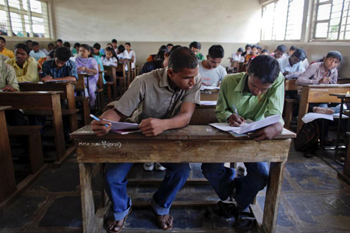
78 students withfake marks cards' barred from degree exams

[email protected] (News Network)
November 12, 2016

ballariBallari, Nov 12: As many as 78 of the 324 Pre-University/Plus II marks cards whose genuineness was in doubt have been found to be fake and the Vijayanagar Sri Krishnadevaraya University has decided not to allow such students to appear for the first year degree exams, according to M.S. Subhas, university Vice-Chancellor.

Addressing a press conference here on Friday, Mr. Subhas said that marks cards of 324 students who got admitted to degree colleges in Ballari and Koppal districts, affiliated to the university, were in suspected to be fake.

A one-man committee, headed by Registrar, after verifying the documents and also after getting confirmation from Maharashtra Secondary Education Board in Pune, found that 78 marks cards were issued by institutions with fictitious names on behalf of Maharashtra Secondary Education Board. “The university will not allow these 78 students to write their exams.

As far as the remaining 246 students were concerned, the process of verification of records was under way. To protect the interest of students, the university will allow them to appear for exams on the condition that their results will be withheld if the marks cards given by them were found to be fake,” he said.

To a question, he said that the university hopes that the 246 students will go by their conscience before filing their examination forms.

The university will write a letter to the Higher Education Department seeking guidelines to deal with such cases, he said and added that pending instructions from the government, the university will not file a FIR against the students.

Comments

Skazi
 - 
Saturday, 12 Nov 2016

Good training of MODI the Feku ....

Add new comment

  • Coastaldigest.com reserves the right to delete or block any comments.
  • Coastaldigset.com is not responsible for its readers’ comments.
  • Comments that are abusive, incendiary or irrelevant are strictly prohibited.
  • Please use a genuine email ID and provide your name to avoid reject.
News Network
February 6,2020

New Delhi, Feb 6: BJP MP Tejaswi Surya said on Wednesday that the majority community has to remain vigilant or Mughal rule will return to the country, as he slammed the anti-CAA protest at Shaheen Bagh.

He was participating in the debate on Motion of Thanks on the President's Address in Lok Sabha.

Referring to the ongoing protest at Shaheen Bagh against the Citizenship Amendment Act, he said, "Unless majority community remains vigilant, the days of Mughal Raj may not be far away."

Surya also praised Prime Minister Narendra Modi for resolving several critical issues which had been pending for several decades.

The CAA, he said, was aimed at resolving the issues emanating from Partition and added, "The new India cannot to built without healing the wounds of the past."

He said that the CAA was about giving citizenship to persecuted minorities in Pakistan, Bangaladesh and Afghanistan and not for taking away anyone's citizenship.

Under the leadership of Modi, Surya said, several issues of the past have seen closure. These include abrogation of Article 370, construction of Ram temple, Bodo problems and abolition of Triple Talaq.

K Sudhakaran (Cong) said that a time when the economy was going through its worst phase and unemployment was high, the President in his speech talked about making India a USD 5 trillion economy by 2024.

On the comments of the government functionaries that fundamentals of the economy are strong, he said the same expression was used by the then US President George Bush, days before the collapse of the America's iconic investment banker Lehman Brothers.

Not only that, Sudhakaran said even before the Great Depression, the then US President used to say that fundamentals of their economy were strong.

Anupriya Patel (Apna Dal) demanded that the government set up All India Judicial Services Commission to ensure representation of the backward community in the judiciary.

Khagen Murmu (BJP) regretted that West Bengal government was not implementing the welfare schemes of the Centre in the state.

Badruddin Ajmal (AIUDF) said that people of all communities have fought for freedom of the country and it would be incorrect to declare everyone opposing the government's policies as 'gaddar' (traitor).

He said that the government should talk to people protesting against the CAA at Shaheen Bagh and other places, and explain the provisions to them.

Shrirang Appa Barne (Shiv Sena) demanded that the ruling party fulfil all promises it had made to the people of the country.

He regretted that although the government promised to double the income of farmers by 2022, farmers were still committing suicide.

Comments

Add new comment

  • Coastaldigest.com reserves the right to delete or block any comments.
  • Coastaldigset.com is not responsible for its readers’ comments.
  • Comments that are abusive, incendiary or irrelevant are strictly prohibited.
  • Please use a genuine email ID and provide your name to avoid reject.
Ram Puniyani
January 14,2020

In the beginning of January 2020 two very disturbing events were reported from Pakistan. One was the attack on Nankana Sahib, the holy shrine where Sant Guru Nanak was born. While one report said that the place has been desecrated, the other stated that it was a fight between two Muslim groups. Prime Minister of Pakistan Imran Khan condemned the incident and the main accused Imran Chisti was arrested. The matter related to abduction and conversion of a Sikh girl Jagjit Kaur, daughter of Pathi (One who reads Holy Guru Granth Sahib in Gurudwara) of the Gurudwara. In another incident one Sikh youth Ravinder Singh, who was out on shopping for his marriage, was shot dead in Peshawar.

While these condemnable attacks took place on the Sikh minority in Pakistan, BJP was quick enough to jump to state that it is events like this which justify the Citizenship Amendment Act (CAA). Incidentally CAA is the Act which is discriminatory and relates to citizenship with Religion, which is not as per the norms of Indian constitution. There are constant debates and propaganda that population of Hindus has come down drastically in Pakistan and Bangla Desh. Amit Shah, the Home minister stated that in Pakistan the population of Hindus has come down from 23% at the time of partition to 3.7% at present. And in Bangla Desh it has come down from 22% to present 8%.

While not denying the fact that the religious minorities are getting a rough deal in both these countries, the figures which are presented are totally off the mark. These figures don’t take into consideration the painful migrations, which took place at the time of partition and formation of Bangla Desh later. Pakistan census figures tell a different tale. Their first census was held in 1951. As per this census the overall percentage of Non Muslim in Pakistan (East and West together) was 14.2%, of this in West Pakistan (Now Pakistan) it was 3.44 and in Eat Pakistan it was 23.2. In the census held in Pakistan 1998 it became 3.72%. As far as Bangla Desh is concerned the share of Non Muslims has gone down from 23.2 (1951) to 9.6% in 2011.

The largest minority of Pakistan is Ahmadis, (https://minorityrights.org/country/pakistan/) who are close to 4 Million and are not recognised as Muslims in Pakistan. In Bangla Desh the major migrations of Hindus from Bangla Desh took place in the backdrop of Pakistan army’s atrocities in the then East Pakistan.

As far as UN data on refugees in India it went up by 17% between 2016-2019 and largest numbers were from Tibet and Sri Lanka.  (https://www.un.org/en/development/desa/population/migration/publication…)

The state of minorities is in a way the index of strength of democracy. Most South Asian Countries have not been able to sustain democratic values properly. In Pakistan, the Republic began with Jinnah’s classic speech where secularism was to be central credo of Pakistan. This 11th August speech was in a way what the state policy should be, as per which people of all faiths are free to practice their religion. Soon enough the logic of ‘Two Nation theory” and formation of Pakistan, a separate state for Muslim took over. Army stepped in and dictatorship was to reign there intermittently. Democratic elements were suppressed and the worst came when Zia Ul Haq Islamized the state in collusion with Maulanas. The army was already a strong presence in Pakistan. The popular formulation for Pakistan was that it is ruled by three A’s, Army, America and Allah (Mullah).

Bangla Desh had a different trajectory. Its very formation was a nail in the coffin of ‘two nation theory’; that religion can be the basis of a state. Bangla Desh did begin as a secular republic but communal forces and secular forces kept struggling for their dominance and in 1988 it also became Islamic republic. At another level Myanmar, in the grip of military dictatorship, with democratic elements trying to retain their presence is also seeing a hard battle. Democracy or not, the army and Sanghas (Buddhist Sang has) are strong, in Myanmar as well. The most visible result is persecution of Rohingya Muslims.

Similar phenomenon is dominating in Sri Lanka also where Budhhist Sanghas and army have strong say in the political affairs, irrespective of which Government is ruling. Muslim and Christian minorities are a big victim there, while Tamils (Hindus, Christians etc.) suffered the biggest damage as ethnic and religious minorities. India had the best prospect of democracy, pluralism and secularism flourishing here. The secular constitution, the outcome of India’s freedom struggle, the leadership of Gandhi and Nehru did ensure the rooting of democracy and secularism in a strong way.

India so far had best democratic credentials amongst all the south Asian countries. Despite that though the population of minorities rose mainly due to poverty and illiteracy, their overall marginalisation was order of the day, it went on worsening with the rise of communal forces, with communal forces resorting to identity issues, and indulging in propaganda against minorities.

While other South Asian countries should had followed India to focus more on infrastructure and political culture of liberalism, today India is following the footsteps of Pakistan. The retrograde march of India is most visible in the issues which have dominated the political space during last few years. Issues like Ram Temple, Ghar Wapasi, Love Jihad, Beef-Cow are now finding their peak in CAA.

India’s reversal towards a polity with religion’s identity dominating the political scene was nicely presented by the late Pakistani poetess Fahmida Riaz in her poem, Tum bhi Hum Jaise Nikle (You also turned out to be like us). While trying to resist communal forces has been an arduous task, it is becoming more difficult by the day. This phenomenon has been variously called, Fundamentalism, Communalism or religious nationalism among others. Surely it has nothing to do with the religion as practiced by the great Saint and Sufi traditions of India; it resorts mainly to political mobilization by using religion as a tool.


Comments

Ashi
 - 
Tuesday, 14 Jan 2020

If Malaysia implement similar NRC/CAA, India and China are the loser.

Add new comment

  • Coastaldigest.com reserves the right to delete or block any comments.
  • Coastaldigset.com is not responsible for its readers’ comments.
  • Comments that are abusive, incendiary or irrelevant are strictly prohibited.
  • Please use a genuine email ID and provide your name to avoid reject.
News Network
April 21,2020

Bengaluru, Apr 21: Bengaluru Police and administration has issued prohibitory orders in the city, with exemptions to essential and emergency services, to enforce the COVID-19 lockdown.

"In exercise of the powers conferred under Section 144 (1) Code of Criminal Procedure, I, Bhaskar Rao, IPS, Commissioner of Police and Additional District Magistrate, Bengaluru city hereby issue a prohibitory order within the limits of Bengaluru city commissioner on midnight of April 20, 2020, to midnight May 3, 2020," the order issued on Monday said.

Section 144 of the CrPC pertains to the power conferred to a District Magistrate, a sub-divisional Magistrate or any other Executive Magistrate to issue orders in urgent cases of a nuisance of apprehended danger.

"As per the guidelines of the Ministry of Home Affairs, Government of India on the measures for containment of COVID-19 epidemic, it is imperative to take stringent measures in the jurisdiction of Commissioner of Bengaluru city to prevent the spread of the disease," the order said.

As per the order, the offices of the Government of India, its autonomous and subordinate offices and public corporations shall remain closed with the exception of defence, central armed police force, treasury, public utilities, disaster management, power generation, and post office, etc.

Offices to the state government, their autonomous bodies, corporation, etc shall also remain closed except police, home guard, civil defence, fire and emergency services, electricity, water, sanitation and Mandis operated by Agriculture Produce Market Committee, etc, it added.

It said that municipal bodies, with staff required for essential services, will also remain functional during this period. Other essential and emergency services, like hospitals, shops, etc have also been exempted from the prohibitory orders.

Comments

Add new comment

  • Coastaldigest.com reserves the right to delete or block any comments.
  • Coastaldigset.com is not responsible for its readers’ comments.
  • Comments that are abusive, incendiary or irrelevant are strictly prohibited.
  • Please use a genuine email ID and provide your name to avoid reject.