


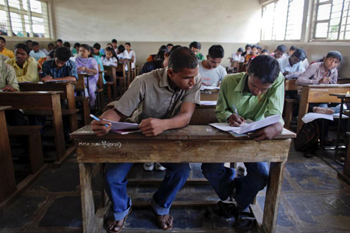
78 students withfake marks cards' barred from degree exams

[email protected] (News Network)
November 12, 2016

ballariBallari, Nov 12: As many as 78 of the 324 Pre-University/Plus II marks cards whose genuineness was in doubt have been found to be fake and the Vijayanagar Sri Krishnadevaraya University has decided not to allow such students to appear for the first year degree exams, according to M.S. Subhas, university Vice-Chancellor.

Addressing a press conference here on Friday, Mr. Subhas said that marks cards of 324 students who got admitted to degree colleges in Ballari and Koppal districts, affiliated to the university, were in suspected to be fake.

A one-man committee, headed by Registrar, after verifying the documents and also after getting confirmation from Maharashtra Secondary Education Board in Pune, found that 78 marks cards were issued by institutions with fictitious names on behalf of Maharashtra Secondary Education Board. “The university will not allow these 78 students to write their exams.

As far as the remaining 246 students were concerned, the process of verification of records was under way. To protect the interest of students, the university will allow them to appear for exams on the condition that their results will be withheld if the marks cards given by them were found to be fake,” he said.

To a question, he said that the university hopes that the 246 students will go by their conscience before filing their examination forms.

The university will write a letter to the Higher Education Department seeking guidelines to deal with such cases, he said and added that pending instructions from the government, the university will not file a FIR against the students.

Comments

Skazi
 - 
Saturday, 12 Nov 2016

Good training of MODI the Feku ....

Add new comment

  • Coastaldigest.com reserves the right to delete or block any comments.
  • Coastaldigset.com is not responsible for its readers’ comments.
  • Comments that are abusive, incendiary or irrelevant are strictly prohibited.
  • Please use a genuine email ID and provide your name to avoid reject.
News Network
June 1,2020

New Delhi, Jun 1: Prime Minister Narendra Modi on Monday sought a discussion on advances in telemedicine, the use of "Make in India" products in the healthcare, and the use of IT tools in the medical sector for a healthier society.

Addressing an event at the Rajiv Gandhi Health University in Bengaluru via video conference, he sought a discussion on whether new models can be conceived that make telemedicine popular on a larger scale.

Referring to the "Make in India" program, he said the initial gains made in this field make him optimistic. "Our domestic manufacturers have started production of personal protective equipment and have supplied about one crore PPEs to those in the frontline of fighting COVID-19.

Modi said IT-related tools for healthier societies can be of great help.

"I am sure you have heard of Arogya Setu. Twelve crore health-conscious people have downloaded it. This has been very helpful in the fight against coronavirus," he said.

Comments

Add new comment

  • Coastaldigest.com reserves the right to delete or block any comments.
  • Coastaldigset.com is not responsible for its readers’ comments.
  • Comments that are abusive, incendiary or irrelevant are strictly prohibited.
  • Please use a genuine email ID and provide your name to avoid reject.
News Network
June 26,2020

Bengaluru, Jun 26: The National Restaurant Association of India (NRAI) on Thursday came up with a Standard Operating Procedure (SOP) for restaurants whereby among other physical distancing norms, it has suggested a 2-metre gap between tables.

Formulated in partnership with Releski, a Bengaluru based skill-tech company, the SoP suggests that in case of back-to-back seating, people sitting with their backs towards each other will have their seats divided by 'Plexiglass' divider raised up to 2 meters from the ground.

"In a typical restaurant, the improvised seating plan should have a minimum distance of 2 metres between tables. The distance of 2 metres (6 feet) between tables should measure from one edge of the table to the other table's edge," it said.

In case of loose or free seating such as in banquet style or food court style seating, a minimum 2 meters of distance should be maintained between tables.

The guidelines noted that, to encourage physical distancing, restaurants have to sacrifice their seating capacity, to promote health and safety, and also to gain trust from their patrons.

"In order to perform this, divide your restaurants under different sectors. Pull out your restaurant's floor plan and colour code different sections red and yellow. Red sections are potential areas where maximum footfall or traffic is observed. Yellow sections are areas where the footfalls are average," it said.

All the red sections are encircled or bordered by placing barricades or Q manager and will open at specific points to access the yellow section and all the opening points will have hand sanitisers and sprays, and every guest who walks from red zones to yellow zones will sanitise himself/herself to reduce the chances of contamination.

For air conditioning, the guidelines of CPWD shall be followed which inter alia emphasises that the temperature setting of all air conditioning devices should be in the range of 24-30 degree Celsius, relative humidity should be in the range of 40- 65 per cent, intake of fresh air should be as much as possible and cross ventilation should be adequate, the guidelines suggested.

The industry body has also suggested appointment of a COVID-free Ambassador who would operate as the Chief Health Officer within the restaurant team, preferably from the management team in each shift.

The ambassador's would put the new daily work routines into practice, to monitor compliance with good practice and to lead the preventative measures, adapt to health & safety recommendations and requirements of the restaurant and oversee the implementation of the norms.

Anurag Katriar, President of NRAI and CEO & Executive Director of deGustibus Hospitality, said: "Every restaurant cutting across formats is facing the harsh reality of subdued to shut business volumes in the present and the uncertainty of business environment in the future. One thing is certain that hygiene and safety will be a key differentiator in the post-pandemic restaurant operations."

Comments

Add new comment

  • Coastaldigest.com reserves the right to delete or block any comments.
  • Coastaldigset.com is not responsible for its readers’ comments.
  • Comments that are abusive, incendiary or irrelevant are strictly prohibited.
  • Please use a genuine email ID and provide your name to avoid reject.
News Network
April 23,2020

Mangaluru, Apr 23: The scarcity of water in Kukkavu area of Belthangady town in Dakshina Kannada district has forced school-going children to dig a well with their hands.
The children studying in primary schools were seen lifting the heavy buckets of water from the well.

The residents were facing the water shortage from the past couple of days, amid the coronavirus lockdown.
A group of five adolescents managed to dug the well as deep as 12 feet within just a span of four days.

" We are facing water problem now. With the support of my five more friends, we dug this well. At the beginning we just found soil, then in the deeper layers, we also found stones. We got access to the water at 10 feet down," said Dhanush, a class 9th student, while speaking to news agency.

The shortage of water during the summer months is a perennial problem in across several states in India, and the growing population has only added to the woes.

In extreme conditions, poor have to draw water from small water holes.

Comments

Add new comment

  • Coastaldigest.com reserves the right to delete or block any comments.
  • Coastaldigset.com is not responsible for its readers’ comments.
  • Comments that are abusive, incendiary or irrelevant are strictly prohibited.
  • Please use a genuine email ID and provide your name to avoid reject.