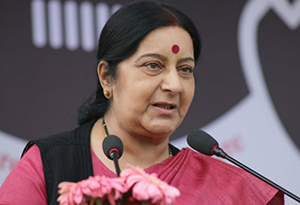
800 jobless Indians starving in Jeddah, Swaraj steps in to help

July 30, 2016

New Delhi, Jul 30: Nearly 800 Indian workers are reportedly starving for the last three days in Saudi city of Jeddah after losing their jobs and Minister of State for External Affairs VK Singh is traveling to the Gulf nation to sort out the issue.sushma-1

External Affairs Minister Sushma Swaraj said the Indian Embassy in Saudi Arabia has been directed to serve food to them and that she was monitoring the situation on an hourly basis.

Her response came following a tweet by a man who said around 800 Indians are starving for the last three days in Jeddah and sought her intervention.

"We have asked @IndianEmbRiyadh to provide free ration to the unemployed Indian workers in Saudi Arabia," she tweeted.

Swaraj said Indians in Saudi Arabia and Kuwait were facing various problems relating to their work and wage and that the "matters are much worse" in Saudi Arabia.

She said MoS External Affairs M J Akbar will take up the issue with Kuwait and Saudi authorities.

"My colleagues @Gen_VKSingh will go to Saudi Arabia to sort out these matters and @MJakbar will take up with Kuwait and Saudi authorities.

"I assure you that no Indian worker rendered unemployed in Saudi Arabia will go without food. I am monitoring this on hourly basis," she said.

Swaraj said a large number of Indians have lost their jobs in Saudi Arabia and Kuwait and that their employers have not paid wages and closed down their factories.

"As a result our brothers and sisters in Saudi Arabia and Kuwait are facing extreme hardship," she said, adding while the situation in Kuwait is "manageable", matters are much "worse" in Saudi Arabia.

Later, Swaraj posted pictures of food being provided to the Indian workers.

Comments

Rikaz
 - 
Saturday, 30 Jul 2016

Stop Modi's enjoyment foreign trip, concentrate on NRI who bring millions of rupees of white money to country....

Add new comment

  • Coastaldigest.com reserves the right to delete or block any comments.
  • Coastaldigset.com is not responsible for its readers’ comments.
  • Comments that are abusive, incendiary or irrelevant are strictly prohibited.
  • Please use a genuine email ID and provide your name to avoid reject.
coastaldigest.com news network
July 1,2020

Mangaluru, July 1: The district administration has imposed prohibitory orders under Section 144 in entire Dakshina Kannada between 8pm and 5am in the entire month of July.

Notice in this regard was issued today by Deputy Commissioner Sindhu B Roopesh. The order will come into force with immediate and will be in place ill July 31, the DC said.

The decision was taken days after Karnataka government took steps to tighten covid restriction and imposed lockdown from 8pm to 5am. 

Under the imposed Section 144, the presence or movement of one or more persons in public places are prohibited. Besides, the gathering of any sort anywhere, including religious places subject to certain conditions in view of the COVID-19 pandemic will also be restricted. 
 

Comments

Add new comment

  • Coastaldigest.com reserves the right to delete or block any comments.
  • Coastaldigset.com is not responsible for its readers’ comments.
  • Comments that are abusive, incendiary or irrelevant are strictly prohibited.
  • Please use a genuine email ID and provide your name to avoid reject.
News Network
July 5,2020

Tirupati, Jul 5: The Karnataka government will soon build a massive pilgrim amenities complex and marriage hall at Tirumala, the hill abode of Lord Venkateswara, at an estimated cost of Rs 200 crore, a temple official said here on Saturday.

The state would soon submit a blueprint for the construction of the Rs 200 crore mega complexes to the Tirumala Tirupati Devasthanams (TTD) that governs the hill shrine, the official said.

Consequently, based on the designs, TTD would construct the complexes with the given fund and after completion, they would be handed over to the Karnataka government, he said.

Karnataka Chief Minister BS Yediyurappa would lay the foundation stone for the mammoth complexes on the hills some time next month, he said.

Andhra Pradesh Chief Minister Y S Jagan Mohan Reddy is likely to take part in the programme, he added.

Comments

Ahmed Ali k
 - 
Sunday, 5 Jul 2020

Dear Sir,   


Keep aside all these type of extra expenditure like spending for statues, monuments, pilgrim amnesties etc.


During this period of virus pandamic, please use all these amount for medicines, medical facilities, food and development of the state.  We are facing shortage of medical facilites and the people are dying on the road by not getting a bed in the hospital.  Please use these amounts for the same.  During this Pandemic not even hindu brothers also accept this offer.  Leave all vote politics and concentrate to develop the state.

Add new comment

  • Coastaldigest.com reserves the right to delete or block any comments.
  • Coastaldigset.com is not responsible for its readers’ comments.
  • Comments that are abusive, incendiary or irrelevant are strictly prohibited.
  • Please use a genuine email ID and provide your name to avoid reject.
Agencies
May 8,2020

Washington D.C., May 8: The prime time for brain development in a child's life is the first year, where the infant spends most of the time asleep. It is the time when neural connections form and sensory memories are encoded.

However, when sleep is disrupted, as occurs more often among children with autism, brain development may be affected, too.

New research led by the University of Washington finds that sleep problems in a baby's first 12 months may not only precede an autism diagnosis but also may be associated with altered growth trajectory in a key part of the brain, the hippocampus.

The study, which was published in the American Journal of Psychiatry, researchers report that in a sample of more than 400 taken of 6- to 12-month-old infants, those who were later diagnosed with autism were more likely to have had difficulty falling asleep.

It also states that this sleep difficulty was associated with altered growth trajectories in the hippocampus.

"The hippocampus is critical for learning and memory, and changes in the size of the hippocampus have been associated with poor sleep in adults and older children.

As many as 80 per cent of the children with autism spectrum disorder have sleep problems," said Annette Estes, director of the UW Autism Center and senior author of the study.

"In our clinical experience, parents have a lot of concerns about their children's sleep, and in our work on early autism intervention, we observed that sleep problems were holding children and families back," added Estes, who is also a UW professor of speech and hearing sciences.

"It could be that altered sleep is part-and-parcel of autism for some children. One clue is that behavioural interventions to improve sleep don't work for all children with autism, even when their parents are doing everything just right. This suggests that there may be a biological component to sleep problems for some children with autism," said Estes.

To consider links among sleep, brain development, and autism, researchers at the IBIS Network looked at MRI scans of 432 infants, surveyed parents about sleep patterns, and measured cognitive functioning using a standardized assessment.

At the outset of the study, infants were classified according to their risk for developing autism: Those who were at higher risk of developing autism -- about two-thirds of the study sample -- had an older sibling who had already been diagnosed.

Infant siblings of children with autism have a 20 per cent chance of developing autism spectrum disorder -- a much higher risk than children in the general population.

In the current study, 127 of the 432 infants were identified as "low risk" at the time the MRI scans were taken because they had no family history of autism.

They later evaluated all the participants at 24 months of age to determine whether they had developed autism. Of the roughly 300 children originally considered "high familial risk," 71 were diagnosed with autism spectrum disorder at that age.

Problems with sleep were more common among the infants later diagnosed with an autism spectrum disorder, as were larger hippocampi. No other subcortical brain structures were affected, including the amygdala, which is responsible for certain emotions and aspects of memory, or the thalamus, a signal transmitter from the spinal cord to the cerebral cortex.

The authors note that while parents reported more sleep difficulties among infants who developed autism compared to those who did not, the differences were very subtle and only observed when looking at group averages across hundreds of infants.

Sleep patterns in the first years of life change rapidly as infants transition from sleeping around the clock to a more adult-like sleep/wake cycle. Until further research is completed, Estes said, it is not possible to interpret challenges with sleep as an early sign of increased risk for autism.


Comments

Add new comment

  • Coastaldigest.com reserves the right to delete or block any comments.
  • Coastaldigset.com is not responsible for its readers’ comments.
  • Comments that are abusive, incendiary or irrelevant are strictly prohibited.
  • Please use a genuine email ID and provide your name to avoid reject.