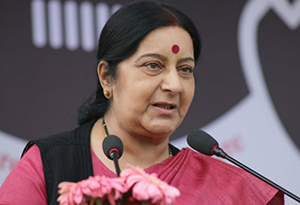
800 jobless Indians starving in Jeddah, Swaraj steps in to help

July 30, 2016

New Delhi, Jul 30: Nearly 800 Indian workers are reportedly starving for the last three days in Saudi city of Jeddah after losing their jobs and Minister of State for External Affairs VK Singh is traveling to the Gulf nation to sort out the issue.sushma-1

External Affairs Minister Sushma Swaraj said the Indian Embassy in Saudi Arabia has been directed to serve food to them and that she was monitoring the situation on an hourly basis.

Her response came following a tweet by a man who said around 800 Indians are starving for the last three days in Jeddah and sought her intervention.

"We have asked @IndianEmbRiyadh to provide free ration to the unemployed Indian workers in Saudi Arabia," she tweeted.

Swaraj said Indians in Saudi Arabia and Kuwait were facing various problems relating to their work and wage and that the "matters are much worse" in Saudi Arabia.

She said MoS External Affairs M J Akbar will take up the issue with Kuwait and Saudi authorities.

"My colleagues @Gen_VKSingh will go to Saudi Arabia to sort out these matters and @MJakbar will take up with Kuwait and Saudi authorities.

"I assure you that no Indian worker rendered unemployed in Saudi Arabia will go without food. I am monitoring this on hourly basis," she said.

Swaraj said a large number of Indians have lost their jobs in Saudi Arabia and Kuwait and that their employers have not paid wages and closed down their factories.

"As a result our brothers and sisters in Saudi Arabia and Kuwait are facing extreme hardship," she said, adding while the situation in Kuwait is "manageable", matters are much "worse" in Saudi Arabia.

Later, Swaraj posted pictures of food being provided to the Indian workers.

Comments

Rikaz
 - 
Saturday, 30 Jul 2016

Stop Modi's enjoyment foreign trip, concentrate on NRI who bring millions of rupees of white money to country....

Add new comment

  • Coastaldigest.com reserves the right to delete or block any comments.
  • Coastaldigset.com is not responsible for its readers’ comments.
  • Comments that are abusive, incendiary or irrelevant are strictly prohibited.
  • Please use a genuine email ID and provide your name to avoid reject.
Agencies
May 8,2020

Washington D.C., May 8: The prime time for brain development in a child's life is the first year, where the infant spends most of the time asleep. It is the time when neural connections form and sensory memories are encoded.

However, when sleep is disrupted, as occurs more often among children with autism, brain development may be affected, too.

New research led by the University of Washington finds that sleep problems in a baby's first 12 months may not only precede an autism diagnosis but also may be associated with altered growth trajectory in a key part of the brain, the hippocampus.

The study, which was published in the American Journal of Psychiatry, researchers report that in a sample of more than 400 taken of 6- to 12-month-old infants, those who were later diagnosed with autism were more likely to have had difficulty falling asleep.

It also states that this sleep difficulty was associated with altered growth trajectories in the hippocampus.

"The hippocampus is critical for learning and memory, and changes in the size of the hippocampus have been associated with poor sleep in adults and older children.

As many as 80 per cent of the children with autism spectrum disorder have sleep problems," said Annette Estes, director of the UW Autism Center and senior author of the study.

"In our clinical experience, parents have a lot of concerns about their children's sleep, and in our work on early autism intervention, we observed that sleep problems were holding children and families back," added Estes, who is also a UW professor of speech and hearing sciences.

"It could be that altered sleep is part-and-parcel of autism for some children. One clue is that behavioural interventions to improve sleep don't work for all children with autism, even when their parents are doing everything just right. This suggests that there may be a biological component to sleep problems for some children with autism," said Estes.

To consider links among sleep, brain development, and autism, researchers at the IBIS Network looked at MRI scans of 432 infants, surveyed parents about sleep patterns, and measured cognitive functioning using a standardized assessment.

At the outset of the study, infants were classified according to their risk for developing autism: Those who were at higher risk of developing autism -- about two-thirds of the study sample -- had an older sibling who had already been diagnosed.

Infant siblings of children with autism have a 20 per cent chance of developing autism spectrum disorder -- a much higher risk than children in the general population.

In the current study, 127 of the 432 infants were identified as "low risk" at the time the MRI scans were taken because they had no family history of autism.

They later evaluated all the participants at 24 months of age to determine whether they had developed autism. Of the roughly 300 children originally considered "high familial risk," 71 were diagnosed with autism spectrum disorder at that age.

Problems with sleep were more common among the infants later diagnosed with an autism spectrum disorder, as were larger hippocampi. No other subcortical brain structures were affected, including the amygdala, which is responsible for certain emotions and aspects of memory, or the thalamus, a signal transmitter from the spinal cord to the cerebral cortex.

The authors note that while parents reported more sleep difficulties among infants who developed autism compared to those who did not, the differences were very subtle and only observed when looking at group averages across hundreds of infants.

Sleep patterns in the first years of life change rapidly as infants transition from sleeping around the clock to a more adult-like sleep/wake cycle. Until further research is completed, Estes said, it is not possible to interpret challenges with sleep as an early sign of increased risk for autism.


Comments

Add new comment

  • Coastaldigest.com reserves the right to delete or block any comments.
  • Coastaldigset.com is not responsible for its readers’ comments.
  • Comments that are abusive, incendiary or irrelevant are strictly prohibited.
  • Please use a genuine email ID and provide your name to avoid reject.
Sushma Bangera
June 4,2020

Kuwait: The Covid-19 pandemic has pushed the whole world into a difficult situation and the situation of Indians in Kuwait is not any different. Many people have lost their jobs, have no salary, are deprived of food and are not able to pay rent. The appalling conditions of labourers, domestic workers, taxi drivers and low waged earners don’t seem to end in Kuwait. 

At this trying situation when many people were even afraid of leaving their houses because of coronavirus, Suresh S. Rao Neramballi, volunteer of the Food Kit Distribution at the ICSG (Indian Community Support Group) has helped many tremendously. He was ready to go around delivering food kits at any time possible by his car. However, after Kuwait imposed a full curfew from 11th May 2020, no one could take out their vehicles unless they had a curfew pass. 

This did not stop Mr. Suresh Neramballi, who then borrowed a bicycle from a friend and ended up going around in the cycle delivering the food kits in curfew break time (4:30pm to 6:30pm) to all those who registered in the ICSG website. This selfless service surely commands appreciation and applause. Mr. Suresh Neramballi has been a light for many families and bachelors in Kuwait and will surely garner the blessings of them who have been able to eat at this time.

He was also the one who could deliver the food kits to many Indian Muslim maids, bachelors, laborers and families previous day and right on the day of EID, as they were not able to go shopping for their groceries for EID, due to the curfew. They blessed him in EID dua. 

Mr. Suresh Neramballi hails from Mangaluru, India and is an Engineer in the Oil sector company in Kuwait. He has been dedicated to social service, achieved 'Aryabhata International Award' for his Kannada Service and Social service, served in many Associations and Distributor of Kannada and Tulu Movies in Kuwait. He wholeheartedly thanks the people and government of Kuwait for his bread and butter.

Comments

Tanveer
 - 
Friday, 5 Jun 2020

May Almighty Allah shower His mescifull blessing on you and your family... Your selfless service will always be remembered,,,

M SHARIEF SULTAN
 - 
Thursday, 4 Jun 2020

God bless you and your family

abdullah
 - 
Thursday, 4 Jun 2020

God bless you brother and keep you healthy plus happy always.   You will be in the prayers of those who receivec your timely regardles they are hindu or muslim or christian.   This is a slap on the face of hate mongers who are always trying to divide the socieity in the name of religion.    Such people are burden to this world and society.   We should clean our society from such dirt and bad people.   Well done brother.  May God bless you.

Add new comment

  • Coastaldigest.com reserves the right to delete or block any comments.
  • Coastaldigset.com is not responsible for its readers’ comments.
  • Comments that are abusive, incendiary or irrelevant are strictly prohibited.
  • Please use a genuine email ID and provide your name to avoid reject.
News Network
February 1,2020

New Delhi, Feb 1: The budget is a little more demanding of the non-resident Indian. Firstly, to be categorized a non-resident, an Indian now has to stay abroad for 240 days, against 182 previously. In other words, an Indian national, to claim the non-resident status, can’t stay in India for 120 days or more in a year.

“We've made changes in Income Tax Act where if an Indian citizen stays out of the country for more than 182 days, he becomes non-resident,” said Revenue Secy Ajay Bhushan Pandey. “Now in order to become non-resident, he has to stay out of the country for 240 days.”

The second rule is more deadly: a non-resident Indian, who is not taxed in the foreign country, will become taxable in India.

“If any Indian citizen is not a resident of any country in the world, he'll be deemed to be a resident of India and his worldwide income will be taxed,” said Pandey.

"It's a very big disadvantage for Indians residing overseas only to save on tax,"  said Dinesh Kanabar of Dhruva Advisors. He expects that many Indians stay abroad in countries, where the income tax is low or nil such as Dubai. Now they will be taxed in India if they are in the income tax bracket.

For Indians, finance minister Nirmala Sitharaman revised income tax rats and proposed new tax slabs.

The new income tax rates will, however, not allow exemptions under Section 80C. Home loan exemption, insurance exemptions, the standard deduction will also not stay under the regime.

"The new tax regime will be optional and the taxpayers will be given the choice to either remain in the old regime with exemptions and deductions or opt for the new reduced tax rate without those exemptions," Sitharaman said while unveiling Budget.

Comments

Kannadiga
 - 
Saturday, 1 Feb 2020

Good news NRIs vote for modi . 

Add new comment

  • Coastaldigest.com reserves the right to delete or block any comments.
  • Coastaldigset.com is not responsible for its readers’ comments.
  • Comments that are abusive, incendiary or irrelevant are strictly prohibited.
  • Please use a genuine email ID and provide your name to avoid reject.