


AAP woman activist commits suicide after her molester released on bail

July 20, 2016

New Delhi, Jul 20: A woman activist of AAP allegedly committed suicide in Narela area of outer Delhi today with her family members claiming that she had gone into depression after her alleged molester, a party colleague, was released on bail.
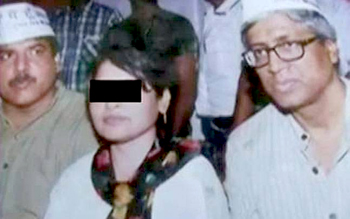
aapPolice said the woman consumed poisonous substance at her home in Narela in the afternoon and died during treatment at LNJP Hospital.

The woman had filed a complaint against party colleague Ramesh Wadhwa for allegedly touching her inappropriately and a case of molestation was registered in June and the accused was arrested, said a senior police officer.

Family members of the woman told police that she went into depression after bail was granted to the accused who, she had alleged, was being protected by the local MLA.

Delhi BJP alleged that AAP leaders had ignored her “harassment” complaint. “It may be recalled this girl had been raising issue of her harassment for months but AAP leaders ignored. This incident has established anti-woman character of AAP,” said Delhi BJP president Satish Upadhyay in a statement.

“Delhi CM Arvind Kejriwal and local MLA Sharad Chauhan are responsible for her death,” he alleged.

AAP refuted the allegations and accused BJP of playing politics over her death.

“There is no mention of the MLA's name in any of the complainants. Whosoever is alleged to have harassed the girl has no connection with the party. The BJP should not stoop this low and play politics over the death of a poor girl. We also want action against the culprit,” AAP spokesperson Deepak Bajpai said.

Comments

True indian
 - 
Wednesday, 20 Jul 2016

Law maker thinks that if v give death penalties to the rapist. Then we are following islamic law.

For that purpose they will never change the law for the rapists.

True indian
 - 
Wednesday, 20 Jul 2016

If the rapist is grant bail or given punishment which is less than 25 years. The victim should commit sucide. To change the stupid indian law.

Add new comment

  • Coastaldigest.com reserves the right to delete or block any comments.
  • Coastaldigset.com is not responsible for its readers’ comments.
  • Comments that are abusive, incendiary or irrelevant are strictly prohibited.
  • Please use a genuine email ID and provide your name to avoid reject.
News Network
February 22,2020

Bengaluru, Feb 22: Karnataka legislative assembly speaker Vishweshwar Hegde Kageri has issued a notification banning entry of journalists in the Legislators House.

"Electronic media and print media cannot enter the Legislators House any time," the notification issued by the Speaker's office read.

The notification which was issued on February 18 said, "The legislators come to Legislators House from their constituencies during the assembly session. It is their private time when they stay there. When journalists come to Legislators House to meet them, it's an invasion of their privacy."

"Arrangements will be made for journalists to speak to MLAs outside the gate. No journalist or camera person will be allowed inside the gate," the notification added.

The Legislators House is located near the Vidhan Soudha, the state legislative assembly.

Comments

Add new comment

  • Coastaldigest.com reserves the right to delete or block any comments.
  • Coastaldigset.com is not responsible for its readers’ comments.
  • Comments that are abusive, incendiary or irrelevant are strictly prohibited.
  • Please use a genuine email ID and provide your name to avoid reject.
News Network
April 28,2020

Mangaluru, Apr 28: Trucks carrying fish loads from Kerala will not be allowed to enter Dakshina Kannada district as the authorities are not being able to control the rush in markets, state Fisheries Minister and district-in-charge Kota Srinivas Poojary said Monday.

The deputy commissioner has been instructed to restrict the entry of fish transport vehicles from outside the district forthwith, in view of the difficulty in maintaining social distancing at the markets identified in the district, the minister told reporters here.

The coastal district has to take more precautionary measures to fight COVID-19 as the number of positive cases have risen in the last couple of days, he said.

Comments

Add new comment

  • Coastaldigest.com reserves the right to delete or block any comments.
  • Coastaldigset.com is not responsible for its readers’ comments.
  • Comments that are abusive, incendiary or irrelevant are strictly prohibited.
  • Please use a genuine email ID and provide your name to avoid reject.
News Network
April 2,2020

The current physical distancing guidelines provided by the World Health Organisation (WHO) and by the US Centers for Disease Control and Prevention (CDC) may not be adequate to curb the coronavirus spread, according to a research which says the gas cloud from a cough or sneeze may help virus particles travel up to 8 metres. The research, published in the Journal of the American Medical Association, noted that the the current guidelines issued by the WHO and CDC are based on outdated models from the 1930s of how gas clouds from a cough, sneeze, or exhalation spread.

Study author, MIT associate professor Lydia Bourouiba, warned that droplets of all sizes can travel 23 to 27 feet, or 7-8 metres, carrying the pathogen.

According to Bourouiba, the current guidelines are based on "arbitrary" assumptions of droplet size, "overly simplified", and "may limit the effectiveness of the proposed interventions" against the deadly pandemic.

 She explained that the old guidelines assume droplets to be one of two categories, small or large, taking short-range semi-ballistic trajectories when a person exhales, coughs, or sneezes.

However based on more recent discoveries, the MIT scientist said, sneezes and coughs are made of a puff cloud that carries ambient air, transporting within it clusters of droplets of a wide range of sizes.

Bourouiba warned that this puff cloud, with ambient air entrapped in it, can offer the droplets moisture and warmth that can prevent it from evaporation in the outer environment.

"The locally moist and warm atmosphere within the turbulent gas cloud allows the contained droplets to evade evaporation for much longer than occurs with isolated droplets," she said.

"Under these conditions, the lifetime of a droplet could be considerably extended by a factor of up to 1000, from a fraction of a second to minutes," the researcher explained in the study.

The MIT scientist, who has researched the dynamics of coughs and sneezes for years, added that these droplets settle along the trajectory of a cough or sneeze contaminating surfaces, with their residues staying suspended in the air for hours.

"Even when maximum containment policies were enforced, the rapid international spread of COVID-19 suggests that using arbitrary droplet size cutoffs may not accurately reflect what actually occurs with respiratory emissions, possibly contributing to the ineffectiveness of some procedures used to limit the spread of respiratory disease," Bourouiba wrote in the study

Comments

Add new comment

  • Coastaldigest.com reserves the right to delete or block any comments.
  • Coastaldigset.com is not responsible for its readers’ comments.
  • Comments that are abusive, incendiary or irrelevant are strictly prohibited.
  • Please use a genuine email ID and provide your name to avoid reject.